

0 引言
渤海湾盆地以古近系湖相烃源岩[1⇓⇓-4]和上古生界煤系烃源岩[5⇓-7]为源灶发育两套规模巨大的含油气系统,油气勘探程度整体进入中高成熟阶段[1]。其中,由于以上古生界煤系烃源岩为中心的含油气系统在演化过程中经历了多次抬升破坏,在过去数十年中油气勘探成果相对较少。近年来,渤海湾盆地上古生界含油气系统被重新重视,并于近几年在二叠系碎屑岩油气储集层中,取得了多个油气勘探的重要突破[5⇓-7],表明位于深层—超深层的渤海湾盆地上古生界油气系统仍具有重要的油气勘探潜力。由于上古生界油气系统具有多期次抬升-沉降背景,经历差异构造叠合演化过程的、不同构造带的碎屑岩储集层特征、成储过程和优质储集层形成机制等尚不明确,导致目前二叠系油气勘探成功率仍相对较低,制约了油气勘探进程。
笔者综合利用渤海湾盆地黄骅坳陷、济阳坳陷、冀中坳陷、临清坳陷等地区钻井岩心、岩石薄片、物性测试资料、扫描电镜、同位素分析及油气地球化学资料等,结合埋藏史-热史,明确了渤海湾盆地上古生界二叠系不同构造带储集层特征,系统研究了不同埋藏史-热史控制下的储集层演化过程、成储机制,阐明了不同类型储集层的发育模式和分布规律,以期对具有相似构造背景的探区优质储集层预测进行指导。
1 地质概况
渤海湾盆地位于华北平原北部、辽河平原南部和渤海海域,周缘为燕山、山西、鲁西南、鲁东和辽东等隆起区,盆地内部划分为辽河、渤中、济阳、黄骅、冀中、临清、昌潍等坳陷以及埕宁、沧县、邢衡、内黄等隆起[8](见图1a )。
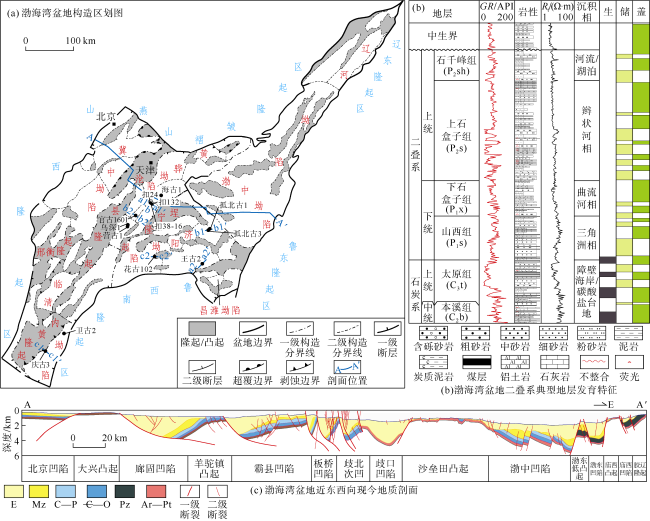
经历多期次构造运动改造和暴露剥蚀后,渤海湾盆地上古生界现今仍保存较厚的石炭系与二叠系,自下而上依次发育石炭系本溪组(C2b)、太原组(C3t)、二叠系山西组(P1s)、下石盒子组(P1x)、上石盒子组(P2s)和石千峰组(P2sh)(见图1b )。山西组—石千峰组依次发育三角洲、曲流河、辫状河和河流/湖泊相沉积[9-10],其中上石盒子组辫状河沉积砂体纵向厚度大、横向分布稳定、粒度粗,钻井油气显示活跃,为二叠系目前主要勘探目的层。下伏太原组和山西组煤系烃源岩广泛发育,受多期构造运动影响,地层分布不均,埋深差异大(见图1c ),除去火山活动影响的异常高值,烃源岩Ro值主要为0.65%~1.60%,多处于中成岩阶段,其在长期演化过程中发生2~3期生酸和生烃过程,为上覆碎屑岩储集层提供了重要油气来源[11⇓-13]。
2 储集层基本特征
2.1 岩石学特征
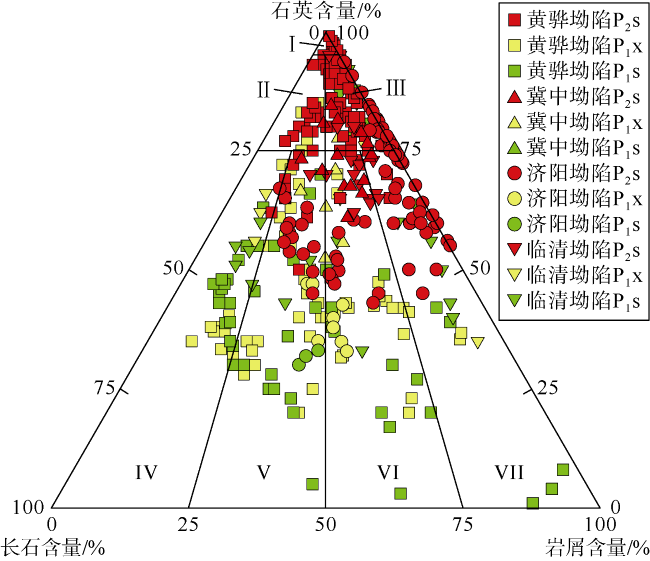
岩心观察和薄片鉴定结果表明,渤海湾盆地二叠系储集层岩性以细砂岩—砂质细砾岩为主;其中上石盒子组岩石以中砂岩、粗砂岩和含砾砂岩为主,下石盒子组和山西组以细砂岩为主。上石盒子组储集层以石英砂岩、岩屑石英砂岩为主,岩石成分成熟度较高,骨架颗粒中石英平均含量为84%,长石平均含量为7%,以钾长石为主,岩屑以石英质变质岩岩屑为主,平均含量为9%(见图2 ),杂基含量平均值为2%。山西组—下石盒子组储集层成分成熟度整体较低,骨架颗粒中石英平均含量为42%,长石平均含量为35%,岩屑平均含量为23%,杂基含量平均值为5%(见图2 )。
2.2 储集物性与储集空间特征
经历长期成岩改造后,渤海湾盆地二叠系储集层整体以中低孔、中低渗—致密储集层为主,孔隙度多为5%~20%,渗透率主体为(0.1~100.0)×10−3 μm2(见图3a 、图3b )。物性-深度剖面表明,储集层孔隙度和渗透率随埋深增大略有降低,3 500 m以浅储集层孔隙度多为5%~20%,渗透率多为(0.1~100.0)×10−3 μm2;3 500 m以深储集层孔隙度多为1%~15%,渗透率多为(0.01~10.00)×10−3 μm2。
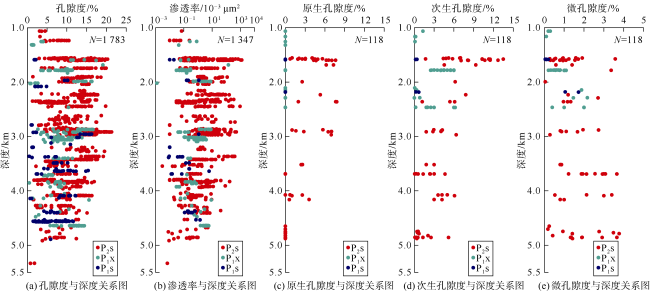
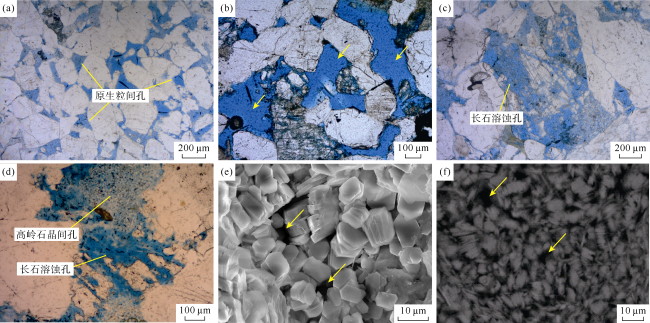
渤海湾盆地二叠系碎屑岩为孔隙型储集层,储集空间包括原生孔隙、次生孔隙、微孔隙等(见图4 )。原生孔隙主要发育于中浅层中粗碎屑砂岩储集层中,为压实和胶结后的残余孔(见图4a );次生孔隙发育,主要为长石颗粒溶蚀孔隙(见图4b —图4d );自生高岭石晶间微孔在中深层普遍发育(见图4d —图4f );深埋储集层局部可见少量微裂缝。铸体薄片定量统计数据表明:二叠系浅层整体以次生孔隙(4%~12%)为主,原生孔隙局部发育(4%~9%);中深层主要以次生孔隙(1%~6%)和微孔隙(1%~5%)并存为特征,部分地区微孔隙(4%~5%)主导,次生孔隙次之(1%~3%)(见图3c —图3e )。
3 成岩-成储过程
长石是二叠系碎屑岩储集层的重要造岩矿物之一,其溶蚀产生的次生孔隙是二叠系储集层的主要储集空间(见图4 ),长石溶蚀作用及其成孔效应决定了储集层的形成与发育。因此,有必要在分析埋藏—抬升过程及不同区带构造演化差异叠合的基础上,厘清不同阶段长石溶蚀的成孔效应及其叠合成储过程。
3.1 多期埋藏-抬升过程与构造叠加样式
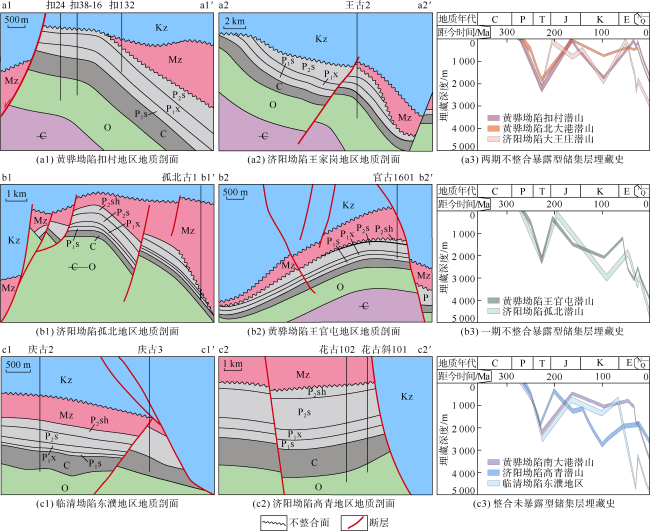
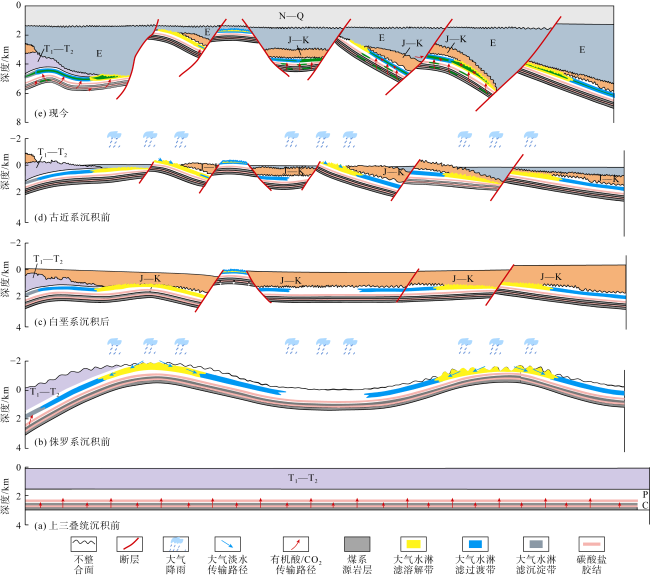
渤海湾盆地上古生界整体经历了3期埋藏和2期抬升过程,结合二叠系抬升暴露—埋藏深埋过程和现今地层结构特征,将二叠系上石盒子组构造演化归纳为3类典型的叠合样式(见图5 ):①两期不整合暴露型,石千峰组及中生界完全剥蚀,上石盒子组与上覆古近系之间发育区域性角度不整合(见图5a 1、图5a 2),如黄骅坳陷扣村地区、济阳坳陷王家岗、大王庄地区等;该类构造区在二叠系沉积后分别于印支末期—燕山期、燕山末期—喜马拉雅期发生两次地层抬升,均导致二叠系暴露地表形成不整合,潜山顶部中生界与石千峰组遭受剥蚀(见图5a 3)。②一期不整合暴露型,大部分石千峰组遭受剥蚀,上石盒子组上覆残留薄层石千峰组或者厚层侏罗系,侏罗系下发育区域性角度不整合(见图5b 1、图5b 2),如济阳坳陷孤北地区及黄骅坳陷王官屯地区等;该类构造区在二叠系沉积后于印支末期—燕山期发生地层抬升,二叠系暴露地表形成不整合;再次沉降后,于燕山末期/喜马拉雅期抬升,二叠系未暴露地表,而后沉降至今(见图5b 3)。③未暴露型,上石盒子组在区域范围上覆石千峰组,中生界保存完好,二叠系上石盒子组主力砂体之上无不整合(见图5c 1、图5c 2),如临清坳陷东濮地区、济阳坳陷高青地区、黄骅坳陷南大港地区等,该类构造区在二叠系沉积后分别于印支末期—燕山期及燕山末期—喜马拉雅期发生两次地层抬升,但均未导致二叠系主力砂层暴露地表,二叠系上部地层保存相对完整(见图5c 3)。
3.2 不同阶段长石溶蚀过程与成孔效应
3.2.1 抬升暴露阶段

以扣村地区储集层岩石为样品(孔隙度为20%、长石含量为7%、石英含量为72%、高岭石含量为1%),利用Geochemist's Workbench模拟低温-高流速背景下倾斜砂层中长石溶解—溶解物质传输—次生矿物再沉淀的整个过程,结果表明,从注水区开始,倾斜砂体中依次发育溶解带和过渡带,随地层倾角从2°增大到40°,模拟形成的溶解带—过渡带的总长度从大于6.0 km逐渐减小到2.5 km(见图6b )。这一模拟结果与扣村地区潜山顶部扣24、扣38-16和扣11等井长石大量溶解、高岭石很少发育,潜山斜坡区扣132井长石溶解、沉淀高岭石的现象也相一致;且扣村地区高岭石同位素组成数据显示标准平均大洋水(SMOW)标准下δD值为−116.9‰~−100.0‰、δ18O值为11‰~14‰,这与大气淡水成因高岭石分布范围重合度高,也支撑大气淡水作用过程[22](见图6d )。
整体来看,抬升暴露的开放体系下,砂层中长石溶蚀产生强烈的增孔作用,伴生的次生矿物仅在局部下游地区得以沉淀。如扣村地区岩石薄片中长石溶蚀孔含量多为5%~12%,自生高岭石含量一般低于1%,石英胶结物含量低于0.2%(见图6c ),说明抬升暴露阶段大气淡水对长石溶蚀过程能够有效提高储集层物性,形成增孔型次生孔隙。这一过程在大王庄、孤北地区等经历过长期暴露的地区也显著发育。
3.2.2 中深埋藏阶段
二叠系主力砂体下伏的山西组和太原组厚层煤系烃源岩埋藏史和现今Ro数据表明,在印支期地层抬升之前的第1次沉降过程中,渤海湾盆地上古生界烃源岩最大埋深可达3 000 m,干酪根演化至低成熟阶段(Ro值为0.6%~0.8%)[11],可以产生大量有机酸和CO2[23⇓⇓-26]。当烃源岩埋深超过3 000 m时,Ro值也逐渐升至5 500 m深度的1.6%,烃源岩会产生更多CO2、有机酸和烃类[23⇓⇓-26]。流体包裹体中的CO2(见图7a )、储集层中多期次烃类以及碳酸盐胶结物的同位素特征(见图7b ),均表明烃源岩中生成的酸性流体能够传输到二叠系储集层中[27]。埋藏条件相对封闭成岩体系下,地层水温度高、流速低,有机质热演化来源的酸性流体溶蚀长石释放的元素通常不能被大规模及时带出,倾向于在准原地发生自生黏土矿物和自生石英的沉淀(见图7c )。该过程发生成岩物质的再调配作用,在形成长石次生溶孔的同时,伴生自生矿物充填了原生孔隙,储集层总孔隙度变化不大[20]。
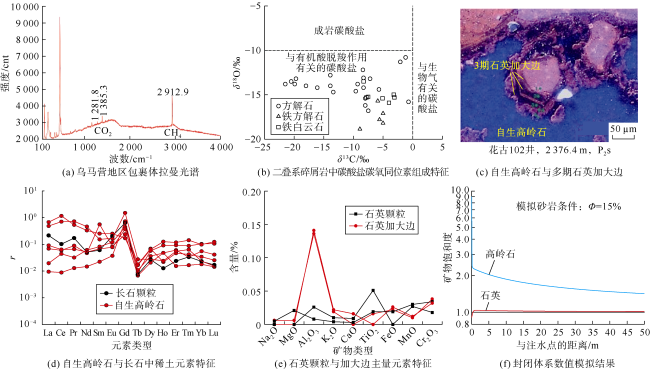
整体来看,近封闭体系下,储集层中长石强溶蚀-高岭石强胶结-石英强胶结,二叠系储集层中自生高岭石与长石溶蚀共生(见图4d )、高岭石稀土元素分析与长石颗粒稀土元素配分模式一致(见图7d )、自生石英电子探针测试获得的元素成分中Al元素含量多高于0.15%,显著高于石英颗粒的0.05%(见图7e ),都说明长石溶蚀作用是储集层中自生高岭石和自生石英的重要物质来源[28⇓-30],多期次自生高岭石和石英(见图7c )也表明存在多期次的深埋藏长石溶蚀过程。如以济阳坳陷高青地区为例,二叠系保存相对完整,上覆中生界泥岩(见图5c 2),说明其未经历大气水淋滤作用,岩石薄片中现存长石溶孔占比为1%~3%,自生高岭石占比为1%~7%,石英胶结物含量为2%~6%,该条件下单位体积钾长石溶蚀后的相对增孔率为11.91%~14.47%[31],自生高岭石的沉淀又导致储集层渗透率降低。以二叠系不同深层储集层为约束,利用Geochemist's Workbench模拟高温-低流速背景下砂层中长石溶解—溶解物质传输—次生矿物再沉淀的整个过程,结果表明砂层中长石的溶解通常与高岭石和石英的沉淀伴生,主要发育沉淀带,不发育溶解带、发育极少的过渡带(小于0.5 m)(见图7f )。
3.3 多期次抬升-沉降背景下储集层成储机制
结合构造样式与长石溶蚀过程分析,综合利用自生矿物交切关系、同位素及包裹体、埋藏史-热史等资料,重建了不同类型构造区带储集层的成岩和储集层演化过程。
3.3.1 浅层成孔-中浅埋藏型
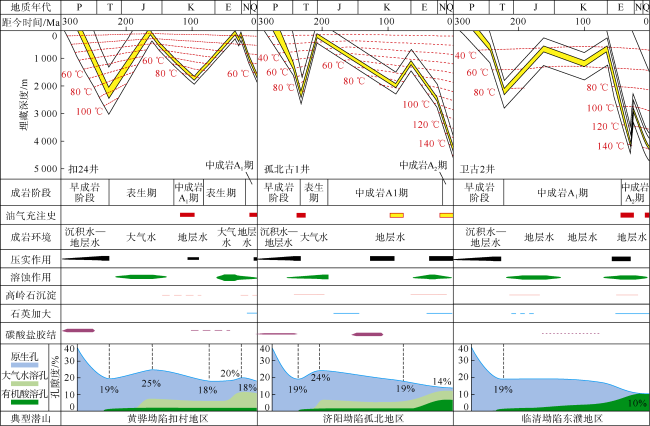
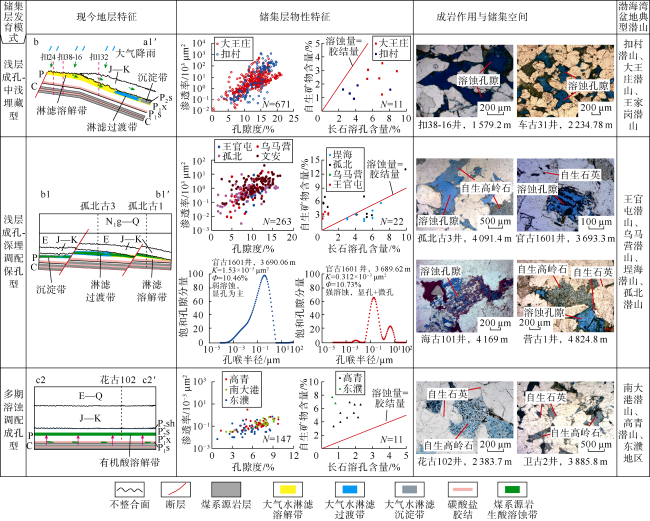
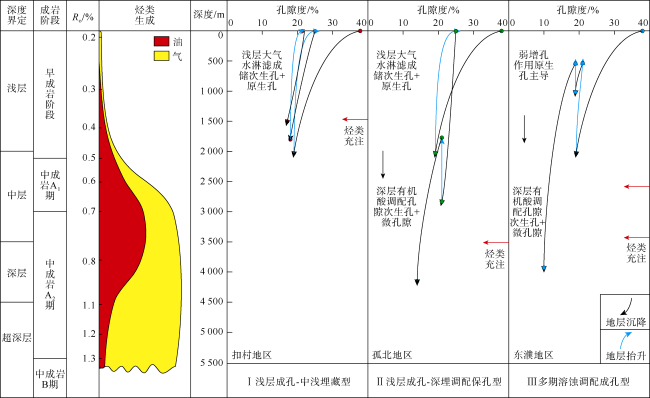
以铸体薄片资料为基础,结合成岩演化序列,利用“反演回剥”法,重建该类储集层成岩-成储演化过程表明(以扣村地区为例)(见图8 ):初始沉降阶段,二叠系埋藏至2 500 m,此过程中以压实为主,孔隙度由原始38%降至19%;三叠纪晚期发生第1期隆升,二叠系整体水平抬升,上覆三叠系及二叠系石千峰组遭受剥蚀,上石盒子组暴露地表遭受大气水淋滤,储集层孔隙度增加至25%,并沿斜坡向下依次形成溶蚀带、过渡带、沉淀带;侏罗纪晚期,地层再次沉降,孔隙度压实至18%;白垩纪末期发生第2次抬升,上石盒子组再次暴露地表遭受淋滤,孔隙度增加至20%;古近纪末期再次沉降至今,孔隙度再次压实至18%。地层后续沉降幅度均小于初次沉降,淋滤形成的增孔型次生孔隙未经强烈压实得以有效保存。该类型储集层压实作用中等,颗粒间以线接触为主,长石溶蚀作用强烈,自生矿物含量低,典型成岩组合特征为强长石溶蚀-弱高岭石胶结-弱石英胶结,储集空间以次生孔隙为主,局部保留有原生孔隙,孔隙度多为5%~20%,渗透率多为(0.1~100.0)×10−3 μm2,孔渗相关性强(见图9 )。
3.3.2 浅层成孔-深埋调配保孔型
重建该类储集层成岩-成储演化过程表明(以济阳坳陷孤北地区为例)(见图8 ):初始沉降阶段,二叠系埋藏至2 300 m,此过程中成岩作用以压实为主,孔隙度由原始38%压至19%;三叠纪晚期地层发生第1期隆升,二叠系抬升接受大气水淋滤作用,储集层孔隙度增加至24%,并沿斜坡向下依次形成溶蚀带、过渡带、沉淀带;侏罗纪早期再次沉降,孔隙度压实至19%;白垩纪末期构造第2次抬升,此阶段抬升幅度小,二叠系未抬升至地表;而后持续埋藏至今,压实作用减孔至14%,此阶段烃源岩热演化生酸溶蚀长石,仅调配孔隙类型,无明显增孔作用。在深埋藏过程中,烃类充注抑制部分碳酸盐胶结和硅质胶结作用,有效保存部分孔隙。该类储集层压实作用强,颗粒间以线-凹凸接触为主,典型成岩组合特征为强长石溶蚀-强高岭石胶结-中等偏弱石英胶结,储集空间兼有长石次生溶孔和大量高岭石微孔隙,储集层孔隙度多为5%~15%,渗透率多为(0.01~10.00)×10-3 μm2,孔渗相关性较弱。早期溶蚀区(黄骅坳陷埕海地区、济阳坳陷孤北地区)溶蚀孔隙量大于溶蚀产物,早期过渡区(黄骅坳陷王官屯、乌马营地区)反之(见图9 )。
3.3.3 多期埋藏溶蚀调配成孔型
通过重建分析该类储集层成岩-成储演化过程,以临清坳陷东濮地区为例(见图8 ):第1次构造沉降过程压实作用强烈,孔隙度由原始38%压至19%;三叠纪晚期地层发生第1期隆升,二叠系整体抬升却未到达地表,此过程缺乏大气水淋滤作用;白垩纪,地层埋藏浅,成岩作用整体较弱;古近纪,二叠系迅速沉降,孔隙度压实至10%,同时发生有机酸溶蚀作用。此类砂岩构造运动中未暴露地表,深埋过程长石溶蚀作用伴随大量高岭石及自生石英沉淀调配孔隙。成岩作用表现为压实作用强,颗粒间以线-凹凸接触为主,典型成岩组合特征为强长石溶蚀-强高岭石胶结-强石英胶结,孔隙度多为5%~10%,渗透率多为(0.01~1.00)×10−3 μm2,溶蚀孔隙量小于溶蚀产物总量(见图9 )。
4 储集层发育演化特征与下步勘探方向
4.1 二叠系储集层发育演化特征
渤海湾盆地不同构造带经历差异性构造叠加过程,导致不同构造带二叠系砂岩储集层发育差异性成岩和成储过程(见图10 )。综合构造演化过程和成岩改造过程,二叠系不同类型储集层的发育可细分为3种模式(见图11 ):Ⅰ类为浅层成孔-中浅埋藏型储集层,此类砂岩在埋藏过程中,分别于燕山期和喜马拉雅期经历两期抬升至地表的构造运动,并遭受大气水淋滤作用增加次生孔隙,由于成储过程中埋深未及3 000 m,大量浅部形成的孔隙得以有效保存。浅层成孔-中浅埋藏型储集层在大气淡水淋滤阶段沿倾斜砂体自上而下形成溶蚀区和过渡区,优质储集层位于两次大气水淋滤注水区附近,储集层质量最好,如黄骅坳陷扣村地区及济阳坳陷大王庄地区等(见图11 )。
Ⅱ类为浅层成孔-深埋调配保孔型储集层,此类砂岩在埋藏过程中,于燕山期抬升至地表遭受大气水淋滤作用增加次生孔隙,深埋过程中,有机质热演化生酸调配孔隙类型,砂岩刚性颗粒含量高和伴随长石溶蚀作用发生的石英胶结抵御深埋藏过程中的压实作用,早期烃类充注抑制胶结作用,有效保存孔隙。浅层成孔-深埋调配保孔型储集层在晚三叠世地层暴露剥蚀之后持续埋藏,封闭条件下干酪根热演化形成的有机酸和CO2溶蚀长石,由于该过程不涉及溶蚀产物的大规模远程运移,早期大气水淋滤注水区仍保持相对高孔渗,为优质储集层。在后续构造演化过程中,若溶蚀区保持潜山的相对高位,则优质储集层现今仍位于潜山顶部;若潜山发生地层倒转,则先前的溶蚀区现今处于潜山斜坡处,同样具备良好的储集层特征,如济阳坳陷孤北地区和黄骅坳陷王官屯地区等(见图11 )。
Ⅲ类为多期溶蚀调配成孔型储集层,此类砂岩在构造运动中未被暴露地表,未经历大气水淋滤增孔作用,受多期次有机质热演化生酸溶蚀成孔作用的改造,储集空间由原生孔隙向次生孔隙+微孔隙转化。“多期溶蚀调配成孔型”储集层未经历抬升剥蚀,储集层质量在3类中最差,如济阳坳陷高青地区和临清坳陷东濮地区等(见图11 )。
4.2 下步勘探方向
综合研究表明,经历不同埋藏-抬升过程和构造叠加的二叠系储集层,其成岩改造过程以及现今储集层质量差异显著。因此,根据三维地震数据,在系统分析不同地区不整合、上覆地层和埋藏深度等地质因素的基础上,系统厘定渤海湾盆地不同构造带的地层埋藏-抬升过程和构造叠加样式,并结合建立的储集层发育地质模式,预测无钻井区储集层的成岩改造过程,进行储集层质量的钻前评价。系统研究结果表明:渤海湾盆地冀中坳陷东北部、沧县隆起、济阳坳陷西北部等地区的上石盒子组以及冀中坳陷东北部下石盒子组上覆古近系/新近系,砂岩厚度大且连通性好,经历两期大气水淋滤增孔作用,主要发育Ⅰ类储集层;渤中坳陷、黄骅坳陷中南部、济阳坳陷东北部等地区的上石盒子组上覆中生界,砂体厚度大且连通性好,经历一期大气水淋滤增孔与溶蚀调配作用,主要发育Ⅱ类储集层;渤海湾盆地山西组砂岩及其他地区上、下石盒子组砂岩上覆石千峰组厚层泥岩,经历多期溶蚀调配作用,主要发育Ⅲ类储集层(见图12a )。
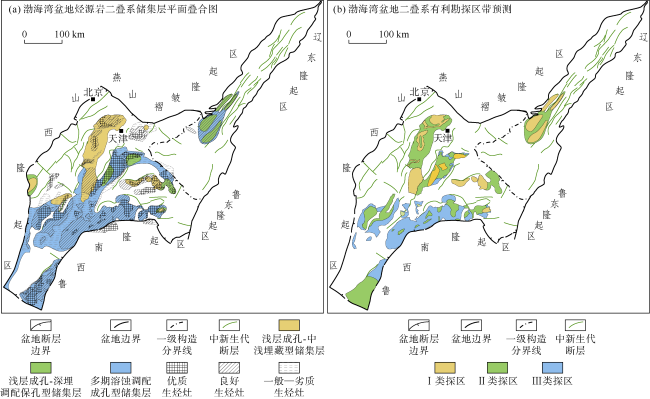


渤海湾盆地上古生界早期油气勘探主要关注潜山顶部,而对潜山斜坡区和洼陷带关注相对较少。浅层成孔-深埋调配保孔型储集层,由于经历早期大气水淋滤之后,发生构造反转,曾位于大气水淋滤溶蚀区的储集层,现今埋藏于潜山斜坡/洼陷带,具有较好的储集层发育潜力,同时配套的上古生界煤系烃源岩处在生油气高峰期,应该作为下步重点勘探方向(见图12b )。
5 结论
渤海湾盆地上石盒子组碎屑岩粒度较粗,成分成熟度高,以富石英砂岩为主;下石盒子组、山西组砂岩粒度较细,以低成分成熟度的贫石英砂岩为主。二叠系储集层以中低孔-中低渗/致密储集层为主,孔隙度多为5%~20%,渗透率多为(0.1~100.0)×10−3 μm2;储集空间以长石溶孔为主,中浅层局部发育原生孔隙,中深层高岭石晶间孔普遍发育。
二叠系碎屑岩储集层经历了3期埋藏和2期抬升过程,据此将二叠系分为3种典型构造叠加样式,两期不整合暴露型、一期不整合暴露型及相对整合未暴露型。溶蚀增孔作用主要发生于抬升期中浅层开放—半开放环境,埋藏期深埋条件下近封闭成岩体系中的溶蚀作用将原生孔隙向次生孔隙和高岭石晶间孔进行调配,储集空间增加有限。
浅层成孔-中浅埋藏型储集层于(近)地表经历两期大气水淋滤增孔作用,浅埋保存溶孔,储集空间以大量次生孔隙为主,兼有部分原生孔隙,物性最好;浅层成孔-深埋调配保孔型储集层于(近)地表接受大气水淋滤增孔,深埋封闭体系下溶蚀作用调配孔隙类型,高刚性颗粒含量和烃类充注保存孔隙,以大量长石次生溶孔为主,高岭石晶间微孔隙为辅,物性次之;多期溶蚀调配成孔型储集层主要经历近封闭-封闭环境下有机来源酸性流体溶蚀调配成孔作用,储集空间以高岭石晶间微孔隙为主、长石次生溶孔为辅,原生孔隙不再发育,物性相对较差。经历早期大气水淋滤,晚期发生构造反转,现今埋藏于潜山斜坡/洼陷带的浅层成孔-深埋调配保孔型储集层为下步重点勘探方向。
符号注释:
GR——自然伽马,API;d——与注水点的距离,km;K——渗透率,10-3 μm2;r——样品中稀土元素含量与球粒陨石中的稀土元素含量的比值,无因次;Rt——地层电阻率, Ω·m;Δt——声波时差,μs/m;θ——地层倾斜角度,(°);ϕ—孔隙度,%。