

0 引言
储层地质建模对于油气勘探开发、二氧化碳地质封存、地热能开发和地下水管理等至关重要,其本质上是一个融合多元多模态数据和信息的过程,这些数据和信息包括专家地质认识、测井解释结果、地球物理数据以及油气井生产动态数据等。考虑到地下储层系统的复杂性、高维度性和多尺度特征,即使融合所有可搜集的数据,储层预测依然存在很大的不确定性。一般通过构建多个储层地质模型实现来表达这种不确定性,从而为后续的生产分析及商业决策提供量化依据。
在生成对抗网络中,生成器神经网络将一个随机向量生成为一个二维或三维数据(如一副人脸图片),而判别器神经网络旨在将前述的生成数据和真实数据(如真实的人脸相片)加以区分。通过对判别器和生成器进行交替训练,生成器最终学习到训练数据集(如大量人脸相片)中蕴含的关于事物的完整空间结构特征(如完整的人脸结构特征)并能在生成的数据中完整地加以复现(即生成逼真的人脸图片)。在地质建模应用中,首先基于专家地质认识构建大量的概念地质模型,而后训练生成器从中学习到关于储层分布的完整的地质规律知识,进而生成器便可快速产生吻合所学地质规律的储层地质模型[6, 14-15]。但这只是无条件约束的储层地质建模,为了进一步实现条件化,学者们提出了基于输入向量扰动的后处理工作流程。其核心思想是搜索合适的输入向量,直到当把这些向量输入给预先训练好的生成器时,其产生既吻合地质规律又与给定条件数据一致的多个地质模型实现[6, 14, 16[]-18]。然而,一旦给定的条件数据发生改变,就须重新开展耗时耗算力的输入向量扰动过程。并且,后处理的工作流程针对井点沉积相条件数据的约束精度往往与期望的100%有较大差距。
为此,Song等[19-20]提出了基于生成对抗网络的直接条件化地质建模框架(GANSim)。GANSim额外引入了条件损失函数,用以训练生成器,使其在学习地质规律知识的同时还能学习条件约束规则(即输出的地质模型与输入的条件数据之间的关系)。凭借这两类知识,训练完成后,生成器便可针对任意给定的条件数据,快速生成既吻合地质规律又与给定条件数据一致的多个地质模型实现(即条件化地质建模)。此外,得益于全卷积的生成器结构设计,即使是在小尺度的概念地质模型或概念地质模型的小截块上训练,训练完成后,生成器也可生成任意大尺度的储层地质模型。GANSim已成功应用于实际三维岩溶储层[8]和曲流河储层[21]的多条件约束地质建模。为了整合单井生产数据,Song等[9]进一步提出了GANSim与基于深度学习的渗流代理模型[22]相融合的框架,实现了动静态共同约束的储层地质建模。
GANSim在算法研发和应用上还存在一些挑战。①在以往的GANSim算法研发与实际应用中,GANSim主要用于单一地质模式储层的地质建模[3,8,13,19 -21],但是对于特定储层,由于对地下认知的局限性,假设的储层分布地质模式往往是多样的(即地质模式的不确定性)。例如,就河道储层而言,假设的地质模式可以是曲流河、辫状河或二者之间的过渡形态。在此情况下,如何调整GANSim使其适应于常见的多模式储层的三维地质建模至关重要。②由于计算资源的限制,通常将大型的概念地质模型裁剪成尺寸较小的数据块,进而训练生成器从这些小数据截块中学习关于储层分布的结构片段。训练完成后,当针对大型储层进行地质建模时,生成器在储层不同位置对所学的结构片段进行采样并缝合。因为在平稳性储层中,整个储层区域内的结构片段都是相似的,该思路的有效性已在如岩溶储层等的地质建模实践中得到了证实[8]。但是对于非平稳性储层而言,关于储层分布的结构片段在整个储层区域内变化十分显著,并存在一定的组织顺序。此时,如果仍然采用概念地质模型截块对GANSim进行训练,那么针对大型储层生成的地质模型可能出现严重的结构混乱的问题,如,三角洲平原直接与前三角洲相连,而在中间缺失过渡型的三角洲前缘储层结构。在目前的GANSim算法研究中,已经采用了沉积相概率体和全局特征图作为约束条件[3],来引导生成器在储层不同位置对不同结构片段进行合理采样,进而生成有序且完整的非平稳地质结构。但是,该思路在复杂非平稳的三维储层中地质建模效果如何,仍需进一步验证。③GANSim一直存在一个技术挑战,即判别器容易忽略只占单一网格的井点沉积相数据,导致井点数据与井周模拟产生的沉积相分布出现严重的不连续现象[19]。为了解决这个问题,以往研究通常将井点数据从单一网格扩展成多个网格(如4×4个网格[8,19])。然而,这种人为扩展井点数据网格面积的做法会在井周引入与地质规律相悖的假象,并且人为地降低了井周储层预测的不确定性。因而需要改进GANSim,使原单网格井点条件数据不被判别器忽略,则无须人为扩展井点数据的网格面积而仍能在井周产生合理的沉积相连续性。
针对上述问题,本文提出“增强型GANSim”地质建模框架:①针对多模式储层提出两种GANSim地质建模流程;②为应对井周储层不连续的问题,引入局部判别器的结构设计。而后,以多模式非平稳浊积扇储层的地质建模为例,验证增强型GANSim的有效性及其对于非平稳储层地质建模的可靠性。
1 增强型GANSim地质建模
1.1 两种GANSim建模流程
针对存在地质模式不确定性的储层,本文提出了两种GANSim地质建模流程。
GANSim建模流程1主要包括如下步骤:①整理不同模式对应的地质认识。系统整理每种地质模式对应的专家地质认识,如地质体的几何形态、拓扑关系、沉积相变化、形成过程和尺寸范围等。②针对各个模式仿真概念地质模型集。将抽象的专家认识具象化为显性的数理表达,如逻辑规则、数学方程及平面图等。然后,基于这些具象化知识,开发自动化流程,针对每种模式仿真出大量概念地质模型。③应用观测数据开展先验证伪。由于在地质认识整理和概念地质模型仿真的过程中不可避免地存在不确定性和偏差,仿真得到的概念地质模型集或无法涵盖地下真实储层的分布状态。因而,将所有模式的概念地质模型全体合并起来(统称为先验集合),利用实际观测到的条件数据对其进行证伪。如果先验集合被证伪,则对原始地质认识整理或概念地质模型仿真过程进行优化,直到在当前观测数据约束下先验集合不可被证伪为止。④创建GANSim训练数据集。训练数据集包括所有模式对应的概念地质模型、井点沉积相数据以及概率体数据。通常将大型的概念地质模型裁剪成尺寸较小的块体,并从中提取井点沉积相和概率体训练数据。⑤设计GANSim中生成器和判别器的神经网络结构。相比于先前的GANSim版本,此处的生成器与判别器的结构均进行了增强设计。⑥针对所有地质模式,训练统一的GANSim模型。⑦对训练后的生成器进行评估。根据对期望地质结构的复现能力、与条件数据的吻合程度以及生成地质模型实现的多样性,对生成器进行评估。⑧针对大型实际储层开展不确定性地质建模。针对大型实际三维储层,将其条件数据输入到训练好的生成器中,快速产生多个地质模型实现,进而对其地质规律、条件约束精度和多样性进行评估。
GANSim建模流程2与流程1在整体步骤上基本相似,其主要区别在于:流程2在先验证伪(步骤③)之后,进一步引入“地质模式证伪”流程(即利用实际观测到的条件数据对各个地质模式分别进行证伪)。随后,仅针对未被证伪的地质模式构建训练数据集,设计生成器与判别器的神经网络结构,并分别为每个未被证伪的模式训练对应的GANSim模型,对训练后的生成器进行评估,最终将其应用于实际储层的地质建模。
GANSim建模流程1是将多种地质模式合并,用于训练一个统一的综合生成器,该生成器同时学习涵盖所有模式的地质知识及条件约束规则,从而可用于不同地质模式储层的建模任务。与流程1相比,流程2中得到的各个生成器仅适用于其对应的未被证伪的地质模式,但其训练难度通常低于流程1中的综合生成器。
1.2 先验证伪及地质模式证伪
GANSim两个流程中的先验证伪和地质模式证伪过程极为相似,下文重点以地质模式证伪为例阐述其思想及基本步骤。
储层地质模式证伪的逻辑为:如果真实地下储层属于某一特定地质模式,则描述真实储层分布的地质真值模型必然处于该模式对应的所有概念地质模型的分布范围内,那么源自该地质真值模型的任何观测数据(即关于实际储层的实测数据,如地球物理数据),无论是在其原始数据空间还是在任何低维特征空间中,也同样处于对这些概念地质模型观测所得的模拟数据的分布范围内。反之,如果观测数据未落入模拟数据的分布范围,则意味着地质真值模型(实际储层分布)不属于该地质模式,该模式应被证伪。
地质模式证伪的一般步骤包括:基于每个模式,生成大量的概念地质模型;对这些概念模型进行正演模拟以获得相应数据;从模拟数据与实际观测数据中分别提取敏感特征;依据所有模拟与观测数据中每对数据在敏感特征空间中的距离,采用多维尺度分析法(Multi-Dimensional Scaling)[23],将这些数据投影到低维空间。最后,在此低维空间中,评估在给定观测数据敏感特征值的情况下各个地质模式的后验概率,以判定每个模式是否应被证伪。后验概率的计算公式为:
(1)式中,Sk代表第k个模式(1≤k≤K),f(d)代表观测数据d的敏感特征。P(Sk)为先验概率,似然度P[f(d)|Sk]的评估是基于低维空间中观测数据点处的概率密度进行的[24]。需要注意的是,这里估算的后验概率P[Sk|f(d)]有别于储层反演所得的后验概率P(Sk|d),因为在证伪过程中仅使用了观测数据的部分信息(即其结构特征f(d))。
对于先验证伪,不再区分具体地质模式,而是将所有地质模式下生成的概念地质模型整体视为一个先验集合,并将“真实储层分布属于该先验集合”视为待检验的假设。在此基础上,应用与地质模式证伪相同的分析流程,计算该先验假设在给定观测数据敏感特征条件下的后验概率。若该后验概率低于预设阈值,则认为当前先验集合无法解释观测数据,应予以证伪;反之,则认为该先验集合在当前观测约束下暂不可被证伪。
1.3 局部判别器神经网络结构设计
之前的GANSim版本中,判别器重点关注生成地质模型全局的地质结构特征,而易忽略稀疏分布、只占据单个网格的井点沉积相条件数据,从而导致在生成的地质模型中井点沉积相与周围沉积相分布之间出现明显的不连续现象,严重影响了储层地质模型的渗流特征。因此,本文提出在保留原有“全局”判别器的基础上,增加“局部”判别器,后者专门关注井周的地质结构特征,进而提升井周生成的储层分布与地质规律的吻合性。实际中,可以设计多个局部判别器,来关注井周不同尺度的区域。这些局部判别器可以独立于全局判别器,也可以集成至全局判别器。在集成式的设计中,局部与全局判别器共享浅层神经网络。实验表明,独立式与集成式设计产生的效果相似。
融合局部判别器后,生成器的损失函数变为:
$\begin{aligned} L(G)= & \mathbb{E}_{z \sim p(z),(\boldsymbol{w}, \boldsymbol{\pi}) \sim p(\boldsymbol{w}, \boldsymbol{\pi})} \sum_{i=0}^{n}-\alpha_{i} D_{i}\left[G(\boldsymbol{z}, \boldsymbol{w}, \boldsymbol{\pi}), I_{\mathrm{wl}}(\boldsymbol{w})\right]+ \\ & \beta_{1} L_{\mathrm{w}}[G(\boldsymbol{z}, \boldsymbol{w}, \boldsymbol{\pi}), \boldsymbol{w}]+\beta_{2} L_{\pi}[G(\boldsymbol{z}, \boldsymbol{w}, \boldsymbol{\pi}), \boldsymbol{\pi}] \end{aligned}$
判别器的损失函数则变为:
$\begin{aligned} L(D)= & \mathbb{E}_{z \sim p(z),(\boldsymbol{w}, \boldsymbol{\pi}) \sim p(\boldsymbol{w}, \boldsymbol{\pi}), \boldsymbol{x} \sim p(\boldsymbol{x})} \sum_{i=0}^{n} \alpha_{i}\left\{D_{i}\left[G(\boldsymbol{z}, \boldsymbol{w}, \boldsymbol{\pi}), I_{\mathrm{wl}}(\boldsymbol{w})\right]-\right. \\ & \left.D_{i}\left[\boldsymbol{x}, I_{\mathrm{wl}}(\boldsymbol{w})\right]+\lambda \mathbb{E}\left[\left\|\nabla_{\hat{x}} D_{i}\left(\hat{\boldsymbol{x}}, I_{\mathrm{wl}}(\boldsymbol{w})\right)\right\|_{2}-1\right]^{2}\right\} \end{aligned}$
为了提升GANSim中神经网络结构的合理性,进一步将生成器的输出与判别器的输入,从单个地质模型调整为所有相类型对应的指示模型(见图1)。在实际地质建模中,可使用argmax等函数,将生成的多个沉积相指示模型转换为一个储层沉积相模型。
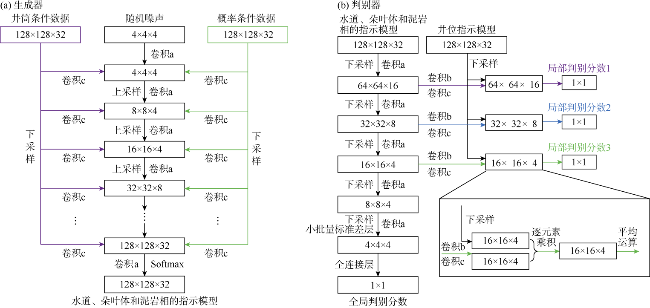
图1简要展示了本研究用于浊积扇储层沉积相地质建模的生成器与判别器网络结构。该浊积扇储层包含3种沉积相类型:水道充填、朵叶体沉积和背景泥岩相。生成器网络的输入包括:8个尺寸为4×4×4的向量(随机噪声)数据块、2个尺寸为128×128×32的井点条件数据块(分别代表井点沉积相模型与井位指示模型)以及2个分别对应水道相与朵叶体相的尺寸为128×128×32的概率体条件数据块。生成器输出3个尺寸均为128×128×32的相指示模型,分别对应水道、朵叶体与泥岩这3种沉积相。生成器采用全卷积网络设计,训练完成后便可用于任意规模储层的地质建模。生成器的输出层采用Softmax激活函数。
判别器的输入包括3个相的指示模型和1个井位指示模型,每个三维数据体的尺寸均为128×128×32。该网络结构由1个全局判别器和3个局部判别器组成。全局判别器通过若干卷积层、下采样层、小批量标准差层以及全连接层处理输入数据,最终生成代表输入沉积相指示模型全局真实性的评分。局部判别器与全局判别器共享相同的沉积相指示模型输入以及前几个卷积层和下采样层,而后通过几个卷积核为3×3×1和1×1×1的独立卷积层(即图1b中卷积b、卷积c),生成一个小型特征数据体(如图1b中紫色箭头右侧的64×64×16的数据体)。该特征数据体中的每个特征值对应于输入相指示模型中的一个特定局部区域(即对该特征值有贡献的区域),将这个局部区域称为该特征值的感受野。单个特征值的大小代表了其对应感受野中地质结构的优劣。随后,该特征数据体与一个经过下采样、尺寸相同的井位指示模型进行逐元素相乘,从而有效屏蔽无关特征值,使其仅关注输入的相指示模型中井点附近的感受野。之后再对相乘结果求取平均值以得到局部判别分数,该分数量化了输入的相指示模型中所有井周感受野范围内地质结构的优劣。感受野的大小可以通过对神经网络结构的解析得到。本文中,局部判别器1,2,3的感受野大小分别为18×18×14,40×40×32,84×84×32个网格(见图1)。
2 增强型GANSim在多模式非平稳浊积扇储层地质建模中的应用
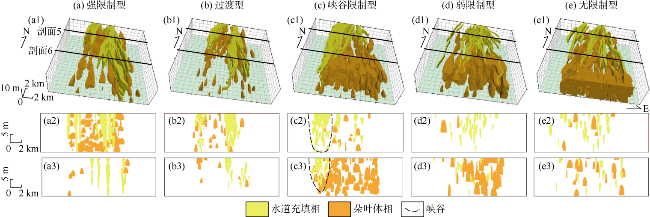
浊积扇储层是油气储集和二氧化碳封存等的优质储层,主要包括海底浊积水道、朵叶体和背景泥岩相,其中前两者是主要的储集空间。水道与朵叶体均从物源区向远端呈现发散式展布,表现出典型的非平稳特征。由于浊积水道发育受到不同程度的限制[29-31],可将浊积扇储层总结为5种地质模式:①强限制型水道和朵叶体,水道受到严格限制,不同期次的水道充填几乎垂向叠置;②强限制型与峡谷限制型之间的过渡模式;③峡谷限制型水道和朵叶体,水道局限于峡谷之内;④弱限制型水道和朵叶体,水道发育受限程度较低;⑤无限制型水道和朵叶体,水道发育不受空间限制。在每个模式中,朵叶体沉积均可被后期的水道充填所侵蚀。这种多地质模式与非平稳特征的叠加,使浊积扇储层成为增强型GANSim地质建模的理想测试案例。
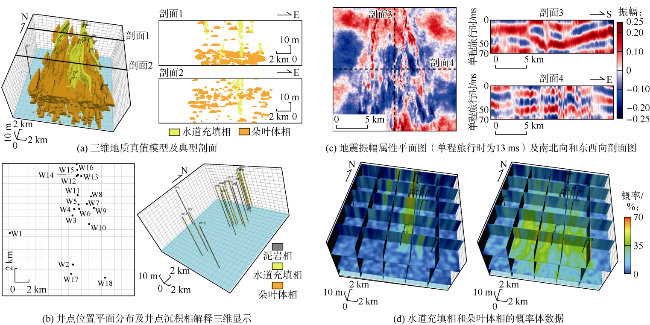
基于浊积扇储层的地质特征,本文提出了基于对象的三维概念地质模型仿真流程,其核心步骤包括:①建立水道端点分布的概率图;②依据概率图随机采样获得特定数量的水道端点;③对水道进行从端到源的模拟;④朵叶体模拟;⑤融合水道与朵叶体模拟结果。通过调整水道端点概率图的分布和水道端点数量,即可仿真出5种地质模式分别对应的概念地质模型。需要注意的是,该仿真流程无法完整地考虑井点等条件数据的约束。基于前述流程仿真得到一个强限制型模式下的浊积扇储层地质模型,作为基准地质真值模型(见图2a),对应储层称为基准储层。该真值模型包含400×400×100个网格,每个网格为50 m×50 m×0.5 m。然后从地质真值模型中随机抽取18口井的沉积相数据;并从真值模型正演模拟获得三维地震数据;还通过对地质真值模型各个相的指示模型进行高斯平滑处理,得到了每个相的概率体数据,其与地球物理解释得到的结果较为相似[32](见图2b—图2d)。下文将在不知基准储层的真实分布状态(基准地质真值模型)的前提下,以井点沉积相、地震和概率体数据为条件数据,并结合浊积扇储层的地质规律,应用增强型GANSim(两种GANSim建模流程和局部判别器设计)对基准储层进行地质建模。
2.1 基于GANSim建模流程1的浊积扇储层地质建模
GANSim建模流程的第1步是整理目标储层相关的专家地质认识,特别需要关注可能存在不同的储层地质模式。前文已对浊积扇储层的5种地质模式进行了简要概述,下文就流程中的其余步骤进行介绍。
2.1.1 概念地质模型与训练数据集的构建
应用前文提出的基于对象的概念地质模型仿真流程,针对5种地质模式,分别仿真了640个大尺度三维概念地质模型,图3就每种模式分别展示了一个任意的概念地质模型。每个概念地质模型包含400×400× 50个网格,网格尺寸为50 m×50 m×0.5 m。
按照GANSim建模流程1的步骤③,需要利用给定的条件约束数据,通过先验证伪过程,对这些先验概念地质模型进行验证。然而,本文中由于概念地质模型与基准地质真值模型所用的仿真方法相同,因此所有模式的概念地质模型作为一个先验整体,将不会被条件约束数据所证伪。故而跳过步骤③,直接进行训练数据集的准备工作。
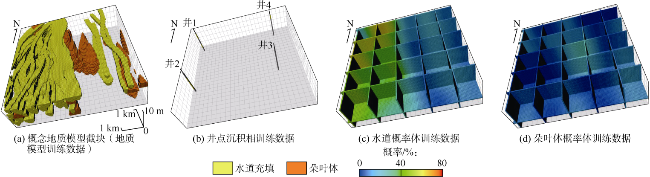
为了节约计算资源,对5种模式对应的所有概念地质模型沿水道和朵叶体进行随机裁剪,得到大量尺寸较小的沉积相模型训练样本。根据Song等[8]的研究,对于平稳性储层,裁剪尺寸设定的法则是:训练样本的尺寸应大于储层中最大的可重复结构单元,如曲流河储层中最大的一段完整河曲。在此次非平稳储层地质建模研究中,受GPU内存的限制,将裁剪尺寸设置为128× 128×32个网格,使生成器能够学习尽可能大的非平稳地质结构片段。最终获得38 400个小尺寸概念地质模型数据块,其中35 000个用于训练,其余用于测试。训练过程需要每个相的指示模型(见图1),因此将这些模型块进一步分解为水道相、朵叶体相和泥岩相的指示模型。而后,从每个相模型块中,随机抽取1~10口直井作为井点沉积相训练数据,每口井在水平方向上占据1个网格。对分解得到的相指示模型进行加噪高斯平滑[8],用以模拟地球物理解释得到的水道相和朵叶相概率体,作为另外一类训练数据。图4展示了任意训练所用的地质模型截块及其对应的井点和概率体数据。
2.1.2 GANSim神经网络结构设计、训练与评估
生成器与判别器的神经网络结构如图1所示。训练过程采用小批量梯度下降法与Adam优化器[33]。考虑到GPU内存的限制,适配的小批量大小设定为128。由于GANSim采用渐进式训练方法,生成器和判别器网络层将从浅层到深层逐步进行训练。生成器与判别器采用交替训练的方式,每次训练各使用一个小批量的数据。经过多次试错实验,将(2)式中井点和概率体数据的条件损失项权重(β1和β2)分别设置为2和0.08。模型包含1个全局判别器和3个局部判别器(见图1),它们在损失函数中的权重(即(2)、(3)式中的α0(全局判别器)、α3(局部判别器3)、α2(局部判别器2)和α1(局部判别器1))分别设置为0.1,0.9,9.0,90.0。(3)式中的权重λ缺省设置为10。GANSim在8块GPU(A100-40G)上并行训练72 h。
训练完成后,选用多个测试数据对生成器进行评估,其中之一如图5所示。将测试沉积相模型对应的条件约束数据(即井点沉积相以及水道和朵叶体的概率体)输入生成器,并通过改变输入的随机噪声而得到多个沉积相模型实现。在单块GPU(A100)上,每个模型实现耗时平均为0.02 s。
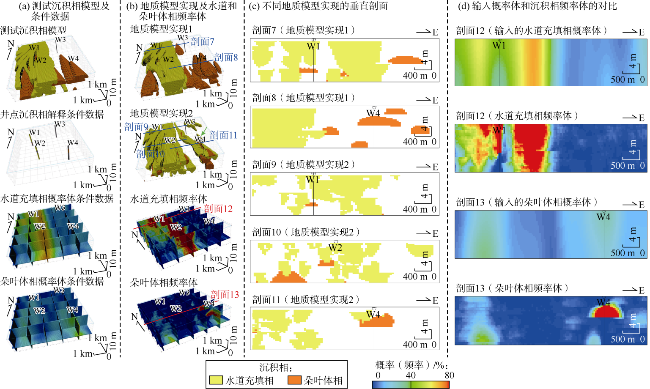
从图5中的地质模型实现及其剖面可以观察到,生成的大多数水道是连续的(尽管存在少量孤立水道,如模型实现2中绿色箭头所指的水道碎片),并且表现为顶平底凸的形态;生成的朵叶体则表现为扇状、顶凸底平的形态;部分水道切割朵叶体。这些特征均与地质认识一致。除了验证地质规律之外,还计算了井点沉积相条件数据在地质模型实现中复现的准确度:在所有测试案例中,该准确度都接近100%。基于100个随机生成的地质模型实现计算了水道相与朵叶体相的频率体。对比发现,频率体与输入的概率体无论在三维空间还是二维剖面上都较为一致(见图5),表明输入概率体对建模结果有着明显的约束作用。当然,频率体的高值区相对更为集中,这是符合预期的。此外,不同地质模型实现差异较大,可较大程度地表达储层预测的不确定性。
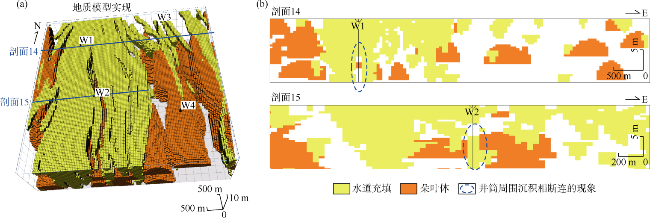
前述分析表明,训练好的生成器能够高效地生成与期望地质规律和条件数据都吻合的多个沉积相地质模型。
2.1.3 基准储层的地质建模
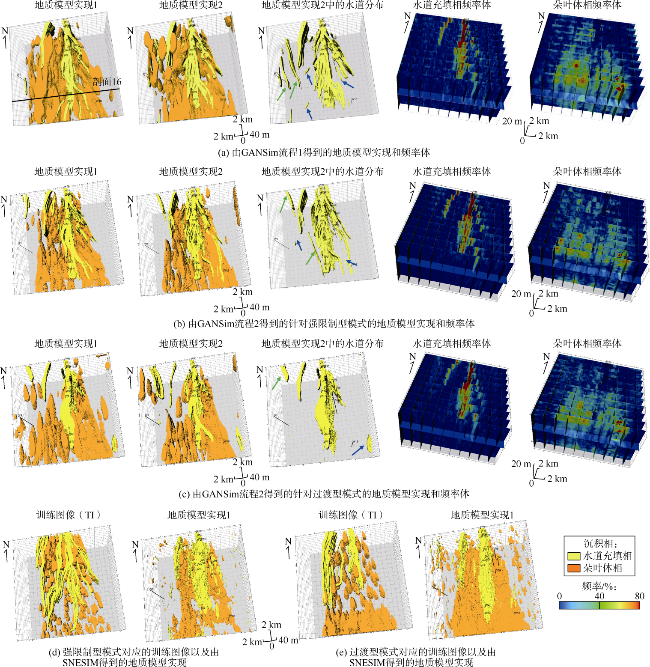
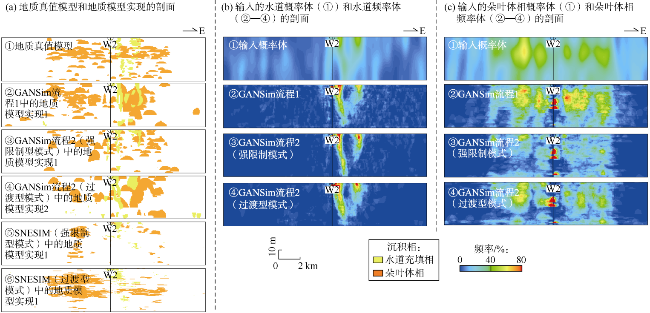
针对前述的基准储层,假设该储层的地质真值模型未知,将训练好的生成器用于该储层的地质建模。需要注意的是,该储层规模为400×400×100个网格,比训练所用的概念地质模型截块(128×128×32个网格)大30倍以上。将基准储层对应的井点沉积相以及水道相和朵叶体相的概率体条件数据输入到生成器,通过改变输入的随机噪声生成多个沉积相地质模型实现,其均包含400×400×100个网格。图7a显示了两个任意的地质模型实现,图8a中②展示了其中一个模型实现的连井剖面(位置见图7a剖面16)。所有模型实现中的水道均呈近垂向叠置的样式,这与强限制型或过渡型水道模式相对应,表明该流程已将5个先验地质模式缩减为了两个后验模式。
2.2 基于GANSim建模流程2的浊积扇储层地质建模
与GANSim建模流程1不同,在流程2中,在先验证伪步骤之后,还须利用井点与地震条件数据进行一次地质模式证伪。然后对每个未被证伪的模式,分别训练一个生成器,用于基准储层的地质建模。
2.2.1 地质模式证伪
由于概念地质模型的厚度(25 m)仅为基准储层厚度(50 m)的一半,因此需要将同一模式的两个概念地质模型进行垂向叠合,以匹配基准储层的厚度。随后,从每个模式中随机选择120个叠合概念地质模型,并使用与基准储层井点条件数据相同的井位,从这些叠合概念地质模型中抽取井点沉积相数据,作为模拟数据。以基准储层井点条件数据为观测数据,计算得到基于井点观测数据的5种地质模式的后验概率,从强限制到非限制型模式的后验概率值依次为0.41,0.56,0.01,0.02和0。同理,从这些叠合概念地质模型中正演模拟得到地震数据(作为模拟数据),计算得到基于基准储层地震条件数据的5种地质模式后验概率,从强限制到非限制型模式的后验概率值依次为0.32,0.18,0.25,0.17和0.08。最后,应用Tau模型将前述两类概率进行融合,从强限制到非限制型模式的联合后验概率依次为0.51,0.47,0.01,0.01和0。据此,后3个地质模式被证伪,仅保留强限制型和过渡型这两个地质模式。
2.2.2 未证伪模式的GANSim训练与基准储层地质建模
3 基准储层的建模结果分析与讨论
3.1 GANSim结果分析
在平稳性储层中,储层结构片段在空间上重复出现,因此使用裁剪后的概念地质模型截块去训练GANSim,最终取得了较好的模拟效果[8]。而在非平稳性储层中,地质结构会随空间位置发生大幅变化。此时,若直接用大型概念地质模型集(每个模型均包含完整的非平稳结构)进行训练,将超出常用GPU的内存上限。因此,在两种建模流程中,均继续使用裁剪后的概念地质模型截块作为训练数据。尽管生成器只能从这些小截块中学习到非平稳结构的小尺度片段,但在对大型储层进行实际地质建模时,若以概率体作为约束条件,概率体将发挥引导作用,将学习到的结构片段“拼接”至储层合适的位置,最终生成的地质模型实现整体展现出完整的非平稳地质结构特征,如图7所示。当然,偶尔也会有少量结构片段被拼接到了不合理的位置,如图7中绿色箭头所指的水道,其形态与浊积水道整体发散式的分布结构相悖(绿色箭头所指的水道形态应发育在研究区的东侧)。除概率体以外,当全局特征(如沉积相比例、河道走向等)也作为约束数据时,它们的空间分布图(或体)同样能够引导生成器合理地拼接所学的结构片段,最终形成完整的非平稳地质结构[3]。SNESIM多点地质建模算法中也有相似的思路(如affinity图和rotation图)来模拟非平稳地质结构[2]。
3.2 两种GANSim建模流程对比
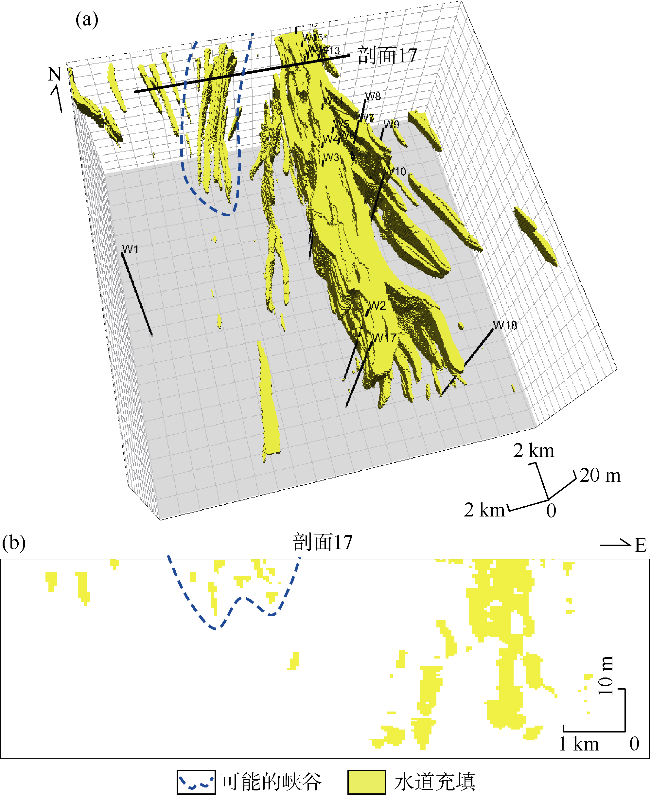
对于建模流程1产生的大部分地质模型实现来说,不同位置的结构片段较为统一,即它们来自于5种地质模式中的某一个特定模式。然而在极少数模型实现中,不同位置的结构片段可能采样自不同的模式。比如在图9中,中央区域的水道表现出强限制型或过渡型模式的特征,但在蓝色虚线所示的模型西侧,水道分布则基本呈现出峡谷限制型或弱限制型模式的特征,从而导致一个地质模型实现中出现了不同模式的结构片段。产生这一模式混杂现象的原因在于,建模流程1的生成器学习了来自所有模式的结构片段,而在地质建模过程中,模式的区分是基于约束数据的局部限制作用而实现的。因此,在约束作用较弱的区域(如图9中模型实现的西侧,该区域没有任何井点数据作为约束),模式的不确定性较强;反之,在约束作用较强的区域(例如图9中包含17口井的中央区域),地质模式则较为确定。这种偶发的模式混杂的问题,也是源于裁剪概念地质模型的训练数据准备方式。相比之下,建模流程2的生成器针对特定模式进行训练,从而规避了此类模式混杂的问题。实际上,建模流程1也可以对单个模式单独训练一个生成器,但如果模式过多,将产生极高的训练成本。


在建模流程1中,训练好的生成器可用于所有储层模式的地质建模;而流程2中训练好的生成器仅能用于对应的单个储层模式。建模流程2的模式证伪过程也需要为每个模式准备一定数量的概念地质模型,但其数量远少于建模流程1中训练生成器所需的数量。模式证伪时,还需要为每一类约束数据配置一个对地质结构敏感的特征提取方程。如果该方程对模式类型没有足够的敏感性,那么许多模式会被保留下来,此时为每个未被证伪的模式训练单独的生成器将带来高昂的训练成本,而若训练单一的涵盖所有未被证伪模式的综合生成器,则带来与流程1类似的局限性。
最后,从概率的角度来看,建模流程1体现了一个直接的“ ”过程,其中m和d分别代表地质模型实现和约束数据;而流程2则可表示为“ ”,其中 代表第k个模式, 为特征提取方程。建模流程2是一个分步约束的过程:第1个子过程为模式证伪,第2个为生成器约束。需要注意的是,第1个子过程得到的未被证伪的模式不一定是最终的模式,在第2个生成器约束子过程中仍然包含了一个隐藏的模式证伪过程。相比之下,建模流程1中的模式证伪则完全是以隐性方式蕴含在生成器约束的过程中。两种建模流程的效果可能存在细微差异,原因在于流程1仅依赖地球物理数据解释得到的沉积相概率体,而流程2在最初的模式证伪子过程中还利用了原始地球物理数据的宏观结构特征。
3.3 GANSim与多点地质统计学方法的地质建模结果对比
SNESIM建模结果与井点和概率体条件约束数据保持一致,这是由算法的固有设计决定的。然而,与两种GANSim建模流程相比,SNESIM算法在重现地质规律方面逊色得多,这可以从模拟得到的水道与朵叶体形态的对比中得到印证。在一台8核i7笔记本电脑上,SNESIM模拟每个模型平均耗时10 min。相比之下,虽然GANSim的训练可能需要数天时间(增加计算资源可缩短耗时),但是一旦训练完成,便可对具有相似地质结构、任意规模的储层进行快速地质建模,如在该例中,构建一个地质模型实现平均耗时0.7 s(在一块A100的GPU上)。
4 结论
在两个方面对GANSim地质建模框架进行了增强:①针对多种可能地质模式的储层提出了两种GANSim地质建模流程;②为应对井周储层不连续的问题,提出了局部判别器的结构设计。其中,GANSim建模流程1旨在训练一个适用于所有模式的综合生成器神经网络,以用于储层三维地质建模;而流程2专门引入了一个地质模式证伪步骤,只为未被证伪的地质模式训练生成器。
对于多模式、非平稳浊积扇储层的地质建模,两种GANSim建模流程均能得到与井点沉积相和地震概率体条件数据吻合的多个地质模型实现;每种流程对应的地质模型实现的差异均较大,表明其均可很大程度地表达储层预测的不确定性。尽管使用裁剪概念地质模型所得的小型模型块体进行训练,生成器仍可借助概率体的空间引导作用,在地质模型实现中产生完整的非平稳地质结构。局部判别器设计的引入,在地质模型实现中成功消除了单网格井点条件数据周围沉积相断连的问题。在一块A100的GPU上,生成一个1 600×104网格的地质模型实现仅需0.7 s,进一步凸显了增强型GANSim体系在实际应用中的良好可扩展性。与传统的多点地质统计学(SNESIM)方法相比,增强型GANSim所得的地质模型实现更能吻合期望的地质规律;虽然GANSim训练过程耗时较长且须准备大量的训练数据集,但一旦训练完成,即可用于任何具有相似地质规律、任意规模储层的快速地质建模,其地质建模速度是SNESIM的近千倍。
GANSim建模流程1训练所得的生成器虽然可用于所有模式的地质建模,但偶尔会出现一个模型实现中不同地质模式混杂的问题。相比之下,建模流程2规避了这一模式混杂的问题,但训练所得的生成器也仅能用于未证伪模式的地质建模。建模流程1将不同模式纳入统一考虑,其或可进一步推动面向多类型、多尺度储层地质建模的大型生成式AI模型的构建。此外,GANSim需要海量多样化的概念地质模型来准备训练数据集,这便要求研发针对不同储层类型和尺度的高效且自动化的概念地质模型仿真流程。
致谢:感谢斯坦福地球资源预测中心的资助。本项目部分计算工作是在斯坦福大学Sherlock计算机集群上完成的,感谢斯坦福大学和斯坦福研究计算中心为本项目研究成果提供的计算资源与支持。
符号注释:
d——储层相关的观测数据;D——判别器神经网络;Di——判别器神经网络,i=0时为全局判别器神经网络;i取值为1,2,…,n时,为局部判别器神经网络;f——敏感特征提取方程;G——生成器神经网络;Iwl——井位指示模型提取方程;K——地质模式数量;L——损失函数;Lw——井点沉积相训练数据的条件损失函数;Lπ——概率体训练数据的条件损失函数;m——地质模型;n——局部判别器神经网络数量;P——概率函数;p(z)——随机向量的数据分布; p(x)——沉积相地质模型训练数据的分布;p(w,π)——井点沉积相训练数据和概率体训练数据的联合分布;Sk——第k个地质模式(1≤k≤K);t——区间(0, 1)的一个随机数;w——井筒沉积相训练数据;x——沉积相地质模型训练数据;xG——生成的沉积相地质模型; ——训练沉积相地质模型与生成沉积相地质模型之间的任意插值;z——随机向量;αi——判别器神经网络Di的权重;β1,β2——Lw和Lπ的权重;λ——Wasserstein梯度惩罚的预设权重;π——概率体训练数据; ——期望算子。