

0 引言
琼东南盆地是南海北部深水油气勘探核心区,构造活动性强,历经半个世纪的勘探,已发现多种类型的天然气资源。几十年的勘探实践揭示了琼东南盆地天然气资源的复杂性和多样性。目前,勘探深度从超浅层到中深层、超深层不断拓展,勘探类型从常温常压到高温超高压,从中—高渗气藏到低渗—特低渗气藏,从常规气到水合物均有分布。不同类型天然气与盆地内不同烃源岩之间的成因关系如何,不同埋深、不同类型的天然气之间有何关系、未来琼东南盆地油气勘探方向如何选择等都是亟待深入研究的问题。显然传统的含油气系统理论已不能完全指导盆地深水区的油气勘探,亟需从全油气系统理论的角度认识油气分布规律,指导深水区复杂条件下的油气勘探。
1 区域地质概况
琼东南盆地是位于中国南海北部的新生代盆地,受欧亚、太平洋和印度等板块汇聚作用影响,盆地为强活动型被动陆缘盆地,平面上具有“南北分带、东西分块”的构造格局[8]。自北向南依次划分为北部坳陷、中部隆起、中央坳陷、南部隆起4个一级构造单元,进一步又可划分为乐东凹陷、陵水凹陷、北礁凹陷、松南凹陷、宝岛凹陷、长昌凹陷以及陵南低凸起、松南低凸起等多个二级构造单元。以区域不整合面T60为界,琼东南盆地纵向上具有“下断上坳”的双层结构。其中,盆地断陷期沉积了始新统岭头组和渐新统崖城组,是盆地主力烃源岩形成期。晚渐新世是盆地的断拗转换期,沉积了渐新统陵水组,发育大型三角洲砂体和厚层海相泥岩,该时期的三角洲砂体是盆地中深层主要的储集体。中新世以来是盆地拗陷期,先后沉积了中新统三亚组、梅山组、黄流组,上新统莺歌海组和第四系乐东组,该时期盆地主要是半深海—深海沉积环境,发育重力流水道、海底扇砂体,是盆地中浅层—超浅层重要的成藏层系[9]。
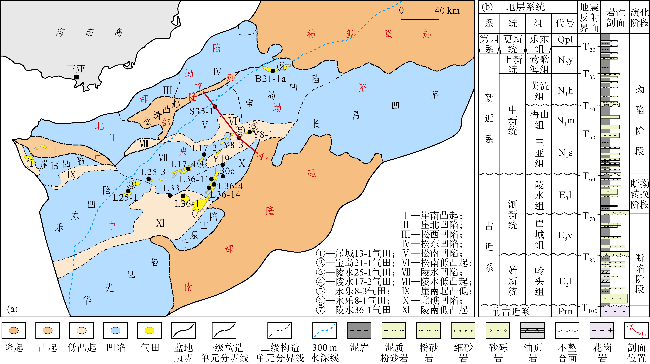
2 琼东南盆地深水区油气地质条件
琼东南盆地深水区强构造活动对地质条件的改造,使其与陆相盆地、浅水盆地全油气系统相比,表现出一定的特殊性。强活动型被动陆缘的复杂构造演化,特别是新构造运动以来的构造变化,一方面造成沉积地层和构造特征多样,形成了多套、多样的生-储-盖配置、多种的圈闭类型和运聚方式;另一方面,地幔热流上涌带来的异常地温,明显加快了烃源岩热演化过程和储层的成岩演化过程。此外,深水条件下,浅部地层处于水合物稳定域,改变了浅层的油气成藏条件和分布格局。这些特殊性使得盆地烃源岩多套、储层类型多样、圈闭种类复杂、运聚通道与方式多样,在有机质丰度整体不高的情况下形成了多个不同类型的大中型气田,包括常规气藏(渗透率大于1×10⁻³ μm2)、致密气藏(渗透率小于1×10⁻³ μm2)及天然气水合物等多类型。值得一提的是,考虑海上开发能力和开发成本,常规气藏中的低渗气藏(渗透率为(1~10)×10-3 μm2)常与致密气藏一起研究。
2.1 深水区海陆相全序列烃源岩
始新世—第四纪,盆地经历由断陷至拗陷构造演化,发育由湖至海沉积充填序列,控制形成了盆地始新统陆相湖盆烃源岩、渐新统海-陆双源烃源岩及中新统上部—第四系海相源岩3大烃源岩体系。受烃源岩展布、埋深及热演化控制,始新统湖相烃源岩至中新统上部—第四系海相源岩形成多个生烃中心且各个生烃中心从东至西有序展布。因此,盆地深水区烃源岩呈现出多层系、多类型、多生烃中心的特点。
2.1.1 多层系多类型的海陆相全序列烃源岩体系
①始新统陆相湖盆烃源岩体系。深水区始新统陆相湖盆的发育主要受北东—南西向断裂控制,其中深水区东部构造伸展较为强烈,形成湖泊群,向西过渡为单个湖泊,奠定了东区湖相烃源灶成群分布、西区孤立分布的格局。目前仅有2口探井钻遇该套烃源岩,主要为浅湖相泥岩,TOC值多低于1%。类比盆地浅水区松西凹陷及相邻顺德凹陷,结合构造背景与烃源岩地球物理特征,预测深水区始新统局部发育以优质页岩、油页岩为主的半深湖—深湖亚相烃源岩。
②渐新统海-陆双源烃源岩体系。该烃源岩体系发育主要受沉积环境与生物类型及繁盛程度控制,形成了海陆过渡相煤系与海相两大类烃源岩,主要分布于崖城组。海陆过渡相煤系烃源岩以陆源高等植物为主,主要发育于三角洲及海岸平原[13-14],Y19井钻遇海陆过渡相煤系,局部发育薄煤层,TOC值为0.5%~20.8%,集中在2%以内,氢指数(HI)不超过250 mg/g,有机质类型以Ⅲ型为主。海相烃源具有海-陆双源特点[8,15 -16],从近岸至广海,海相烃源岩呈现出从陆至海陆源有机质贡献逐渐减弱、海源有机质贡献逐渐增强特点,依次形成了海相陆源型、海陆混合型、海相内源型3类烃源。已发现中央坳陷边部宝岛21-1、永乐8-1等气田天然气主要与该套体系中的海陆过渡相和海相陆源型烃源岩有关[8],而中央坳陷中部的陵水25-1、陵水17-2气田天然气与海相陆源型、海陆混合型烃源更为密切。海相烃源岩TOC值多为0.6%~1.0%,很少超过1.5%,即以中低丰度为主,这明显不同于全球大量富油气盆地主要烃源岩——海相内源型烃源岩有机质丰度高的特点[16]。尽管其有机质丰度不高,但其能形成多个大中型气田,与该烃源岩中含有一定量的海相藻类与草质体等富氢组分可提升烃源岩生烃能力有关。如L33井崖城组上段海陆混合型烃源岩中海相沟鞭藻及草质体丰度明显高于中下段的海陆过渡相煤系烃源岩。黄金管-高压釜封闭热模拟实验结果表明,海相泥岩(海相陆源型)烃源岩烃产率为240~320 mg/g,海陆过渡相煤系烃源岩产率为160~200 mg/g,崖城组海相泥岩的生气潜力总体高于海陆过渡相泥岩,表明海相烃源岩中富氢组分增加,有效改善了烃源岩品质,提升了生烃能力[15]。深水区凹陷内部崖城组烃源岩厚度最大超过1 000 m,成熟烃源岩面积超过12 000 km2,烃源岩厚度大、分布广、热演化程度高,加上与其相匹配的正向汇烃背景,为大中型油气田形成奠定物质基础。
2.1.2 强伸展高热流背景下形成多个生烃中心
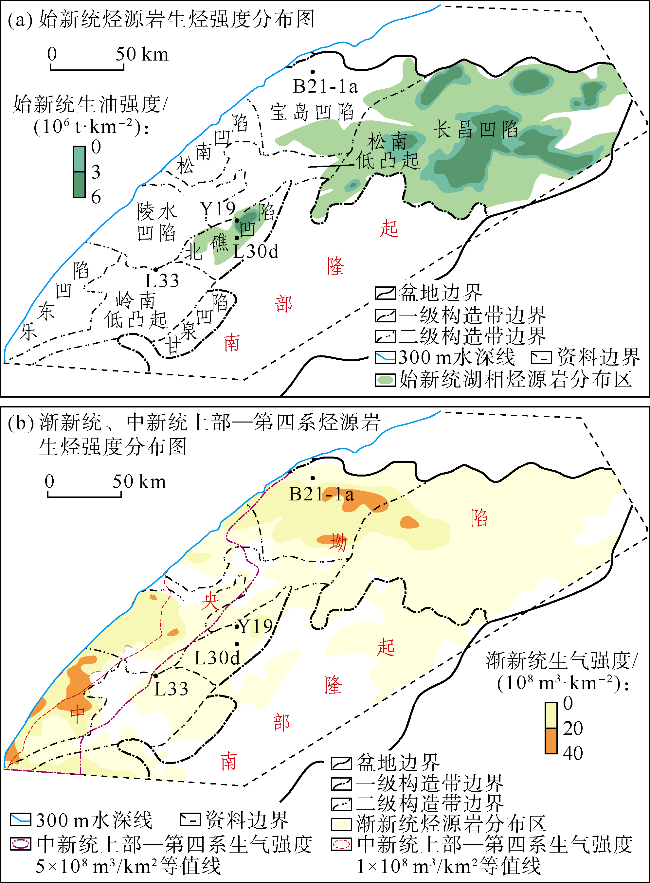
琼东南盆地新生代经历了持续的岩石圈伸展、薄化等“非瞬时”伸展过程,地壳厚度由陆架和南部隆起区的20.2 km逐渐减薄至10 km以下,局部仅为3 km,强烈地壳薄化作用与地幔热隆岩浆活动造成高地温场。在深水区,地温梯度为22~64 ℃/km,平均地温梯度为44 ℃/km,明显高于世界上其他时代沉积盆地的平均地温梯度(30 ℃/km)[18]。深水东区地温梯度明显高于深水西区,已钻井分析显示深水区从西到东,生烃门限逐渐变浅。深水西区具有厚层古近系与厚层新近系,东区则具有厚层古近系与薄层新近系,造成深水东、西区烃源岩埋深的差别。地温场、埋深及烃源岩展布耦合作用下,始新统湖相烃源岩至中新统上部—第四系海相源岩形成多生烃中心且从东至西有序展布:始新统湖相烃源岩生烃中心主要分布在深水东区的长昌凹陷,西区北礁凹陷也有小范围生烃中心,最大生油强度均超过6×106 t/km2;由于目前尚未发现源自始新统的规模油藏,本文对此不作深入讨论。渐新统海-陆双源烃源岩广泛分布于深水区,在东部宝岛凹陷和西部陵水凹陷、乐东凹陷均有生气强度超过40×108 m3/km2的生烃中心;中新统上部—第四系海相源岩生气中心则主要分布于深水西北部的乐东凹陷和陵水凹陷,最大生气强度超过5×108 m3/km2(见图2)。
2.2 深水区多类型储层有序分布特征
琼东南盆地深水区储层类型多样,既有中生界潜山储层,也有新生界碎屑岩储层;既有牵引流沉积储层,也有重力流沉积储层;既有深层致密型储层,也有超浅层疏松型储层,等等。上述不同类型储层在时空分布上呈现明显的规律性,为深水区天然气资源有序分布奠定了物质基础。
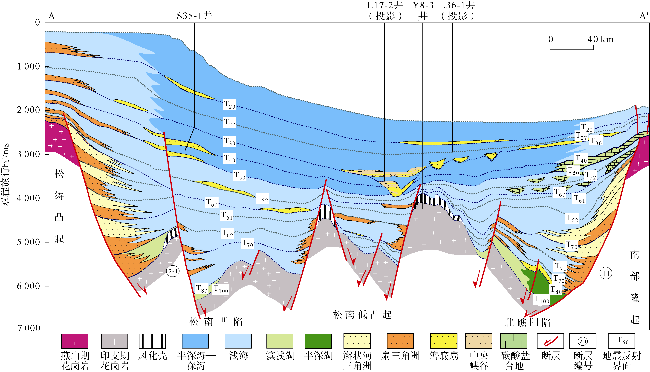
综合各时期典型地层的壁心和薄片资料来看,基岩潜山以二长花岗岩、钾长花岗岩、花岗闪长岩等为主,主要受印支期特提斯洋俯冲碰撞、燕山期太平洋板块俯冲的构造事件控制,具多期发育的特征,以裂隙型储层为主,顶部发育孔隙-裂缝型储层,在盆地各凸起及低凸起区、各凹陷斜坡地带物性较好[19]。碎屑岩储层在盆地内分布广泛。断陷期岭头组和崖城组发育扇三角洲及辫状河三角洲,岩性整体较粗,以含砾粗砂岩、中砂岩、杂砂岩等为主,局部发育细砂岩等。断-拗转换期陵水组沉积期发育辫状河三角洲,晚期凹陷中心开始发育海底扇,整体以中砂岩、细砂岩及粉砂岩等为主,局部含砾。热沉降期三亚组—乐东组在陆架区发育大型三角洲,以中砂岩、细砂岩等为主,局部见粗砂岩及含砾;陆坡区发育斜坡扇等,以细砂岩及粉砂岩等为主,泥质含量多较高;盆底区受重力流及底流的共同影响,发育沿盆底轴向展布的大型海底扇及峡谷水道等,以细砂岩及粉砂岩等为主。值得注意的是,热沉降期南部隆起由于缺乏物源供给,开始发育碳酸盐台地,受其影响,盆地南部局部发育生物碎屑灰岩、泥质灰岩等[20]。以上表明,琼东南盆地储层具有多时代发育、多岩石类型、多水动力影响的特征,在深水区垂向上构成“基底潜山-下牵引流砂体-上重力流砂体”的叠置模式(见图3),为天然气多层系成藏提供了有利条件。
同时,碎屑岩储层受成岩演化的控制,在埋深大于5 200 m时,通常孔隙度小于10%,渗透率低于0.1×10⁻³ μm2,以泥页岩为主;在埋深为4 500~5 200 m时,通常孔隙度为10%~15%,渗透率可为(0.1~10.0)×10-3 μm2,以低渗和致密储层为主;埋深为3 800~4 500 m时,通常孔隙度为10%~30%,渗透率可为(1~1 000)×10-3 μm2,以低渗和常规储层为主;埋深3 800 m以浅以常规储层为主,存在一部分的低渗储层,其中埋深小于2 500 m的储层因埋藏浅、压实程度弱,处于未—弱成岩阶段,根据岩心和壁心实测数据表明孔隙度为25.9%~43.8%,平均值为38.7%,渗透率为(20.1~2 830.0)×10-3 μm2,平均值为613.6×10⁻³ μm2,整体上为中—特高渗储层,储层的储集空间主要为原生粒间孔隙、粒内孔隙和晶间孔,部分可见生物碎屑。粒间孔隙直径为10~30 μm,晶间孔隙直径一般小于5 μm,生物体腔直径一般为200~300 μm。乐东组储层颗粒整体上以游离式—点接触式为主,棱角—次棱角状,分选中—好级别。盆地内这种储层类型及物性特征的有序分布为超深层致密气藏、深层低渗气藏、中浅层中高渗气藏、超浅层高渗气藏和天然气水合物的有序分布奠定了物质基础。
2.3 深水区全油气系统流体动力场
贾承造、宋岩、庞雄奇等在全油气系统理论中指出,根据地层的孔喉结构、孔喉中流-固耦合作用,流体在地层中运移的受力特征,可以将含油气盆地中的流体动力场划分为浮力主导的自由流体动力场、毛管压力主导的局限流体动力场和毛管压力与分子间作用力主导的束缚流体动力场(见图4)[21-22]。在琼东南盆地深水区,从深部至浅部,依次出现位于束缚流体动力场的深层泥岩中的页岩气(推测埋深大于5 200 m),局限流体动力场的深层高温低渗—致密气藏(埋深4 500~5 200 m)[23-24],介于局限流体动力场与自由动力场过渡带的中深层低渗气藏(埋深3 800~4 500 m)[25-26],位于自由动力场的浅层常规气藏(埋深2 500~3 800 m)和超浅层未—弱成岩地层气藏(埋深小于1 900 m),及位于低温高压区特殊束缚流体动力场的天然气水合物(埋深小于1 900 m)[10,27]。
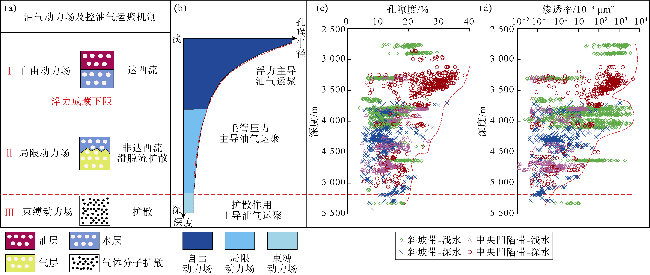
其中,推测束缚流体动力场与局限流体动力场的转换深度大约在5 100 m~5 200 m,渗透率界限在(0.05~0.10)×10-3 μm2,局限流体动力场与自由流体动力场的转换深度大约在3 800~3 900 m,渗透率界限大约为10×10-3 μm2。值得指出的是,该边界与界限并非绝对的,而是反映盆地尺度的整体规律,在特定的油气藏内,其具体的流体场情况与其流体动力和储层物性变化、温度密切关联。高地温会加剧储层的成岩演化程度,使得储层整体物性更差,非均质性强,同时也加速了烃源岩的热成熟,提高了生烃增压,为流体流动提供了高驱动力。特别的是,深部致密和低渗储层中的裂缝发育会明显改变局部的流体动力场特征,在裂缝集中发育区域会出现自由流体动力区,但并不影响宏观整体的流体动力场特征。
①束缚流体动力场的泥岩中的页岩气,据推测主要分布在崖城组,泥岩孔渗极低,孔隙度主体小于10%,渗透率主要为(0.02~0.10)×10-3 μm2,孔喉较微小,主要为0.05~0.10 μm,在孔喉系统中,大分子游离相难以运移,甲烷分子以扩散或者滑脱流动为主。②局限流体动力场的低渗—致密气藏主要分布在陵水组,储层孔隙度主要为5%~15%,渗透率集中分布在(0.1~1.0)×10-3 μm2,孔喉主要分布在0.1~0.3 μm,孔喉系统中毛细管力大,排替压力为0.7~1.8 MPa,在较高的源-储压差驱动下,流体以非达西流动方式运聚,如驱动力不足则滞留成藏[28]。③中深层常规—低渗气藏,主要出现在中央凹陷黄流组,储层孔隙度分布在5%~30%,渗透率为(0.5~100.0)×10-3 μm2,孔喉半径为0.3~2.0 μm,在这类气藏中受储层物性变化影响,既可以出现局限流体动力场也可以出现自由流体动力场。④陵水凹陷黄流组的浅层常规气藏和陵南低凸起第四系乐东组的超浅层气藏,储层孔隙度为10%~30%,渗透率为(1~1 000)×10-3 μm2,孔喉半径为2~7 μm,毛管压力微小,排替压力为0.04~0.10 MPa,流体在孔喉中的流动表现为自由流体运动特征,浮力主导了油气的运聚。⑤第四系乐东组三段的天然气水合物在低温高压下水分子与甲烷分子的络合固结形成的分子间作用力较强,油气流体难以流动。
值得注意的是,超浅层气藏虽然位于自由流体动力场中,但其成藏与上覆未—弱成岩泥岩和水合物盖层紧密关联,受上覆巨厚海水影响,未—弱成岩泥岩处于低温高压环境,水界面张力增高,盖层孔喉半径不变情况下封盖能力明显增强。此外,超浅层发育多套未—弱成岩泥岩盖层,通过未—弱成岩沉积物盖层封闭能力定量评价装置,以乐东组3段超浅层气藏储盖特征为地质模型(见图5a),采用海泥海沙模拟深海泥质盖层和砂质储层,从底部注入天然气,不断提高注入压力,模拟天然气注入—聚集—散失全过程。
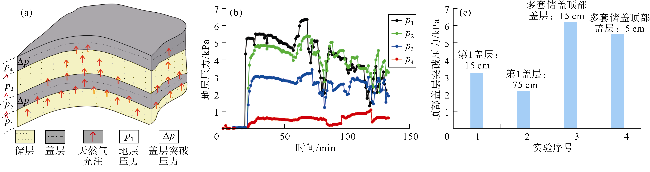
实验结果表明,多套盖层会产生叠加补偿效应,从底部储层至顶部盖层,气体压力不断降低,运移动力大幅损耗(见图5b),直接盖层作为直接封盖层,会大幅消耗天然气运移压力,阻滞压力传导,因此要突破顶部区域盖层,天然气须在储层中积聚足够的能量和压力,多套盖层产生了类似于多级水坝的拦截效果(见图5)。多套盖层和单一盖层的天然气突破压力物理模拟实验也表明,多套盖层体系中相同厚度或者厚度更小的顶部盖层比单一盖层体系中的盖层的突破压力提高1.0~1.5倍,这表明多套盖层的存在会逐级消耗天然气充注量和充注动力,从而导致相同厚度的顶部盖层的突破压力更高(见图5c)。同时,这种效应也与研究区计算的供气量(4 800×108 m3)及散失气量(258×108 m3)的天然气聚散特征是相符的,也是陵水36-1气田主力气层A3砂层中在盖层更多的区域实测地层压力明显偏离静水压力线的关键原因,比如L36-4井在1 740 m处具有17.95 MPa的地层压力,明显高于相同深度、盖层套数更少的相邻区域地层压力;另一方面,水合物在稳定域内以固态形式充填于颗粒孔隙间,对天然气直接起到极好的垂向封盖作用,上述作用共同导致超浅层气藏表现出介于自由流体动力场和局限流体动力场的流体特征(见图4)。
3 琼东南盆地深水区天然气类型及有序分布
受流体动力场控制,深水区超深层页岩气、中深层—深层潜山气藏、低渗储层气藏、中浅层中高渗储层气藏、超浅层天然气高渗气藏和天然气水合物等不同类型天然气资源有序分布。
3.1 天然气(藏)类型
3.1.1 页岩气(推测)
页岩气是源岩层内部天然气被吸附作用和毛细管力作用滞留而形成,可分为海相、陆相和海陆过渡相页岩气[29-30]。琼东南盆地深水区渐新统崖城组海陆过渡相烃源岩有机质丰度较高,埋深普遍超过4 500 m,现今处于高—过成熟阶段,已大量生气,具备形成页岩气的石油地质条件。影响泥页岩含气量的因素较多,如有机质丰度、热演化程度、孔隙大小、矿物组成及脆性、温压、含水量等,并且高有机质丰度烃源岩层更有利于形成高含气量的页岩气。深水区钻井证实泥页岩层段内含气响应与有机质丰度相关,北礁凹陷L30d井在崖城组三段钻遇一套三角洲前缘亚相泥页岩,其TOC值为1.3%~2.5%(平均为1.7%),源内气测值平均为1.6%,而该井TOC值平均为0.8%的泥页岩层段的气测值平均仅为0.8%。尽管目前深水区尚未发现规模页岩气藏,但深水区3套烃源岩中渐新统崖城组海陆过渡相煤系烃源岩的有机质丰度整体较高,TOC值最高可达20.8%,且现今多处于高—过成熟阶段,具有形成优质海陆过渡相页岩气的物质基础。与北美页岩气勘探不同,较好的保存条件是中国页岩气富集的关键因素之一[30]。琼东南盆地为强活动深水盆地,断陷期整体构造活动强烈,但在部分深凹区域存在局部相对弱构造活动区,是页岩气赋存的有利区域。深水区乐东—陵水凹陷南部、北礁凹陷B洼等凹陷中心区域是琼东南盆地相对弱构造活动区,这些区域发育多个含煤三角洲,可形成有机质丰度中等—高的烃源岩,且离深大断裂带较远,上覆厚层海相泥岩能形成良好的顶板条件,是超深层海陆过渡相页岩气形成的有利区。
3.1.2 低渗—致密气藏
3.1.2.1 永乐8-1、8-3气田
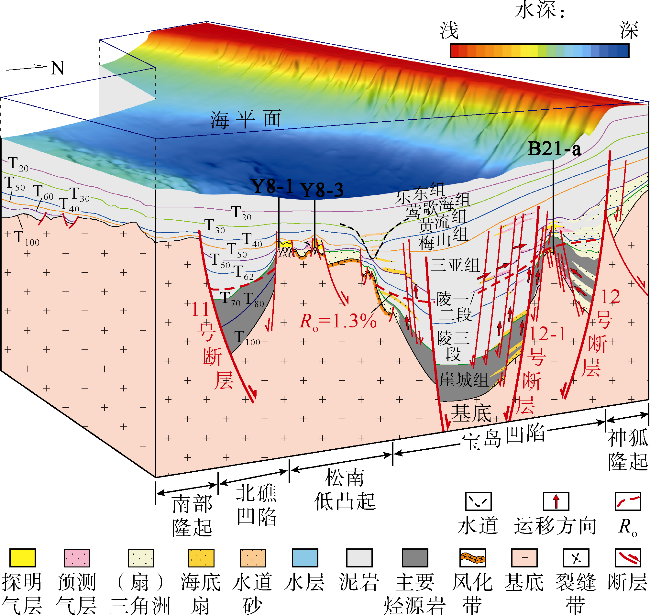
永乐8-1、8-3气田为琼东南盆地深水区潜山气田。琼东南盆地深水区大规模发育印支期花岗岩,裂缝带与风化带储层均较发育[9],且潜山之上覆盖厚层海相泥岩,为深水区发育规模潜山气藏奠定了基础。深水区潜山气藏具有“海陆过渡相与海相陆源型烃源岩供烃、浮力驱动、断-砂-脊-不整合面复合输导、陵水组与三亚组浅海泥/超压封盖、花岗岩潜山储集”的成藏模式,且由低位潜山至高位潜山有序聚集(见图6)。目前已发现永乐8-1、8-3气田为浮力驱动高位潜山成藏的典型代表。该气田位于琼东南盆地松南低凸起主体部位,为源外高位潜山。永乐8-1、永乐8-3气藏的储层以印支期花岗岩为主,埋深约2 700~3 600 m,上覆水深1 830~1 900 m,储层厚度约88~310 m,孔隙度为2.7%~17.8%,渗透率为(0.02~13.90)×10-3 μm2,为高孔、特低渗储层,个别为致密储层。地层压力系数为1.036~1.082,原始地层温度为67.97~84.38 ℃,属常温常压气藏。天然气纯烃含量高,气藏中气油比高,为40 994~59 787 m3/m3,但天然气成熟度不高(甲烷碳同位素组成约为-43‰),主要是由于该烃源岩为海陆过渡相与海相陆源型烃源岩,生气为主,且目前埋深相对浅。
3.1.2.2 宝岛21-1气田
宝岛21-1气田为琼东南盆地深水区深层高温低渗气田。琼东南盆地为强活动型被动陆缘盆地,相对稳定的走向斜坡型转换带是强活动型被动陆缘盆地大—中型油气田富集的“黄金带”[31],其中宝岛凹陷存在多个转换断阶带,是烃类气体的有利汇聚区。宝岛凹陷深部崖城组海相陆源型烃源岩生成的热成因气,沿着大型构造脊汇聚,再通过沟源断裂垂向运移到陵三段构造-岩性圈闭中聚集成藏,控圈断裂晚期不活动、有利于天然气保存,整体源-脊-断-砂配置好、控制天然气富集。
宝岛21-1气田为其典型代表(见图6),该气田位于琼东南盆地宝岛凹陷北坡断阶带东段,水深659.5~1 568.0 m,埋深3 600~4 500 m,储层主要为陵水组三段大型辫状三角洲/三角洲前缘沉积,主力气组储层厚度约50~70 m,孔隙度主峰为12.0%~14.0%,渗透率主峰为(0.80~1.60)×10-3 μm2,为低孔、低渗储层,个别为致密储层。地层温度为119.04~158.72 ℃,压力系数为1.024~1.170,地层压力为37.277~46.140 MPa,属常压高温气藏。
3.1.3 常规气藏
3.1.3.1 陵水25-1气田
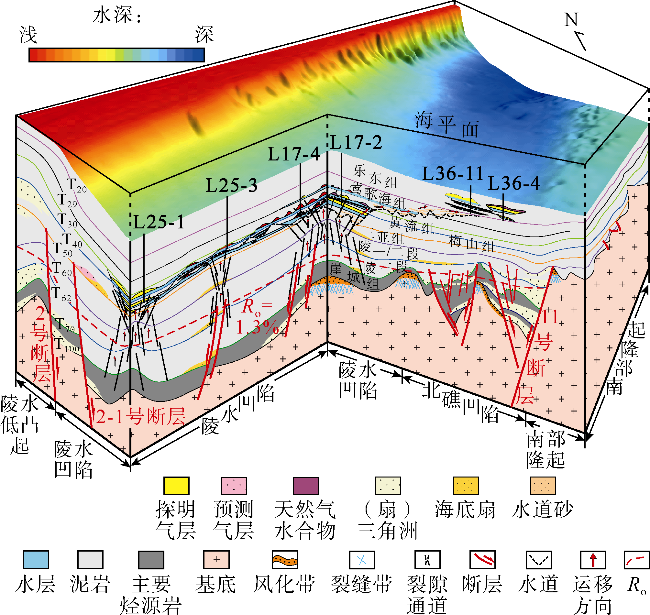
陵水25-1气田是琼东南盆地深水区中深层常温高压气田。中新世以来,琼东南盆地进入裂后热沉降期,中央坳陷快速沉积厚层海相地层,下部渐新统崖城组烃源岩被快速深埋,进入生气阶段并形成强超压,深层天然气在中深层泄压路径上被有效圈闭捕获,形成常温高压气藏。受南海西北部走滑、伸展陆缘应力的叠加作用,乐东凹陷形成琼东南盆地新近系沉积中心,也成为琼东南盆地的超压—强超压中心,且渐新统崖城组发育规模大、品质较好的海相陆源型和海陆混合型烃源岩,中新统发育大型重力流沉积体,是琼东南盆地中深层常温高压气藏有利发育区,以陵水25-1气田下部气组为代表(见图7)。陵水25-1气田水深860~975 m,埋深3 700~4 100 m。储层为黄流组中央峡谷早期水道和梅山组海底扇砂岩,储层厚度约13.7~105.7 m,以粉砂岩、细砂岩为主,储层孔隙度主要为14.7%~26.0%,渗透率主要为(4.6~437.9)×10-3 μm2,属低—高孔、特低—中渗储层。黄流组和梅山组地层温度为125.18~140.90 ℃,地层压力为43.220~72.196 MPa,压力系数为1.173~1.814,为常温高压气藏。
3.1.3.2 陵水17-2气田
陵水17-2气田是琼东南盆地深水区中浅层常温常压—弱超压气田。琼东南盆地中新统发育大型(扇)三角洲、重力流海底扇/水道储集体,是盆地重要的泄压层系,深部渐新统崖城组烃源岩生成的天然气在强超压驱动下通过气烟囱、裂隙带、断层等垂向通道向上运移,在中新统低势区形成浅层常温常压—弱超压气藏。浅层常温常压—弱超压气藏在乐东、陵水、松南、宝岛等多个凹陷均有发现,特别是在乐东—陵水凹陷中新统中央峡谷内发现了大型深水气田——陵水17-2气田(见图7)。陵水17-2气田位于陵水凹陷中南部,埋深约3 200~3 700 m,水深1 250~1 550 m。储层为黄流组中央峡谷晚期水道优质砂岩,总厚度可达939 m,单层砂体最大厚度达52 m。整体埋深浅,压实作用不强,储层物性好,岩心孔隙度为30.0%~33.7%,渗透率为(290~2 500)×10-3 μm2。地层温度为85.0~93.1 ℃,压力系数为1.19~1.22,地层压力为37.4~40.3 MPa,为常温常压气藏。目前在琼东南盆地中央峡谷内已发现中浅层常温常压—弱超压气藏储层近2 000× 108 m3,已建成中国首个千亿立方米级别自营深水大气田——“深海一号”气田。
3.1.3.3 陵水36-1气田
陵水36-1气田是琼东南盆地超浅层低温常压气田,是琼东南盆地近年来新发现的油气藏类型,主要发育于深水—超深水区,是重要的勘探新领域。这里将海底以下埋藏深度小于300 m的地层中赋存的天然气称为超浅层天然气[10,17]。过去认为超浅层远离深部气源且地层未—弱成岩,天然气难以大规模富集成藏。近年来研究表明琼东南盆地深水超浅层具有“双源供烃、接力输导、多元封盖、三气共存”的规模天然气成藏模式,研究成果支撑发现了陵水36-1大型气田(见图7)。陵水36-1气田位于琼东南盆地陵南低凸起,水深1 489~1 677 m,海底以下埋深146~264 m,探明天然气地质储量1 088×108 m3,为中国首个超深水超浅层大型气田[10]。陵水36-1气田储层主要为第四系海底扇砂体,主力气组最大厚度为37.8 m,孔隙度为26.1%~46.8%,渗透率为(6.2~2 265.2)×10-3 μm2,为特高孔、高—特高渗储层。地层温度为13.9~16.9 ℃,地层压力为17.2~19.3 MPa,压力系数为1.04~1.06,属低温常压气藏。气藏之上常有水合物发育,水合物与浅层气间的界面为水合物稳定域底界,陵水36区内很少发育因水合物破裂而产生的海底扰动或麻坑,说明稳定域内水合物对下伏游离气具有较好的保存效应。陵水36-1气田天然气以甲烷为主(含量为98.2%~99.8%),具有热成因气和生物气混源特征,多数气组以热成因气为主,生物气贡献较小[17],这可能与该区生物气生气强度较弱有关。
3.1.4 深水超浅层天然气水合物
琼东南盆地深水超浅层具备天然气水合物稳定发育的温度、压力条件,是天然气水合物发育的有利场所。受水深变化、热流体活动和天然气组分差异的影响,琼东南盆地天然气水合物稳定域厚度变化较大,但普遍小于260 m。琼东南盆地深水超浅层发育孔隙型和裂缝型两类天然气水合物资源,其中资源规模较大的孔隙型天然气水合物主要发育于陵南低凸起第四系。钻井揭示陵南低凸起孔隙型天然气水合物富集于第四系大型海底扇储层中,储层位于海底以下埋深210~260 m,厚1.1~7.6 m,孔隙度为26.5%~42.8%,饱和度为9.5%~74.0%,与超浅层气层常以“上冰下气”的模式伴生成藏[32]。天然气水合物与下伏超浅层气藏甲烷碳同位素值一致,为-49‰~-43‰,具有相同的气源条件[17]。深部热成因气通过断层、裂隙、中央峡谷叠置砂体等输导通道运移至超浅层后,与生物气混合,受天然气水合物稳定域控制赋存状态发生改变,当天然气位于稳定域内时,形成天然气水合物,当天然气位于稳定域之下时,形成天然气藏,同时,随着时间的迁移,水深、上覆地层等发生变化也会引发二者相互转化。
3.2 天然气(藏)有序分布
受储集体物性特征及流体动力场控制,琼东南盆地深水区纵向自下而上有序发育潜山及页岩气(推测)致密气藏、深层低渗气藏、中浅层中—高渗气藏、超浅层高渗气藏和天然气水合物。同时平面上天然气也呈现出有序分布特征。受新构造运动控制,琼东南盆地沉降-沉积中心在晚期由东往西迁移,造成东区长昌凹陷沉积地层相对较薄(地层埋深约6 000~8 000 m),中部松南—宝岛凹陷次之(地层埋深约7 000~10 000 m),西部乐东凹陷最厚(地层埋深一般大于12 000 m)[33]。晚期快速沉降作用有利于烃源岩快速熟化,导致中央坳陷带渐新统烃源岩由东向西成熟度逐渐增高,因此东区长昌凹陷有利于生油,中部松南—宝岛凹陷有利于生气,局部烃源岩埋深适中且母质来源中海源占比高的地区有利于生油,西区乐东—陵水凹陷烃源岩成熟度过高则主要以生气为主。同时从凹陷边缘到凹陷中心,渐新统海-陆双源烃源岩陆源有机质贡献逐渐降低,海源有机质贡献逐渐增大,生成的天然气地球化学特征也表现出规律性变化,如从永乐8-1气田至宝岛21-1气田、陵水17-2气田再到陵水25-1气田,天然气干燥系数逐渐变小,气油比降低,凝析油含量增加,形成“外干气、内干气+湿气”的天然气分布格局。
除此之外,温度场和压力场也会影响琼东南盆地深水区天然气藏的类型。盆地深水区中央坳陷带热流值较高,且由西往东热流值逐渐升高,更高的地温场导致深水东区储层成岩演化更快、储层埋深下限更浅,宝岛21-1气田和永乐10-6气田均存在部分低渗或致密储层;而西区储层成岩演化较慢、储层埋深下限较深,陵水组及以上地层储层物性均较好,其中陵水17-2、陵水25-1气田分别为高孔—特高孔、高渗—特高渗以及中孔—高孔、低渗—高渗储层。晚期快速沉降引起欠压实造成深水区发育超压,整体表现为“西高东低”特征,西部乐东凹陷异常压力最高,中部陵水凹陷、松南凹陷次之,东部宝岛凹陷、长昌凹陷基本不发育超压。“西高东低”的超压分布格局,造成盆地天然气藏的差异分布。乐东凹陷、陵水凹陷及陵南低凸起分布一系列超压气藏,如陵水25-1气田、陵水32-1气田等;宝岛凹陷和长昌凹陷则主要以常压气田为主,如宝岛21-1气田等。
晚期断裂、泥底辟、气烟囱以及沟通浅层的裂隙等不同类型油气运移通道,单独或联合沟通了深部烃源层以及深浅目的层,有利于天然气平面和纵向叠置复式成藏。因此,琼东南盆地构造活动、沉积充填及温度场和压力场差异分布影响全油气系统内烃源岩、储层等的分布类型及演化,结合断裂等,共同控制了系统内油气的有序分布。
4 琼东南盆地深水区复合全油气系统形成演化
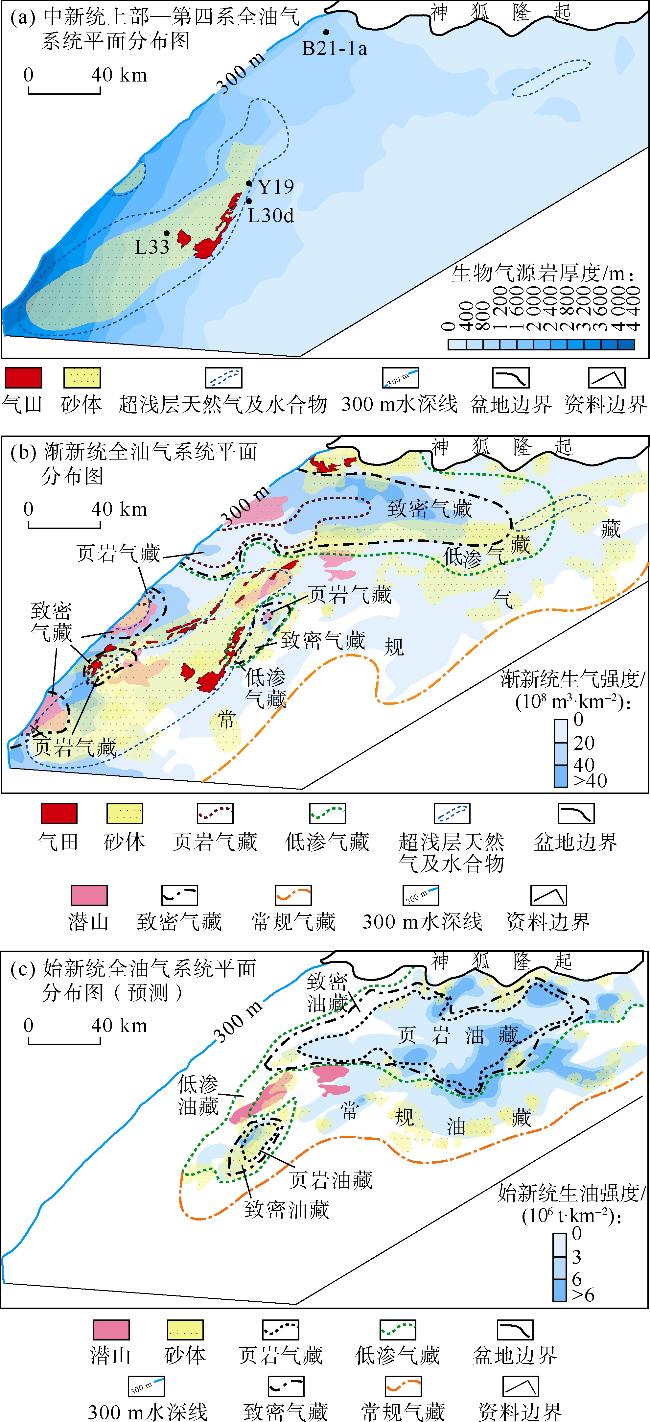
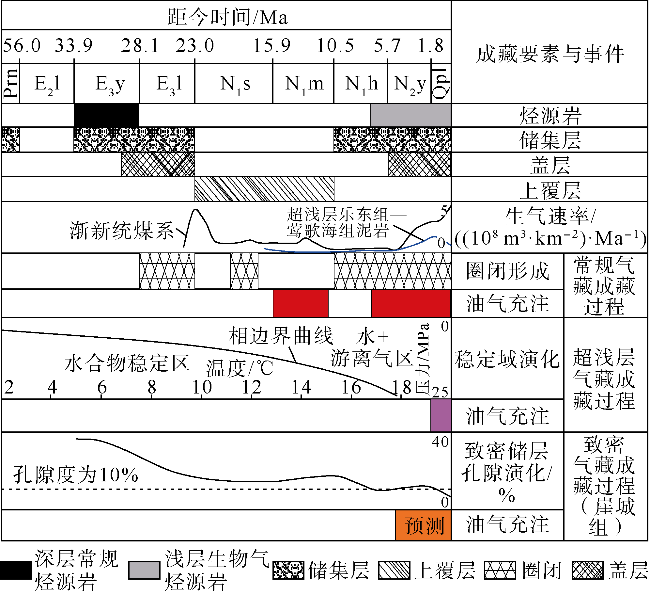
3套全油气系统内的油气分布在平面上呈现出一定规律(见图8),渐新统全油气系统内凹陷中部发育页岩气藏和致密气藏,向边缘过渡为以低渗—常规气藏为主。始新统全油气系统油气分布规律与渐新统全油气系统相似。中新统上部—第四系全油气系统天然气主要为超浅层天然气及水合物,主要分布在盆地深水西区。
琼东南盆地的大多数油气藏均是很晚才形成[8]。晚期的盆地深水区油气成藏具有明显几个特征:①晚期快速增温和薄地壳所带来的高地温场下烃源岩加速成熟和高强度快速生烃;②坳陷中心超压发育,带来了充足运移动力,并抑制了深部烃类流体的相态分异;③3套不同类型烃源岩发育,全油气系统多具有复式成藏特征。同一个油气序列的烃源可能不同,也可能相同;不同的油气序列烃源也可能相同。④坳陷浅层部分位于斜坡—低凸起/南部隆起区的区域由于流体势低,且有优势通道与深部高势烃源连通,因此成为油气规模成藏有利区域(见图9),并在这些区域从下到上、由深至浅形成了规律性的油气序列分布。由北至南,这些区域分为4个带:坳陷北部陡坡带、坳陷中心底辟带、坳陷南部斜坡/低凸起带、坳陷南部边界陡坡—南部隆起构造—生物礁圈闭带。
晚期随着深部烃源岩的高强度生烃,在超压的作用下,生成的一部分油气经初次运移后进入邻近储层。由于深层砂岩成岩程度高,物性差,油气进入储层中形成致密油气,比如宝岛21-1邻洼深部的致密油气。未被致密地层的“自封闭作用”保存下来的油气,穿过致密地层后,在高孔渗砂岩中浮力的作用下继续运移,聚集成藏,形成了常规油气藏。比如坳陷北部的宝岛21-1深层低渗气藏(主要成藏时间约为距今11.0~16.0 Ma、距今7.8 Ma以来)和陵水13-2浅层(成藏时间为距今4.8~2.0 Ma)常规气藏;坳陷中心的陵水25-1和陵水17-2中浅层常规气藏(成藏时间晚于距今3.7 Ma);坳陷南部斜坡/低凸起区永乐8-1/3中浅层常规气藏(成藏时间约为距今5.5 Ma)。特殊的是中央峡谷气田泄露的油气向更浅层运移,在浅层生物气辅助补充下,综合形成陵水36-1超浅层常规气藏和天然气水合物(成藏时间晚于距今0.68 Ma)[17],油气序列更为丰富(见图10)。
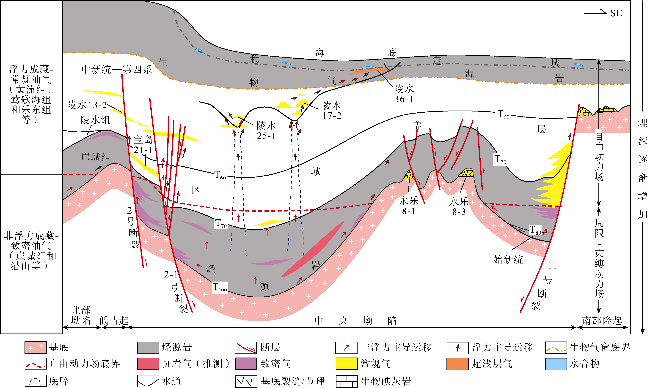


这些序列分布的油气中,常规油气勘探程度高,剩余潜力有限,下一步勘探重点应转向勘探程度更低的深层致密气藏和超浅层常规气藏/水合物。由于基岩潜山储层的演化与常规碎屑岩不同,其储层主要受与构造相关的裂缝,与流体相关的溶蚀和充填,及与暴露相关的风化改造等有关,因此在适当的构造、流体及风化条件下,位于深部致密气藏下的低位潜山依然具备形成常规潜山气藏的条件,是值得关注的有利勘探区。此外,随着勘探的深入,页岩气也将成为不可忽视的领域。
5 全油气系统研究对深化油气勘探的启示
5.1 促进了盆地油气资源潜力的系统性评价
全油气系统理论打破了传统资源分类界限,将页岩气、致密油气、常规油气、超浅层天然气及天然气水合物等不同赋存状态的油气资源视为有机整体,系统考量油气从生成、运移、聚集到成藏的全生命周期过程,强调地质历史时期中油气系统的动态演化[24]。这一理念不仅考虑了圈闭中已聚集的油气量,还通过追溯烃源岩在热演化各阶段的生烃量、排烃量及滞留烃量,构建了完整的烃类物质平衡链条。同时,结合各类资源在不同介质中的流动性特征,以及开发过程中的技术可采性,可精准评估琼东南盆地全油气系统的原地资源量与可采资源量。这种基于物质守恒定律的新型资源评价范式,通过多因素耦合分析与动态演化模拟,实现了对盆地资源潜力的客观、全面评价,提升资源评价成果的科学性与可信度,为后续勘探开发部署提供坚实的数据支撑与理论依据。
5.2 深化对盆地油气成藏规律的认识
琼东南盆地具有独特的低丰度烃源岩及深水沉积环境,运用全油气系统理念,能够将盆地内不同类型的油气资源纳入统一框架进行研究。从烃源岩的品质、类型、分布、热演化史,到油气的初次运移、二次运移以及最终的聚集、相态演变,系统研究各个环节,有助于准确把握盆地内油气成藏的规律。例如,研究发现琼东南盆地梅山组海底扇、黄流组中央峡谷气田、乐东组超浅层气田及天然气水合物在运移、富集、调整、保存等方面存在时空耦合配置关系。通过全油气系统理念可以进一步深入剖析这种天然气由深层到超浅层、由气态到固态的演变过程与控制因素,明确气源供给、运移通道、相态演变在整个油气成藏过程中的作用与相互关系,深化对盆地油气成藏规律的认识,指导我们精准预测盆地油气富集区。
5.3 推动盆地勘探新领域拓展与预测
传统的勘探往往集中于特定的层系和区域,而全油气系统理念着眼于在更广泛的范围内寻找油气资源。因此,以全油气系统理念为指引,在琼东南盆地未来的勘探中,可重点向深、浅进行勘探新领域拓展。向深方面,主要聚焦深层与超深层,针对页岩气、致密气、低渗气等非常规油气资源,加强地质条件分析与成藏规律研究,探索其富集模式与分布规律,挖掘资源潜力。向浅方面,应重点评估超浅层气及天然气水合物的勘探价值,明晰超浅层气藏的气源供给、形成机制与分布特征,攻关天然气水合物的形成条件、转化机制与有利赋存区,拓展新的资源类型。除此之外,潜山储层由于在埋藏过程中受致密化影响较小,也是值得进一步拓展的资源类型。同时,基于全油气系统勘探理念,还可依据上述不同资源的特点与勘探成熟度,科学规划勘探节奏与技术路线,实现勘探领域的多元化发展,推动琼东南盆地油气勘探迈向新台阶。
6 结论
琼东南盆地深水区烃源岩具有多层系多类型多生烃中心特征,始新统湖相烃源岩、渐新统海陆双源烃源岩、中新统上部—第四系海相源岩形成多生烃中心且从东至西有序展布。始新统湖相烃源岩生烃中心主要分布在深水东区的长昌凹陷,西区北礁凹陷也有小范围生烃中心;渐新统海-陆双源烃源岩广泛分布于深水区的宝岛凹陷和陵水凹陷、乐东凹陷;中新统上部—第四系海相源岩生气中心则主要分布于深水西北部的乐东凹陷和陵水凹陷。
琼东南盆地深水区储层具有多时代发育、多岩石类型、多水动力影响的特征,在深水区垂向上构成“基底潜山-下牵引流砂体-上重力流砂体”的叠置模式,同时受成岩演化控制垂向上储层物性逐渐变差。储层类型及物性特征的有序分布为深水区不同类型天然气藏纵向有序分布奠定基础。
琼东南盆地深水区复合全油气系统存在自由动力场、局限动力场、束缚动力场,烃源岩、储层及3种动力场的耦合作用造成自下而上油气有序分布,埋深大于5 200 m,推测发育位于束缚流体动力场的深层页岩气;埋深4 500~5 200 m位于局限流体动力场,发育深层高温低渗—致密气藏;埋深3 800~4 500 m介于局限流体动力场与自由动力场过渡带,发育中深层低渗气藏;埋深2 500~3 800 m位于自由动力场,发育浅层常规气藏;埋深小于1 900 m亦位于自由动力场,发育超浅层未—弱成岩地层气藏,此外该区域局部低温高压区可能发育天然气水合物。
基于全油气系统理论,琼东南盆地油气深化勘探的方向为深层与超深层页岩气、致密气、低渗气等非常规油气资源,超浅层常规藏与水合物,以及基岩潜山气藏勘探。