

0 引言
近年来,鄂尔多斯、准噶尔等盆地深部煤岩储层中天然气勘探开发取得重大突破,初步估算埋深超过2 000 m的煤岩气地质资源量超过30×1012 m3[1]。2024年,中国石油天然气股份有限公司新投产煤岩气井超百口,年产量突破23×108 m3,较上年增长130%,建成全球首个煤岩气田[2]。煤岩气已成为中国天然气增长及可持续发展的重要战略接替资源[1-3]。与浅部煤层相比,深部煤岩储层具有较高的地应力、地层流体压力和地层温度,使得深部煤岩气具有投产即见气、见气即高产且生产周期长的特点[4-5]。目前深部煤岩气开发参考了页岩气的开发模式,但其储层特征及生产规律与页岩气存在较大差异,对深部煤岩气开发机理的研究整体还处于起步阶段,尤其是对深部煤岩气生产过程中气体产出特征及吸附气、游离气产出比例的认识尚不充分[6-7],在一定程度上制约了生产制度的优化和单井产量的提高。
深部煤岩基质微纳米孔与宏观割理/裂缝均发育,具有双重孔隙结构特征,吸附能力强,吸附气占比65%~90%[8]。与中浅部煤层气相比,深部煤岩气储层保存条件好,游离气含量相对较高,但目前对深部煤岩原始吸附气、游离气量及其比例尚有争议[9-11],对煤岩气产出机理及吸附气、游离气定量评价研究较少。目前业内定量评价吸附气、游离气主要基于物质平衡法和在线核磁共振法[12-14]。物质平衡法通过监测岩心的视平均压力与累产气量的关系,确定产出过程的游离气量,用总产气量减去游离气量得到产出过程的吸附气量[12,15]。核磁共振是一种确定流体赋存状态的重要手段[16],通过横向弛豫时间(T2)谱图可将甲烷气体分为游离气和吸附气。但由于核磁共振的监测时间较长,多用于研究等温吸附实验中特定条件下的平衡状态[17-19],难以对气体产出的动态过程进行实时、连续监测,在煤岩开发过程研究方面的应用也相对较少[13-14]。此外,划分游离气和吸附气的界限(T2截止值)主要通过主观判断,缺少统一标准和理论支撑。
本文以鄂尔多斯盆地石炭系本溪组深部煤岩全直径样品为研究对象,开展深部煤岩气井全生命周期衰竭开发物理模拟实验。基于实验结果,构建煤岩裂缝/割理-基质孔耦合的双重介质同位素分馏模型,形成全生命周期的吸附气/游离气产出规律评价方法,明确不同生产时间与控压生产方式下吸附气/游离气产出规律,为深部煤岩气开发技术升级和生产制度优化提供理论支撑。
1 深部煤岩气井全生命周期衰竭开发物理模拟实验
1.1 地质背景与实验样品
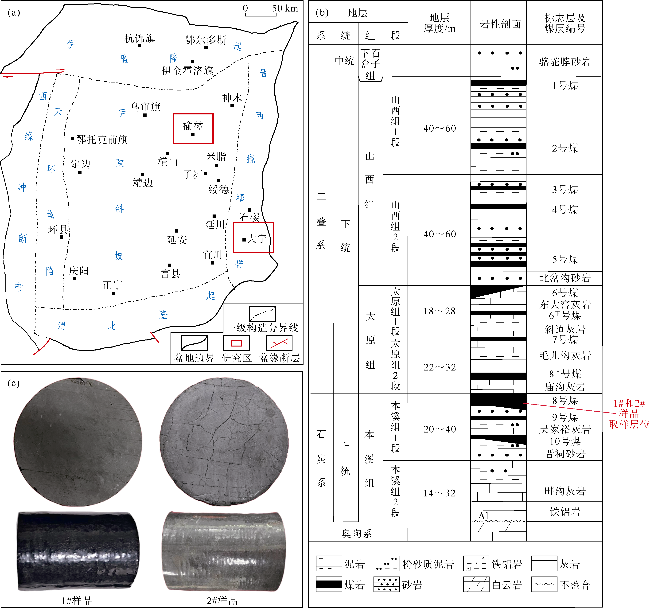
1#和2#样品的基础物性参数和工业分析、显微组分分析结果如表1所示。1#样品和2#样品的孔隙度分别为7.07%和9.19%,渗透率分别为0.006 34×10-3 μm2和1.12×10⁻³ μm2。2#样品的渗透率远高于1#样品,这与在图1c中观察到的2#样品割理/裂缝较为发育相符。1#样品的Ro值为2.61%,属于高阶煤岩,2#样品的Ro值为1.74%,属于中阶煤岩。工业分析结果显示:1#样品的空干基灰分为22.13%,空干基挥发分为7.09%,水分为0.71%,固定碳为70.09%;2#样品的空干基灰分为7.53%,空干基挥发分为13.62%,水分为0.42%,固定碳为78.43%。对于中—高阶煤岩,兰氏体积随着固定碳的增加而增加[45],2#样品的固定碳比1#样品高,表明2#样品相较于1#样品具有更大的吸附气量。1#和2#样品的显微组分都以镜质组为主,其含量分别为84.89%和79.00%;其次为惰质组,含量分别为8.75%和17.40%;壳质组和矿物组含量较低,壳质组含量分别为0%和1.20%,矿物组含量分别为6.36%和2.40%。一般镜质组和惰质组对甲烷的吸附能力要高于壳质组[46],2#样品的镜质组和惰质组含量总和大于1#样品,表明2#样品对甲烷的吸附能力可能高于1#样品。
表1 1#和2#样品的基本物性参数、工业分析结果和显微组分分析结果 |
| 样品 | 井号 | 井深/m | 类型 | Ro/% | 层位 | 长度/cm | 直径/cm | 孔隙度/% | 渗透率/10-3 μm2 | 质量/g | 实验压力/MPa |
|---|---|---|---|---|---|---|---|---|---|---|---|
| 1# | DJ5 | 2 153.45 | 8号煤 | 2.61 | 本溪组 | 12.28 | 9.97 | 7.07 | 0.006 34 | 1 528.99 | 24.09 |
| 2# | YY2 | 2 585.16 | 8号煤 | 1.74 | 本溪组 | 10.51 | 9.92 | 9.19 | 1.120 00 | 1 076.38 | 26.08 |
| 样品 | 工业分析 | 显微组分 | |||||||||
| 水分/% | 灰分 | 挥发分 | 固定碳/% | 镜质组/% | 惰质组/% | 壳质组/% | 矿物组/% | ||||
| 空干基 灰分/% | 干燥基 灰分/% | 空干基 挥发分/% | 干燥基 挥发分/% | 干燥无灰基 挥发分/% | |||||||
| 1# | 0.71 | 22.13 | 22.28 | 7.09 | 7.14 | 9.19 | 70.09 | 84.89 | 8.75 | 0 | 6.36 |
| 2# | 0.42 | 7.53 | 7.56 | 13.62 | 13.68 | 14.80 | 78.43 | 79.00 | 17.40 | 1.20 | 2.40 |
1.2 实验方法
1.2.1 样品预处理
1.2.2 深部煤岩气井全生命周期衰竭开发模拟
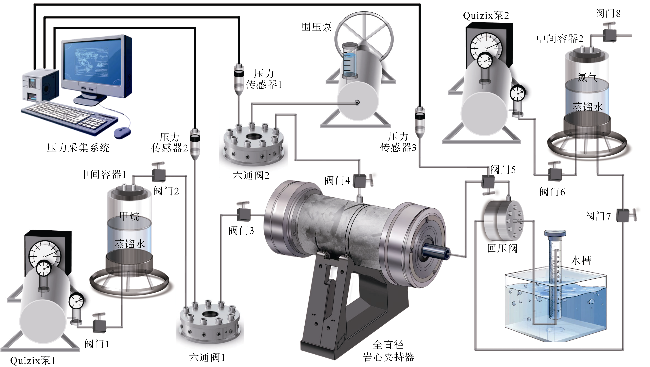
采用自主设计的解吸-扩散-渗流耦合物理模拟实验装置(见图2),实验系统最高压力可达60 MPa。前人室内模拟研究表明,温度对同位素分馏整体规律的影响相对较小[48],为便于与其他多数在室温条件开展的模拟实验结果进行对比分析,本文在25 ℃条件下开展模拟实验。具体实验步骤为:①施加围压。将预处理后的岩心放入全直径岩心夹持器中,打开阀门4,先通过围压泵对岩心施加围压到15 MPa。②甲烷初步饱和。将甲烷气体注入中间容器1,打开阀门1,通过Quizix泵1对中间容器1中的甲烷增压,再打开阀门2和3,关闭阀门5,开始饱和甲烷。③逐渐增压饱和。为避免围压施加过程中有效应力过大导致孔隙闭合,在充入甲烷过程中同步增加围压,使围压与孔隙压力差值始终在15 MPa左右(大吉地区8号煤岩与顶板垂向应力差主体为8~18 MPa[49-50],为了反应实际储层的有效应力情况,本文选取15 MPa作为围压与孔隙压力的差值)。④吸附饱和平衡。饱和甲烷至模拟地层压力(pf)后,采用恒压模式继续饱和5 d以上,然后关闭阀门1和2,观察岩心的出/入口压力,直到压力不再降低,认为充分饱和结束,关闭阀门3,撤掉高压气源,准备开始衰竭开发(1#和2#样品的pf值分别为24.09 MPa和26.08 MPa,1#和2#样品增压饱和分别持续了66 d和23 d)。⑤安装回压阀。通过Quizix泵2对中间容器2的水端加压至ph(ph>pf),同时将岩心夹持器的出口端连接到回压阀顶端,回压阀的出口端连接管线进入水槽,用于计量采集气体。⑥开始衰竭开发。保持围压不变,打开阀门5和7,由于ph>pf,一开始出口端未产出气体,再打开阀门8,降低中间容器2水端压力,当其小于模拟地层压力时,气体开始产出,通过控制阀门8来调整出口端的降压速率。⑦数据监测与样品采集、测试。开发全过程中样品的围压、入口压力和出口压力分别由压力传感器1、2和3连接压力采集系统进行实时连续监测记录,从回压阀出口端产出的气体通过量筒进行连续读数,并定期采用盐水瓶采集气体,进行甲烷碳同位素组成的测试分析。为了减小甲烷在玻璃瓶中储存时由于逸散发生的同位素分馏[51],确保每个气瓶内水的体积占瓶子体积的1/3且一直保持气水倒置,并在采集后的1个月之内完成同位素组成测试。
1.2.3 甲烷碳同位素组成测试
产出气的甲烷碳同位素组成(δ13C1)采用稳定同位素比质谱仪和气相色谱仪进行测试分析,仪器的碳同位素组成测量精度为±0.3‰。采用PoraPLOT Q色谱柱(25 m×0.32 mm×10 μm)以氦气为载气(1.5 mL/min)分离气体成分。气相色谱仪烘箱温度最初设置为50 ℃,保持3 min,然后以15 ℃/min的速度升至150 ℃,并保持2 min。
2 实验结果及分析
2.1 压力递减和产气曲线
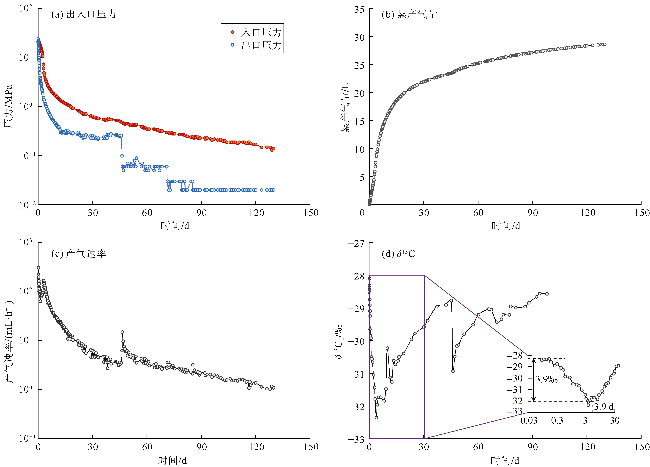
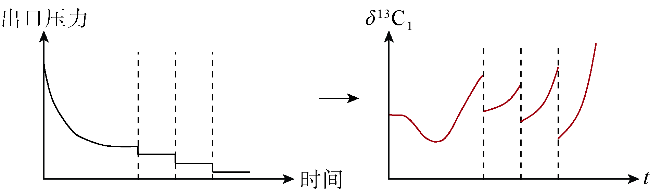
为模拟深部煤岩气衰竭开发模式,1#样品衰竭开发采用了缓慢控压生产方式,出口压力在12.9 d内从24.09 MPa降至0.2 MPa,压降速率为1.85 MPa/d。考虑到回压阀要保持一定的压力,1#样品的出口压力降至0.2 MPa后稳定生产至33 d,然后继续放压式生产。由于样品渗透率较低,入口压力降低的速率远低于出口压力(见图3a)。累产气量和产气速率后期随着出口压力的变化波动较小,截至130 d时,累计产出气量28.63 L,产气速率由306 mL/h降至1.09 mL/h(见图3b、图3c)。监测产出气的δ13C1值在生产初期呈现出明显的“稳定→变轻→变重”的现象,变轻→变重拐点处对应的时间为3.9 d,变轻的分馏幅度为3.9‰。当出口压力突然降低时,δ13C1值出现“快速变轻后继续变重”的现象(见图3d)。
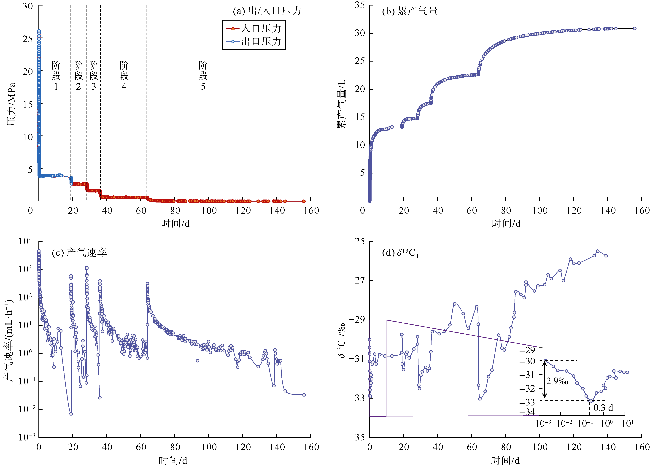
由于2#样品割理/裂缝发育,采用了阶段式逐级控压开采方式:①阶段1为快速降压阶段,出口压力以4 MPa/h的压降速率从初始压力26.08 MPa降低到3.8 MPa(模拟井底压力)之后,以3.8 MPa定压生产;②阶段2降低出口压力至2.5 MPa后定压生产;③阶段3降低出口压力至1.5 MPa后定压生产;④阶段4降低出口压力至0.5 MPa后定压生产;⑤阶段5降低出口压力至大气压后放压生产。由于2#样品的割理/裂缝较为发育、渗透率较高,入口压力和出口压力随着时间增加呈现出几乎相同的下降规律(见图4a)。每个阶段末,随着出口压力的降低,累产气量和产气速率随之增大,截至156 d时,累计产出气量30.84 L,产气速率由4 023.53 mL/h降至0.03 mL/h(见图4b、图4c)。产出气的δ13C1值在生产初期(阶段1)呈现出“变轻→变重”的现象,变轻→变重拐点处对应的时间为0.3 d,变轻的分馏幅度为2.9‰;当出口压力突然降低时,δ13C1值重新变轻之后再变重,且每一次降压都会发生“快速变轻后继续变重”的现象,直到生产后期(阶段5)出口压力恒定为大气压时,δ13C1值变轻后呈现持续变重的特征(见图4d)。
2.2 煤岩气同位素分馏机理
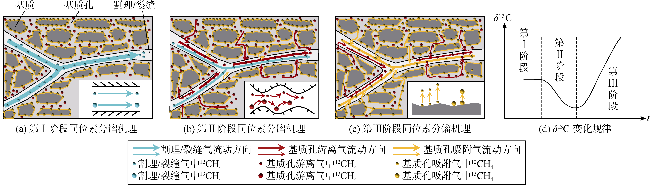
从实验结果可以看出,在出口压力突变前的生产前期,1#样品和2#样品的同位素分馏过程分别观察到了“稳定→变轻→变重”和“变轻→变重”的现象。前人通过开展页岩样品吸附-解析模拟实验发现页岩完整解析过程中甲烷碳同位素普遍存在“稳定→变轻→变重→再变轻”的4阶段分馏特征[23]。结合本文实验现象,提出深部煤岩气产出过程同位素分馏机理和一般模式:①第Ⅰ阶段,δ13C1值处于波动较小的“稳定”阶段,产出气以割理/裂缝气为主,12CH4和13CH4高压差下同步运移,不产生明显分馏(见图5a、图5d);②第Ⅱ阶段,δ13C1值“变轻”,割理/裂缝气和基质气共同产出,其中基质气以游离气为主,基质气优先补给的是扩散速度较快、吸附能力更弱的12CH4,随着基质气的混入导致δ13C1值开始“变轻”(见图5b、图5d);③第Ⅲ阶段,δ13C1值“变重”,产出气以基质孔中的吸附气为主,游离气次之,由于前期12CH4的大量消耗,后期岩心内残余气中13CH4占比增加(含量仍然低于12CH4),使得δ13C1值单调“变重”(见图5c、图5d)。1#样品对应模式中的第Ⅰ—Ⅲ阶段,而2#样品主要对应模式中的第Ⅱ阶段和第Ⅲ阶段,原因在于2#样品的渗透率较高,生产初期产出气为割理/裂缝气和基质气的混合气,故直接进入了第Ⅱ阶段。在相同的实验条件下,2#样品变轻的幅度要低于1#样品(2.9‰<3.9‰),这与2#样品割理/裂缝较为发育有关。与前人页岩解析实验[23]不同的是,本文两块煤岩样品均未出现“再变轻”的第Ⅳ阶段,这可能与样品中干酪根固溶气难以脱附有关。
2.3 基于物质平衡法计算吸附气/游离气量
根据物质平衡方程,对于不考虑吸附气的封闭气藏,视平均压力随着累产游离气量的增加而线性降低:
$G_{\text {free }}=G_{0}\left(1-\frac{p / Z_{\mathrm{g}}}{p_{0} / Z_{0}}\right)$
(1)式中p/Zg为任意时刻的岩心视平均压力,可以由岩心出、入口压力及气体压缩因子计算得到:
$\frac{p}{Z_{\mathrm{g}}}=\sqrt{\left(\frac{p_{\text {in }} / Z_{\text {in }}}{2}\right)^{2}+\left(\frac{p_{\text {out }} / Z_{\text {out }}}{2}\right)^{2}}$
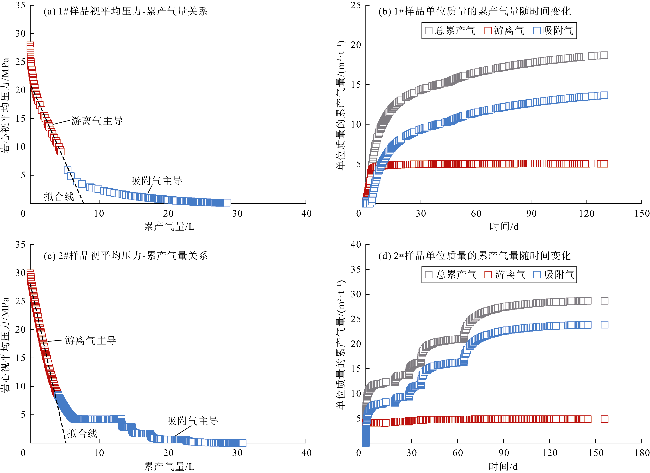
由于生产初期受岩心端面与管线中死体积气体产出影响,一般采用生产一段时间后累产气量和视平均压力的线性段数据进行产出规律分析。在高压段,随着岩心视平均压力的降低,累产气量与岩心视平均压力呈现出良好的线性关系,该阶段游离气占主导;随着岩心视平均压力继续降低,实测累产气量逐渐偏离拟合线(即物质平衡线),任一压力对应的实测累产气量大于物质平衡线对应的累产气量,说明吸附气开始大量解吸(见图7a、图7c)。通过物质平衡线后推可以确定任意时刻的累产游离气量,再用实测总累产气量减去累产游离气量可计算出产出过程中任意时刻累产吸附气量(见图7b、图7d)。1#样品生产130 d时,采用物质平衡法计算累产气量为18.72 m3/t,其中游离气量为5.05 m3/t,吸附气量为13.67 m3/t,游离气产量贡献率为27.0%;2#样品生产156 d时,累产气量为28.66 m3/t,其中游离气量为4.81 m3/t,吸附气量为23.85 m3/t,游离气产量贡献率仅为16.8%。2#样品割理/裂缝发育,实际上游离气量及贡献率应该更高一些,出现上述计算结果的主要原因是物质平衡法是通过监测的岩心入口压力和出口压力计算岩心视平均压力,而在割理/裂缝发育的情况下监测的岩心出/入口压力难以代表岩心内部基质孔隙及割理/裂缝的平均压力,使得物质平衡法计算的吸附气/游离气量存在很大偏差。同时,该方法只能计算有实测累产气量数据部分的游离气量和吸附气量,无法对未来生产过程中吸附气量及其比例进行预测。
3 煤岩裂缝/割理-基质孔耦合的双重介质同位素分馏模型
鉴于物质平衡法的计算偏差,且已有研究表明煤岩气生产过程中的同位素分馏现象与吸附气/游离气的原始赋存状态和产出进程等密切相关,本文考虑利用同位素分馏效应计算深部煤岩气产出过程吸附气/游离气量。Xia等建立了考虑单孔介质中扩散和吸附/解吸耦合的同位素分馏模型[30];Li等建立了考虑时变边界的多尺度孔隙半耦合同位素分馏模型[31];Wang等[32]考虑煤岩内部复杂孔隙结构和流动机理,建立了双分散孔隙结构与多种气体传输机理耦合的同位素分馏模型。由于深部煤岩割理和微孔发育,具有双孔双渗特征,因此本文在前人研究基础上,考虑深部煤岩的双重介质(割理/裂缝系统和基质孔系统)特性和多种气体传输机理耦合,构建适用于表征深部煤岩衰竭开发过程的甲烷碳同位素分馏模型,具体的控制方程组如下:
$\left\{\begin{array}{l} C_{1} \frac{\partial p_{\mathrm{m}}}{\partial t}+B_{1} \frac{\partial p_{\mathrm{m}}^{*}}{\partial t}=\nabla \cdot\left(D_{\mathrm{m}_{-} \text {app }} \nabla p_{\mathrm{m}}\right)-D_{\mathrm{m}} \alpha^{*}\left(p_{\mathrm{m}}-p_{\mathrm{f}}\right) \\ C_{2} \frac{\partial p_{\mathrm{m}}}{\partial t}+B_{2} \frac{\partial p_{\mathrm{m}}^{*}}{\partial t}=\nabla \cdot\left(D_{\mathrm{m}_{-} \text {app }}^{*} \nabla p_{\mathrm{m}}^{*}\right)-D_{\mathrm{m}}^{*} \alpha^{*}\left(p_{\mathrm{m}}^{*}-p_{\mathrm{f}}^{*}\right) \\ \phi_{\mathrm{f}} \frac{\partial p_{\mathrm{f}}}{\partial t}=\nabla \cdot\left(D_{\mathrm{f}} \nabla p_{\mathrm{f}}\right)+D_{\mathrm{m}} \alpha^{*}\left(p_{\mathrm{m}}-p_{\mathrm{f}}\right) \\ \phi_{\mathrm{f}} \frac{\partial p_{\mathrm{f}}^{*}}{\partial t}=\nabla \cdot\left(D_{\mathrm{f}}^{*} \nabla p_{\mathrm{f}}^{*}\right)+D_{\mathrm{m}}^{*} \alpha^{*}\left(p_{\mathrm{m}}^{*}-p_{\mathrm{f}}^{*}\right) \end{array}\right.$
其中$B_{1}=-\frac{\left(1-\phi_{\mathrm{m}_{\mathrm{L} \_ \text {eff }}}\right) c K K^{*} p_{\mathrm{m}}}{\left(1+K p_{\mathrm{m}}+K^{*} p_{\mathrm{m}}^{*}\right)^{2}}$
$\begin{array}{c} C_{1}=\phi_{\mathrm{m}_{-} \text {eff }}+\frac{\left(1-\phi_{\mathrm{m}_{-} \text {eff }}\right) c\left(K+K K^{*} p_{\mathrm{m}}^{*}\right)}{\left(1+K p_{\mathrm{m}}+K^{*} p_{\mathrm{m}}^{*}\right)^{2}} \\ B_{2}=\phi_{\mathrm{m}_{-} \text {eff }}+\frac{\left(1-\phi_{\mathrm{m}_{-} \text {eff }}\right) c\left(K^{*}+K K^{*} p_{\mathrm{m}}\right)}{\left(1+K p_{\mathrm{m}}+K^{*} p_{\mathrm{m}}^{*}\right)^{2}} \\ C_{2}=-\frac{\left(1-\phi_{\mathrm{m}_{\text {eff }}}\right) c K K^{*} p_{\mathrm{m}}^{*}}{\left(1+K p_{\mathrm{m}}+K^{*} p_{\mathrm{m}}^{*}\right)^{2}} \end{array}$
$c=\rho_{\mathrm{s}} V_{\mathrm{L}} Z_{\mathrm{m}} R T / V_{\text {std }} \quad \alpha^{*}=4 N(N+2) / L^{2}$
(3)式中,$D_{\mathrm{m}_{-} \mathrm{app}}$、$D_{\mathrm{m} \_\mathrm{app}}^{*}$分别为基质孔中12CH4和13CH4的表观扩散系数(黏性流、克努森扩散和表面扩散的耦合),$D_{\mathrm{f}}$、$D_{\mathrm{f}}^{*}$分别为割理/裂缝中12CH4和13CH4的扩散系数,ϕm_eff为基质孔的有效孔隙度,其具体计算公式参见文献[32]。
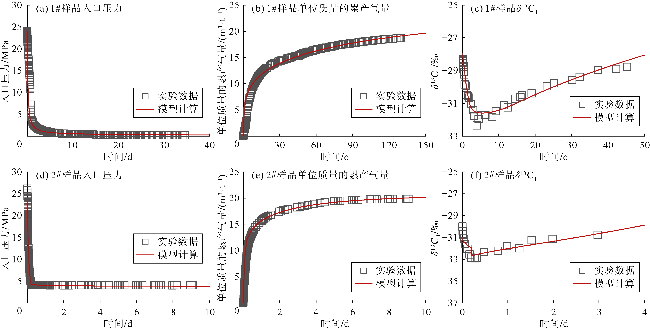
根据表1中的岩心尺寸建立几何模型,将上述方程组导入模型。初始条件设置为:初始压力为p0;边界条件设置为:出口端连接管线处压力等于实验实际监测的出口压力pout。通过COMSOL Multiphysics或MATLAB等软件可对上述模型进行求解,得到岩心内部压力场的时空分布。通过对割理/裂缝和基质孔中的分压($p_{f}$、$p_{\mathrm{f}}^{*}$、$P_{\mathrm{m}}$和$p_{m}^{*}$)进行积分可以计算出入口压力、累产气量和δ13C1值。其中入口压力为:
$p_{\text {in }}=\frac{1}{S} \iint\left[\phi_{\text {m_eff }^{-}}\left(p_{\mathrm{m}}+p_{\mathrm{m}}^{*}\right)+\phi_{\mathrm{f}}\left(p_{\mathrm{f}}+p_{\mathrm{f}}^{*}\right)\right] /\left(\phi_{\mathrm{m}_{-} \text {eff }}+\phi_{\mathrm{f}}\right) \mathrm{d} s$
割理/裂缝中12CH4和13CH4的累产气量、基质孔游离态12CH4和13CH4的累产气量、基质孔吸附态12CH4和13CH4的累产气量以及总的累产气量分别为:
$Q_{\mathrm{f}}(t)=V_{\mathrm{m}} \iiint\left[\frac{\phi_{\mathrm{f}}(0) p_{\mathrm{f}}(0)}{Z_{\mathrm{f}}(0) R T}-\frac{\phi_{\mathrm{f}}(t) p_{\mathrm{f}}(t)}{Z_{\mathrm{f}}(t) R T}\right] \mathrm{d} V$
$Q_{\mathrm{f}}^{*}(t)=V_{\mathrm{m}} \iiint\left[\frac{\phi_{\mathrm{f}}(0) p_{\mathrm{f}}^{*}(0)}{Z_{\mathrm{f}}(0) R T}-\frac{\phi_{\mathrm{f}}(t) p_{\mathrm{f}}^{*}(t)}{Z_{\mathrm{f}}(t) R T}\right] \mathrm{d} V$
$Q_{\mathrm{m} \_ \text {free }}(t)=V_{\mathrm{m}} \iiint\left[\frac{\phi_{\mathrm{m} \_ \text {eff }}(0) p_{\mathrm{m}}(0)}{Z_{\mathrm{m}}(0) R T}-\frac{\phi_{\mathrm{m} \_ \text {eff }}(t) p_{\mathrm{m}}(t)}{Z_{\mathrm{m}}(t) R T}\right] \mathrm{d} V$
$Q_{\mathrm{m} \_ \text {fiee }}^{*}(t)=V_{\mathrm{m}} \iiint\left[\frac{\phi_{\mathrm{m} \_ \text {eff }}(0) p_{\mathrm{m}}^{*}(0)}{Z_{\mathrm{m}}(0) R T}-\frac{\phi_{\mathrm{m} \_ \text {eff }}(t) p_{\mathrm{m}}^{*}(t)}{Z_{\mathrm{m}}(t) R T}\right] \mathrm{d} V$
$\begin{array}{c} Q_{\mathrm{m}_{-} \text {ads }}(t)=\iiint\left\{\rho_{\mathrm{r}} V_{\mathrm{L}} \frac{\left[1-\phi_{\mathrm{m}_{-} \text {eff }}(0)\right] K p_{\mathrm{m}}(0)}{1+K p_{\mathrm{m}}(0)+K^{*} p_{\mathrm{m}}^{*}(0)}-\right. \\ \left.\rho_{\mathrm{r}} V_{\mathrm{L}} \frac{\left[1-\phi_{\mathrm{m}_{-} \text {eff }}(t)\right] K p_{\mathrm{m}}(t)}{1+K p_{\mathrm{m}}(t)+K^{*} p_{\mathrm{m}}^{*}(t)}\right\} \mathrm{d} V \end{array}$
$\begin{array}{c} Q_{\mathrm{m} \_ \text {ads }}^{*}(t)=\iiint\left\{\rho_{\mathrm{r}} V_{\mathrm{L}} \frac{\left[1-\phi_{\mathrm{m} \_ \text {eff }}(0)\right] K^{*} p_{\mathrm{m}}^{*}(0)}{1+K p_{\mathrm{m}}(0)+K^{*} p_{\mathrm{m}}^{*}(0)}-\right. \\ \left.\rho_{\mathrm{r}} V_{\mathrm{L}} \frac{\left[1-\phi_{\mathrm{m} \_ \text {eff }}(t)\right] K^{*} p_{\mathrm{m}}^{*}(t)}{1+K p_{\mathrm{m}}(t)+K^{*} p_{\mathrm{m}}^{*}(t)}\right\} \mathrm{d} V \end{array}$
$\begin{aligned} Q_{\text {total }}(t)= & Q_{\mathrm{f}}(t)+Q_{\mathrm{f}}^{*}(t)+Q_{\mathrm{m} \_ \text {free }}(t)+Q_{\mathrm{m} \_ \text {free }}^{*}(t)+ \\ & Q_{\mathrm{m} \_ \text {ads }}(t)+Q_{\mathrm{m} \_ \text {ads }}^{*}(t) \end{aligned}$
产出气的δ13C1值可按下式计算:
$\delta^{13} \mathrm{C}_{1}(t)=\frac{\frac{\mathrm{d} Q_{\mathrm{f}}^{*}(t)}{\mathrm{d} t}+\frac{\mathrm{d} Q_{\mathrm{m} \_ \text {fiee }}^{*}(t)}{\mathrm{d} t}+\frac{\mathrm{d} Q_{\mathrm{m} \_ \text {ads }}^{*}(t)}{\mathrm{d} t}}{\left[\frac{\mathrm{~d} Q_{\mathrm{f}}(t)}{\mathrm{d} t}+\frac{\mathrm{d} Q_{\mathrm{m} \_ \text {free }}(t)}{\mathrm{d} t}+\frac{\mathrm{d} Q_{\mathrm{m} \_ \text {ads }}(t)}{\mathrm{d} t}\right] R_{\text {std }}}-1$
表2 同位素分馏模型中参数取值 |
| 参数 | 1#样品取值 | 2#样品取值 |
|---|---|---|
| 基质孔平均孔径 | 5.50 nm | 5.16 nm |
| 基质孔初始渗透率 | 5.02×10⁻¹⁹ m2 | 1.52×10⁻¹⁸ m2 |
| 割理/裂缝初始渗透率 | 1.71×10⁻¹⁸ m2 | 1.04×10⁻¹⁵ m2 |
| 初始基质孔隙度 | 1.5% | 1.4% |
| 初始割理/裂缝孔隙度 | 2.31% | 3.75% |
| Langmuir体积 | 22.2 m3/t | 23.6 m3/t |
| Langmuir压力 | 2.31 MPa | 1.82 MPa |
| 初始δ13C1值 | -28.05‰ | -31.04‰ |
| $D_{\mathrm{m}_{-} \mathrm{app}}^{*} / D_{\mathrm{m}_{-} \mathrm{app}}$ | 0.991 | 0.998 |
4 吸附气/游离气产出规律评价
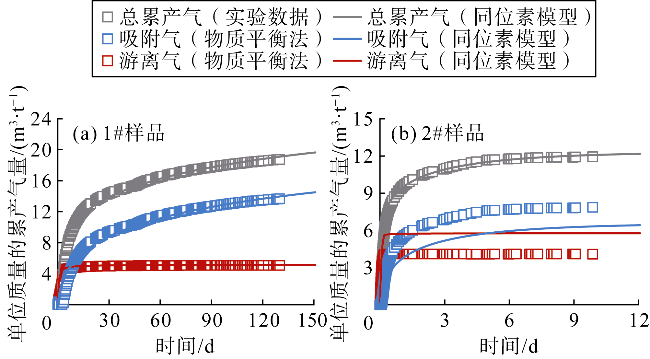
采用同位素分馏模型可计算出深部煤岩气全生命周期衰竭开发过程的吸附气/游离气阶段贡献率和采出程度。吸附气/游离气阶段贡献率指某一阶段吸附气/游离气累产气量与该阶段总累产气量的比值,吸附气/游离气采出程度是指某一时刻吸附气/游离气累产气量与原始总吸附气/游离气量的比值。从图9a可以看出,通过同位素分馏模型计算出的1#样品吸附气/游离气的累产气量与物质平衡法计算结果整体上较为吻合,通过同位素分馏模型计算出的2#样品吸附气/游离气的累产气量与物质平衡法计算结果初期较为吻合,后期物质平衡法计算结果出现偏差,说明同位素分馏模型比物质平衡法准确性高。根据岩心基础物性参数和同位素分馏模型,计算出1#样品的原始含气量为23.9 m3/t,其中原始游离气为5.5 m3/t,原始吸附气为18.4 m3/t,游离气占比23.0%;2#样品的原始含气量为30.7 m3/t,其中原始游离气为9.4 m3/t,原始吸附气为21.3 m3/t,游离气占比30.6%。相较于1#样品,2#样品具有更高的原始游离气量和吸附气量,这和2#样品具有更大的孔隙度和更高的固定碳含量的测试结果相符。
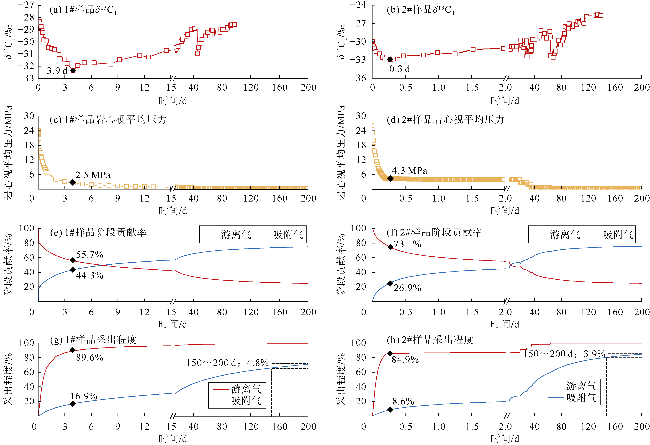
随着气体的产出,岩心内部压力降低,两块样品都呈现出游离气阶段贡献率减小,吸附气阶段贡献率增大的特点。1#样品同位素分馏第Ⅱ、Ⅲ阶段拐点(P2点)在3.9 d左右(见图10a),对应的游离气阶段贡献率为55.7%(见图10e);2#样品的P2点在0.3 d左右(见图10b),对应的游离气阶段贡献率为73.1%(见图10f)。可见两块割理/裂缝发育程度不同的煤岩样品,在同位素分馏的第Ⅱ阶段都表现出以游离气为主的特征(阶段贡献率大于50%)。1#和2#样品在P2点对应的游离气采出程度分别为89.6%和84.9%,吸附气采出程度分别为16.9%和8.6%(见图10g、10h),这表明在深部煤岩气同位素分馏的第Ⅰ、Ⅱ阶段,大部分游离气已产出(采出程度大于80%),而仍有大量的吸附气有待产出,这也是深部煤岩气井生产初期产量高且稳产时间长的原因。生产初期(P2点以前),岩心视平均压力快速降低(见图10c、图10d),吸附气和游离气采出程度显著增大,且游离气采出程度增大速率大于吸附气(见图10g、图10h);生产中后期(P2点以后),压力降低缓慢(见图10c、图10d),游离气采出程度增大速率缓慢且低于吸附气(见图10g、图10h)。通过阶段式逐级控压开采方式有效地增大了吸附气和游离气采出程度,特别是难以动用的吸附气。当压力降低至常压后(150 d后),游离气采出程度接近100%,吸附气动用的难易取决于岩石的解吸能力。虽然2#样品的渗透率要高于1#样品,但在第150 d到第200 d的生产时间内,2#样品的吸附气阶段采出程度(3.9%)要小于1#样品(4.8%)。这是由于相较于1#样品,2#样品具有更高的“镜质组+惰质组”含量和更低的Langmuir压力,前者的两个值分别为93.6%和2.31 MPa,后者的两个值分别为96.4%和1.82 MPa。一般镜质组和惰质组对甲烷的吸附能力要高于壳质组,Langmuir压力越小,岩石的吸附能力也越强。实测的“镜质组+惰质组”含量和历史拟合确定的Langmuir压力都反映出2#样品具有更强的吸附能力,使得生产后期吸附气动用能力要弱于1#样品。
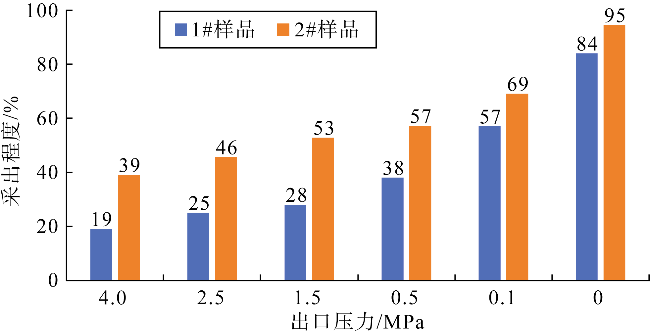
实验结果表明,煤岩产气具有高渗流通道、低供给能力的特征,这与煤岩微孔和割理/裂缝均发育的U型孔隙结构紧密相关。不同割理/裂缝发育程度下鄂尔多斯盆地8号煤岩主体渗透率在(0.01~0.50)×10-3 μm2[2]。但从图11所示的实验结果来看,当实验出口压力降低至4 MPa(接近现场井底压力)时,采出程度较低(1#样品为19%、2#样品为39%);降低至0.1 MPa时,采出程度也分别仅为57%和69%;即使开采到最后,1#样品仍有16%的气体没有被采出,说明煤岩基质内部渗流通道小,解吸和供气速度异常缓慢。与页岩相比,深部煤岩孔径更小、毛管压力更强,在储层含水条件下,气体在解吸后通过微孔渗流时更容易受到毛管阻力,体现在后期存在较长的低产期。本文实验岩心采用干岩心,未考虑水的影响,一旦在渗流通道上叠加水或者压裂液,气体分子更难以突破水相封锁。因此,在生产后期有效提高气体的脱附能力是提高煤岩吸附气采出程度的关键。尽管本文实验较真实地模拟了煤岩气产出过程,但几何尺度与时间跨度的影响可能导致实验的同位素分馏特征(各阶段分馏幅度与持续时间)与实际煤岩气井仍存在差异,未来需结合现场生产监测与数值模拟进一步拓展验证。


5 结论
深部煤岩气产出过程中δ13C1值存在“稳定(Ⅰ)→变轻(Ⅱ)→变重(Ⅲ)”的3阶段同位素分馏特性。边界压力(井底流压)的突然降低会导致δ13C1值趋于前一阶段的气源值,若在第Ⅲ阶段突然降压,δ13C1值会呈现出“快速变轻后继续变重”的特征。
不同于浅部煤层气,深部煤岩气产出具有游离气优先动用、吸附气长期供给的特征。实验中1#样品的原始游离气占比为23.0%,2#样品的原始游离气占比为30.6%。1#和2#样品同位素分馏的第Ⅱ、Ⅲ阶段拐点对应的游离气阶段贡献率分别为55.7%和73.1%,表明同位素分馏的前两阶段累产气以游离气贡献为主。
煤岩储层具有高渗流通道、低供给能力的特征,吸附气高效动用仍然是煤岩气长期稳产的关键。实验中井底压力降低至4 MPa时,采出程度不超过40%,开采结束时1#样品仍有16%的气体没有被采出。对于吸附气为主的煤岩气,如何有效提高吸附气采出程度仍是提高采收率的关键。生产中需要深入研究阶段式控压开采、高压主动解吸(如压裂液吸附置换、注CO2吸附置换、加热)等方式进一步提高煤岩气的采出程度。
符号注释:
c——质量平衡系数,Pa;Df——割理/裂缝中12CH4的扩散系数,m2/s;$D_{\mathrm{f}}^{\mathrm{*}}$——割理/裂缝中13CH4的扩散系数,m2/s;Dm——基质孔中12CH4的扩散系数,m2/s;$D_{\mathrm{m}}^{\mathrm{*}}$——基质孔中13CH4的扩散系数,m2/s;Dm_app——基质孔中12CH4的表观扩散系数,m2/s;$D_{\mathrm{m}_{-} \mathrm{app}}^{*}$——基质孔中13CH4的表观扩散系数,m2/s;G0——岩心总游离气量,m3;Gfree——压力p下对应的游离气量,m3;K——12CH4的Langmuir常数(K=1/pL),Pa-1;K*——13CH4的Langmuir常数,Pa-1;L——割理/裂缝间距,m;N——割理/裂缝的组数(1,2或3);p——任意时刻岩心内平均压力,Pa;p0——初始时刻岩心内平均压力,Pa;pf——割理/裂缝中12CH4的压力,Pa;$p_{\mathrm{f}}^{\mathrm{*}}$——割理/裂缝中13CH4的压力,Pa;pin——任意时刻岩心的入口压力,Pa;pL——Langmuir压力,Pa;pm——基质孔中12CH4的压力,Pa;$p_{\mathrm{m}}^{\mathrm{*}}$——基质孔中13CH4的压力,Pa;pout——任意时刻岩心的出口压力,Pa;Qf——割理/裂缝中12CH4的累产气量,m3;$Q_{\mathrm{f}}^{\mathrm{*}}$——割理/裂缝中13CH4的累产气量,m3;Qm_ads——基质孔吸附态12CH4的累产气量,m3;$Q_{\mathrm{m}_{-} \mathrm{ads}}^{*}$——基质孔吸附态13CH4的累产气量,m3;Qm_free——基质孔游离态12CH4的累产气量,m3;$Q_{\mathrm{m}_{-} \mathrm{free}}^{*}$——基质孔游离态13CH4的累产气量,m3;Qtotal——总的累产气量,m3;R——气体常数,8.314 J/(mol·K);Ro——镜质体反射率,%;Rstd——标样中13CH4与12CH4的物质的量比值,无因次;s——微元面积,m2;S——入口端面积,m2;t——时间,s;T——岩石温度,K;V——体积微元,m3;VL——Langmuir体积,m3/kg;Vm——气体摩尔体积,m3/mol;Vstd——标况下气体摩尔体积,0.022 4 m3/mol;Z0——压力p0对应的气体压缩因子,无因次;Zf——割理/裂缝中的气体压缩因子,无因次;Zg——压力p对应的气体压缩因子,无因次;Zin——压力pin对应的气体压缩因子,无因次;Zm——基质孔中的气体压缩因子,无因次;Zout——压力pout对应的气体压缩因子,无因次;α*——割理/裂缝的特征参数,m-2;ρr——岩石密度,kg/m3;ρs——岩石骨架密度,kg/m3;ϕf——割理/裂缝孔隙度,%;ϕm_eff——基质孔有效孔隙度,%。