

0 引言
前人针对CO2驱替过程中的驱油和埋存机理开展了大量研究,例如侯大力等[14]通过细管实验和数值模拟,研究了低渗透油藏的CO2混相特征、CO2注采参数和埋存规律等;还对比了气态和超临界态CO2驱提高采收率机理和效果,并预测了相应生产制度下的CO2埋存量[15]。张烈辉等[16]开展了CO2-CH4-H2O-NaCl体系的相平衡规律及注CO2提高采收率与封存的数值模拟研究,结果表明注CO2能增压补能、驱替置换残余天然气,提高采收率并实现碳封存。Zhou等[17]研究了油藏非均质性对CO2提高采收率以及地质封存的影响,通过生成热泡沫凝胶体系封堵高渗透层,提高低渗透储层的CO2驱油效率和CO2封存量。陈秀林等[18]利用核磁共振技术探讨了气驱后CO2埋存形态及分布特征,结果表明岩心物性越好,CO2埋存量越大,CO2利用率越高。然而,现有研究并未分析特低渗透油藏CO2驱替过程中CO2埋存的孔隙范围、埋存形式、原油生产和CO2埋存的协同关系,同时也未量化混相程度对原油动用特征及CO2埋存规律的影响。
针对上述问题,以江苏油田特低渗透油藏为例,开展CO2-原油体系长细管驱替实验、CO2注入能力实验和高温高压在线核磁共振岩心驱替实验,分析不同混相程度下CO2驱替过程中的原油赋存状态、油气组分传质特征、原油动用规律等生产特征,明确了CO2驱替过程中混相程度对CO2埋存孔隙范围、埋存特征的影响规律。
1 实验介绍
1.1 实验样品
岩心样品取自江苏特低渗透油田L区块,将岩样切割成直径为25 mm,长度为79 mm的圆柱样品,岩心孔隙度为11%、平均渗透率为7×10⁻³ μm2。每次实验前使用甲苯彻底清洗岩心,并在200 ℃恒温箱中烘干48 h,直至岩心物性恢复为初始状态。取目标区块岩心碾碎并采用筛网筛选粒径为30~100 μm的岩石碎屑,将其导入20 m长盘管中,通过高压氮气吹扫使长盘管内的岩石碎屑压实,得到孔隙度为18%、渗透率为10×10−3 μm2的长盘管。
L区块原始地层压力为30.3 MPa,饱和压力为17.0 MPa,地层温度110 ℃,脱气油密度0.826 g/cm3,气油比94 m3/m3。根据高温高压PVT(压力-容积-温度)实验结果,确定目标油藏的溶解气组分和脱气后原油组分如表1 所示。在储层温度和压力条件下,利用高温高压活油配制装置将脱气原油和溶解气按照目标区块气油比配制地层含气活油。经检验,复配得到的原油样品与原始油藏流体性质相同,满足实验要求。
表1 脱气原油及溶解气组分表 |
| 脱气原油 | 溶解气 | ||
|---|---|---|---|
| 组分 | 物质的量分数/% | 组分 | 物质的量分数/% |
| C1—C5 | 2.35 | CO2 | 0.83 |
| C6—C10 | 29.41 | N2 | 2.04 |
| C11—C20 | 33.75 | CH4 | 74.76 |
| C21—C30 | 27.47 | C2H6 | 10.06 |
| C30+ | 7.02 | C3H8 | 5.74 |
| C4H10 | 3.35 | ||
| C5H12 | 3.22 | ||
对L区块的地层水进行离子浓度测试,其中K++Na+,Ca2+,Mg2+,Cl−,SO42−,HCO32−的质量浓度分别为3 409,10,4,3 892,968,1 169 mg/L。为防止常规水中1H信号干扰核磁共振实验流体信号识别,本研究采用重水(D2O)复配目标区块的地层水。
1.2 CO2-原油体系长细管驱替实验
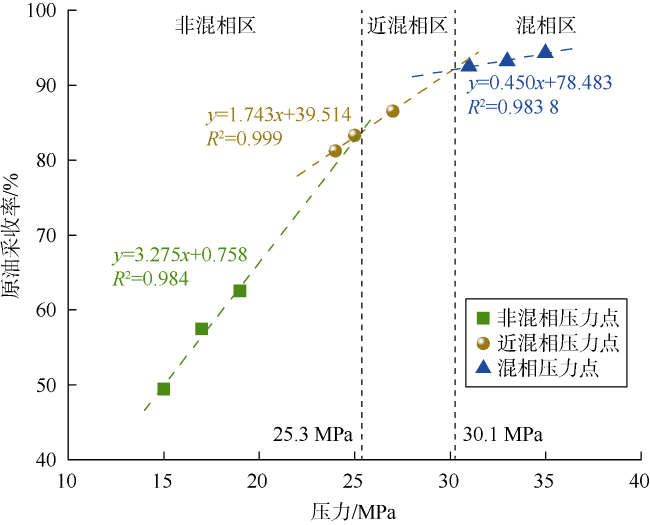
基于配制的含气活油样品采用长盘管开展CO2-原油体系混相程度测试实验,实验按照行业标准《SY/T 6573—2016最低混相压力实验测定方法——细管法》[19]操作,采用多功能岩心驱替系统进行了9组实验压力(15,17,19,24,25,27,31,33,35 MPa)条件下的加密测点细管实验。监测不同压力下不同时刻CO2注入量、气油比、物质的量分数、原油采出量等参数,得到注入压力与原油采收率关系曲线,划分CO2-原油体系的非混相、近混相和混相压力区间,收集产出端产物并进行色谱分析。
1.3 CO2注入能力实验
实验设备主要包括:ISCO高精度恒压泵(美国Corelab公司),压力精度为0.05 MPa,流速精度为0.001 mL/min;高温高压岩心夹持器,压力上限为70 MPa;高精度压力监测系统,压力精度为0.001 MPa;MacroMR12-150H-HTHP大孔径低场核磁共振仪(苏州纽迈分析仪器股份有限公司)。岩心夹持装置的围压液体选用美国3M公司生产的FC-3283氟化液以规避1H氢信号,岩心套管使用耐高压热缩管。
实验步骤:①打开加热系统使整个系统温度升至110 ℃,将清洗过的岩心烘干48 h;②将岩心放入夹持器内抽真空,通过石油醚调节系统压力至饱和压力之上;③向岩心转注2 PV(孔隙体积)活油,确保岩心孔隙充分饱和活油;④以恒定流速0.01 mL/min注入CO2,监测注入过程中上游压力的变化,计算进出口端压差,结合注入指数公式(见(1)式)评估CO2注入能力[20];⑤调整实验压力至22,26,30,35 MPa,重复步骤①—④;⑥将驱替介质换成水,重复步骤①—⑤,比较CO2和水的注入能力差异。
$I=\frac{Q}{A\Delta p}$
1.4 在线核磁共振驱替实验
核磁共振在线监测的CO2驱替实验是评估CO2提高采收率、原油动用特征和CO2埋存潜力的关键手段。采用恒速压汞实验校正高温高压核磁共振在线监测系统,开展不同油气混相程度下的CO2驱替实验。
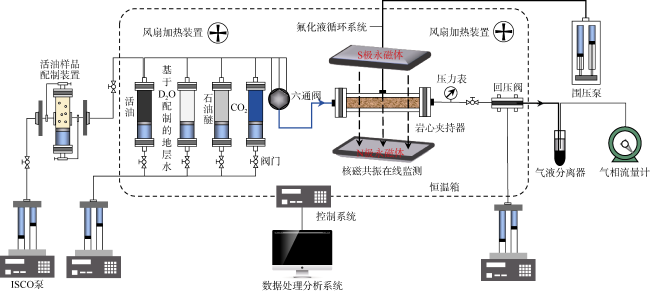
实验装置如图1 所示,实验步骤包括:①将清洗过的岩心使用热缩管固定在高温高压在线核磁共振分析仪的夹持装置上,系统加热至110 ℃,将岩心抽真空,通过石油醚提升系统压力至饱和压力之上;②以0.05 mL/min的速度缓慢向岩心注入基于D2O配制的地层水,而后向岩心中饱和含气活油,待产出端活油的气油比恒定为94 m3/m3时视为岩心饱和流体完成,扫描此时核磁T2图谱及三维图像;③打开岩心夹持器入口端,将CO2注入压力分别设置为混相、近混相、非混相条件下的油气体系压力,通过氟化液循环系统施加围压至3 MPa以上,而后恒速0.10 mL/min向岩心中注入1.2 PV CO2,待稳定后扫描此时的核磁T2图谱及三维图像,收集产出端产物。
2 结果与讨论
2.1 CO2-原油体系混相程度表征
细管实验9组注入压力与原油采收率的拟合曲线如图2 所示,据此划分出CO2-原油体系非混相、近混相和混相阶段的压力区间。随着混相程度的增加,原油采收率不断增加。非混相区的原油采收率随注入压力的增加呈线性变化,在25.3 MPa处出现拐点并持续缓慢增长,直至到达第3阶段的拐点30.1 MPa后进入混相区。结合笔者前期研究[13]和细管实验结果,江苏油田L区块的最小混相压力为30.1 MPa,近混相压力区间为25.3~30.1 MPa,非混相压力的上限值为25.3 MPa。
2.2 混相程度对CO2驱油生产特征的影响
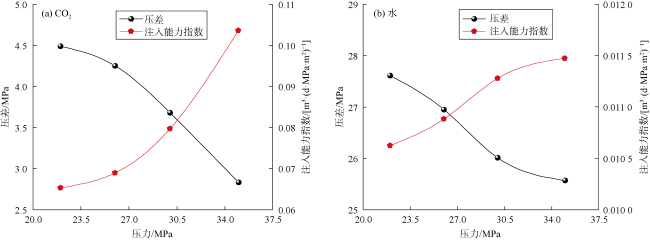
CO2注入能力是评价超低渗透油藏开发方式可行性和参数优化的重要依据,基于注入能力指数公式评估目标区块在不同压力条件下CO2和水的注入能力差异。由图3 所示,在非混相压力条件下(22 MPa),CO2和水的注入能力指数分别为0.065 3和0.010 6 m3/(d·MPa·m2)。由于CO2相较于水压缩性更强、在原油中的溶解量更大,对原油物性的改善程度显著,因此随着混相程度的增加,CO2的注入能力指数呈指数型递增,而水的注入能力指数呈先缓慢增加然后逐步平缓的趋势。当体系压力达到最小混相压力时,油气界面张力为零,消除了毛管压力,使得CO2注入能力显著提升。不同压力条件下CO2的注入能力指数是水的6.16~9.03倍,说明CO2是目标特低渗透储层的理想注入介质。
根据气油比和原油采收率特征将CO2驱油过程划分为3个主要阶段:CO2顶替阶段、CO2突破阶段和气窜后CO2抽提阶段,混相驱、近混相驱及非混相驱不同驱油阶段对应的CO2注入量如图4a 和图4b 所示。顶替阶段气油比维持原始状态,油气界面稳定推移,原油采出程度随着CO2注入量呈近似线性增加;CO2突破时,气油比攀升,原油采出程度增幅下降;气窜后CO2抽提阶段气油比急剧增加,原油采出程度缓慢增加直至平稳,CO2与原油之间的组分传质逐渐成为CO2突破后提高采收率的主要机制。提高混相程度能够提高CO2驱原油采收率和产油速度,室内实验中CO2混相驱采收率为79%,比近混相驱和非混相驱分别提高了11.7,18.0个百分点。由于非混相驱中CO2的黏性指进作用[21⇓-23],气窜形成较早,CO2混相驱见气时对应的注入量分别比非混相和近混相驱多0.20 PV和0.07 PV。由此可知,混相程度的增加提高了油气前缘带运移的稳定性,生产初期的CO2顶替阶段更长,波及效率更高。
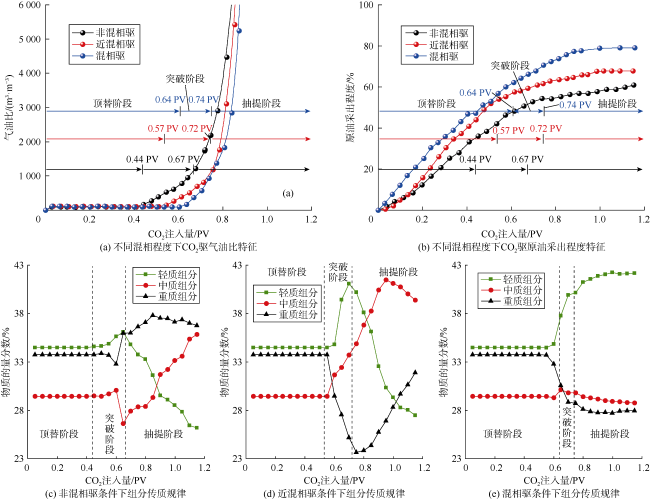
初始原油中轻质组分(C1—11)、中质组分(C12—20)和重质组分(C21+)物质的量分数分别为35.3%,29.4%,34.5%,CO2的物质的量分数为0.8%。通过色谱法分析产出物的组分构成(见图4c —图4e )。CO2的溶解、降黏和原油膨胀能力会随着压力的增大而提高,由于CO2顶替阶段的原油组分无明显变化,该阶段主要依赖CO2降黏改质作用和原油的膨胀效应提高采收率。非混相驱CO2突破后,由于CO2抽提、萃取作用较弱[24],开发结束时产出物的中、重质组分占比之和达73.8%,轻质组分含量随着CO2注入呈现下降趋势(见图4c );当体系压力上升至近混相驱条件时,CO2突破前期产出物以轻、中质组分为主,CO2抽提阶段产出物中的重质组分含量比非混相驱下降了4.9个百分点(见图4d );混相驱CO2突破后产出物中轻质组分含量随着CO2注入量增加而升高至42.2%,中质组分含量呈小幅度下降趋势,而重质组分含量由于流体运移能力最弱,CO2突破后其组分含量下降了6.0个百分点(见图4e )。因此,CO2与原油之间的组分传质逐渐成为CO2突破后提高采收率的主要机制。
2.3 不同混相程度下CO2驱过程中原油动用特征
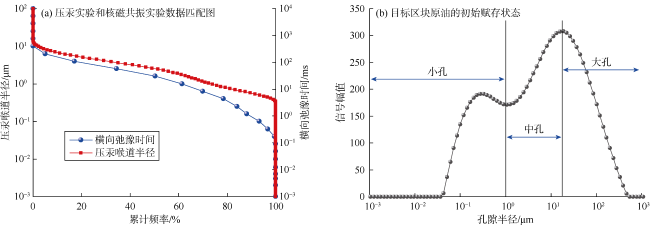
对目标区块岩样进行恒速压汞实验测试,结果显示汞饱和度较高时存在较长平缓阶段,中值压力为1.36 MPa,最大进汞饱和度为85%,排驱压力为0.17 MPa,退汞效率低;岩样孔隙半径中值为0.54 μm,孔隙结构分布较为均匀,连通性较好。
核磁共振的横向弛豫时间T2与岩石的表面弛豫率有关[28],即:
$\frac{1}{{{T}_{2}}}={{\left( \frac{1}{{{T}_{2}}} \right)}_{S}}+{{\left( \frac{1}{{{T}_{2}}} \right)}_{B}}+{{\left( \frac{1}{{{T}_{2}}} \right)}_{D}}$
${{T}_{2}}=\frac{{{r}_{c}}^{n}}{\rho {{F}_{n}}}$
因此,横向弛豫时间与孔隙半径的关系用下式表示:
${{r}_{c}}=C{{T}_{2}}^{\frac{1}{n}}$
根据压汞实验和核磁共振实验结果,孔隙半径与横向弛豫时间的累计频率分布曲线如图5a 所示;结合(4)式进一步计算得到C为0.002,n为0.648,按照此结果对核磁共振实验得到的T2谱进行标定。依据T2图谱左右峰及封顶趋势,依次将孔隙分为小孔(小于1 μm)、中孔(1~18 μm)和大孔(大于18 μm),则目标区块小孔、中孔和大孔内原油占比分别为28.8%,37.2%和34.0%(见图5b )。
不同混相程度下CO2驱过程中的核磁共振在线监测结果如图6 所示。由于CO2优先进入阻力较小的大孔隙并与原油接触[31],因此岩心大孔隙中的原油被优先采出。随着CO2的持续注入,孔隙动用下限降低,中孔内原油动用程度逐步增加。在CO2驱替后期,小孔内原油成为主要开发对象。此外,由于CO2分子直径小于目标油藏的主要纳米孔喉直径,使得CO2沿渗流通道裹挟部分原油轻质组分进入纳米孔隙。由于纳米级孔喉存在启动压力和较大的毛管阻力,该部分原油成为较难动用的剩余油。因此,原油在CO2驱替过程中的动用规律大致可分为3个阶段:①驱替前期,大孔隙内原油动用程度最高;②驱替中期,中孔隙内原油成为增油主力;③驱替后期,小孔隙内原油动用程度增加,CO2裹挟部分被抽提的原油流入更小孔隙。基于CO2驱替实验前后的核磁信号幅值变化,可以得到不同尺寸孔隙中原油采收率,非混相、近混相、混相驱条件下,大孔隙内原油采收率分别为33.7%,35.3%,33.4%,中孔采收率分别为20.5%,23.4%,26.0%,小孔采收率分别为15.1%,17.2%,17.2%。

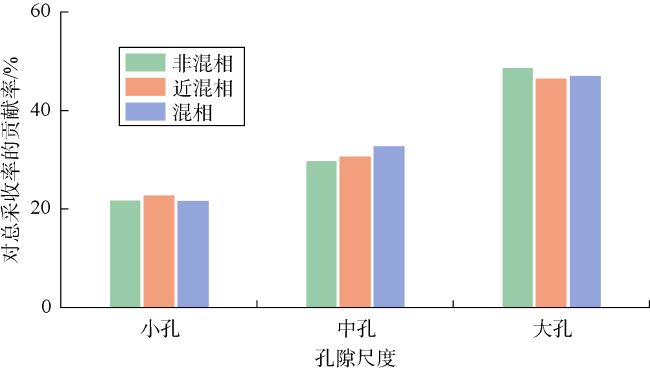
随着混相程度的提高,大孔和中孔的原油动用程度提高,而小孔内原油由于渗流阻力较大及部分原油进入纳米级孔隙,导致动用程度低。通过累计信号幅值变化计算总原油采收率(见图6b 、图6d 、图6f ),当驱替压力由22 MPa升至26 MPa时,油气体系由非混相驱向近混相驱过渡,原油采收率由60.9%增至67.8%,提升了6.9个百分点,动用孔隙半径下限由5.7 nm降低至4.8 nm。当驱替压力升高至35 MPa时,原油与CO2之间的界面张力消失,且CO2分子动能增大,原油采收率升至79.0%,动用孔隙半径下限降至2.4 nm,极大提升了原油的动用能力。由图7 可知,不同混相程度下大孔隙为CO2驱增油的主力区,对原油采收率的贡献率均达46%以上;中孔为增油接替区,贡献率均为30%以上。因此,随着压力水平的升高,对大、中孔隙内原油的动用更为明显,而小孔隙内原油动用难度高,提压界限应依据大、中孔隙的动用极限来调整,而非小孔内原油动用程度。
2.4 CO2驱过程中的埋存机理
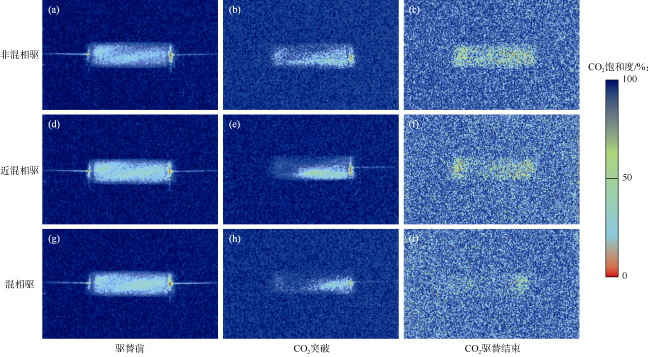
CO2在地层中的埋存方式主要包括构造埋存、溶解埋存、束缚埋存和矿化埋存[32]。其中,矿化埋存通常在几十年甚至上百年后趋于稳定[33]。由于目标油藏地层水中钙镁离子质量浓度均小于10 mg/L,且受实验时间限制,矿化埋存量可以忽略。在本研究中,构造埋存和溶解埋存统一为游离态埋存,CO2运移至小孔隙中视为束缚埋存。CO2驱后期,生产井溢出大量CO2导致埋存率和换油率骤降,考虑目标油田现场CO2驱的关井条件,核磁共振岩心驱替实验在产出端气油比达到2 000 m3/m3时结束。如图8 所示,非混相驱条件下CO2主要置换岩心上层位置的原油,并以游离态的形式埋存在产出原油的孔隙内。随着混相程度的提高,CO2前缘推进更稳定,波及范围更广,相同条件下CO2埋存范围更大,CO2受浮力作用减弱且在垂向上逐渐趋于均匀分布,缓解了埋存过程中CO2重力超覆作用导致的盖层泄漏风险。
对不同CO2埋存阶段的T2信号幅值进行累计求和,结合(5)式计算CO2埋存率,对驱替过程中CO2的埋存潜力进行分析:
${{S}_{C{{O}_{2}}}}=\frac{{{V}_{\text{i}}}-{{V}_{\text{p}}}_{\text{ }\!\!~\!\!\text{ }}}{{{V}_{\text{i}}}}\times 100%$
为了方便比较,将不同混相程度下CO2驱替过程中的CO2注入量、CO2产出量归一到标准状况下(0.1 MPa,25 ℃)进行分析。由图9 可知,混相驱CO2泄漏(注入量0.74 PV)前的埋存率高于近混相驱和非混相驱,CO2气窜后随着气油比增大,CO2埋存率急剧降低;混相驱相比近混相驱和非混相驱的累计埋存量分别提高0.64 mL和0.91 mL。

由图10 可知,3个埋存过程中CO2完全埋存阶段对整体埋存量贡献最大,非混相、近混相和混相条件下该阶段CO2埋存量占比分别为47%、64%和71%。该阶段游离态CO2在大孔隙中的埋存量占比最大,中孔的埋存量占比次之。
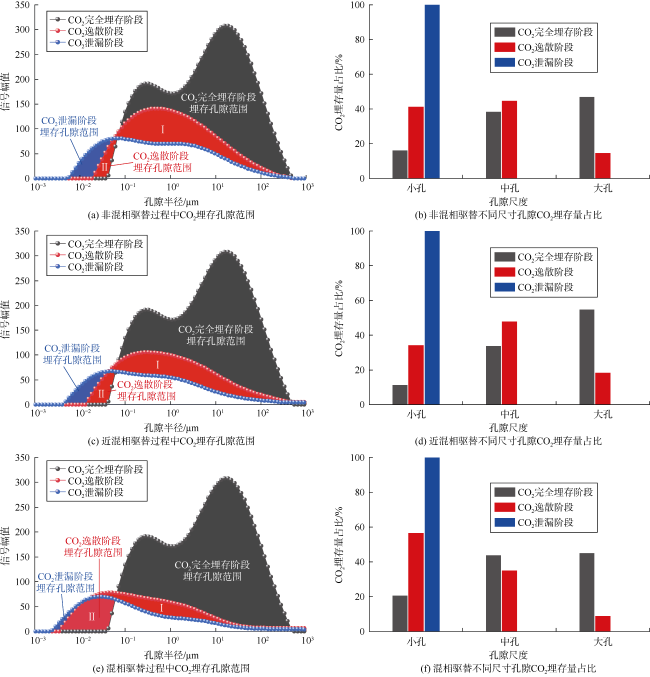


CO2逸散阶段部分原油的赋存孔隙范围未发生显著变化,且混相程度越高,CO2完全埋存阶段剩余未被封存的孔隙空间越小,因此该部分CO2埋存量随着混相程度的提高而降低(图10 中红色Ⅰ部分)。另一部分原油的轻质组分被CO2气体裹挟流动,进入原始饱和原油条件下不含油的更小级别的孔隙中,束缚埋存量增加。由于压力水平越高,CO2的分子动能和蒸发抽提作用越强,导致混相条件下该部分CO2束缚埋存量相比近混相和非混相条件均有所提高(图10 中红色Ⅱ部分)。因此,逸散阶段持续注入CO2将引发两种埋存机理:①CO2在压差的驱动力下继续置换顶替阶段的剩余油,仅实现部分原油初始赋存孔隙范围的原位埋存;②CO2的蒸发抽提作用携带部分轻质组分进入尺度更小的孔喉中,孔隙尺寸越小,其引发的空间限域效应作用越强,促进了埋存的稳定性。
由于混相程度越高,CO2逸散阶段的微纳米级尺寸的剩余埋存空间越小,因此泄漏阶段CO2埋存量随混相程度增加而降低,近混相和非混相条件下的CO2埋存量相比混相条件有所提高。由于该阶段CO2沿着气窜优势通道大量排出,CO2在同级别孔隙内的原位埋存并不显著,表现为CO2裹挟原油流入更小尺寸孔隙。
综上所述,原油生产过程和CO2埋存过程中,如果储层中的气窜通道已经形成,继续注入CO2会导致大量CO2沿优势通道窜流而出,整体埋存率持续下降。此时应封堵储层中优势通道,改善CO2的流动路径,使得CO2向储层深处横纵向运移,扩大CO2波及效率。因此,基于产出井的气油比变化特征等参数,判别CO2埋存阶段,采取相应关井、调剖、封堵气窜通道等方式,可以增加CO2的埋存率和封存量。
3 结论
将CO2驱油过程分为CO2顶替阶段、CO2突破阶段和气窜后CO2抽提阶段,驱替前期主要通过CO2的溶解和降黏作用提高原油的膨胀势能,CO2突破后以置换、萃取原油中的轻质组分为主要机制提高采收率,本文实验条件下,混相驱CO2突破后产出流体的轻质组分含量增至42.2%。
在CO2驱过程中,大孔隙中的原油被优先采出,本文实验条件下大孔隙内原油对总体采收率贡献率达46%以上;随着CO2的持续注入,中孔内原油成为增油主力;CO2突破后,小孔隙内原油被少量动用,部分抽提后的原油被CO2裹挟进入纳米级孔隙。
随着混相程度的提高,CO2前缘推进更稳定,波及范围更广,相同条件下CO2埋存范围和埋存量更大,CO2受浮力作用的影响减弱,在垂向上分布更均匀,缓解了实际埋存过程中CO2重力超覆作用导致的盖层泄漏风险。CO2完全埋存阶段对整体埋存量贡献最大;CO2逸散阶段埋存机理为部分原油初始赋存孔隙范围的原位埋存和CO2裹挟原油进入更小孔隙从而增大埋存量;CO2泄漏阶段CO2随原油产出而大量泄漏,CO2埋存率急剧降低。因此,基于产出井的气油比变化特征等参数,判别CO2埋存阶段,采取相应的关井、调剖、封堵气窜通道等方式,可以增加CO2的埋存率和封存量。
符号注释:
A——岩心横截面积,m2;C——T2与孔隙半径之间的孔径转换系数,μm/ms;Fn——几何形状因子,无因次;I——注入能力指数,m3/(d·MPa·m2);n——幂指数,无因次;Δp——实验进出口端压差,MPa;Q——注入速度,m3/d;rc——孔隙半径,μm;${{S}_{C{{O}_{2}}}}$——CO2埋存率,%;T2——弛豫时间,ms;Vi——CO2注入体积,cm3;Vp——CO2产出体积,cm3;ρ——表面弛豫率,μm/s。下标:S——表面弛豫;B——体积弛豫;D——扩散弛豫。