

0 引言
目前,数据挖掘和人工智能技术逐步渗透各工业领域并取得显著成果,为数字化转型中的传统石油行业带来新机遇[10⇓-12];现阶段在石油领域的应用包括地质模型参数化[13-14]、地球科学建模[15-16]、流体特性预测[17]、油井产量预测[18-19]、甜点检测[20]以及页岩气采收率计算等[21-22]。其中,深度学习[23]凭借其强大的非线性建模能力,自动学习和提取输入数据中的抽象特征,实现更复杂的映射和表征,为自动历史拟合[24-25]和生产优化[26⇓⇓⇓-30]提供了构建油藏动态预测代理模型的新方法。Zhu等[31]构建了量化地质不确定性的贝叶斯深度卷积神经网络;Tripathy等[32]开发了单相流正演模拟代理模型;Laloy等[33]利用生成对抗网络(GAN)建立了单相流正演模拟代理模型,其中高维投影通过训练两个对抗性神经网络来确定;Wang等[34]在理论指导下提出预测二维多孔介质中单相流的神经网络;Zhong等[35-36]基于GAN建立模拟储层压力和流体饱和度的代理模型;Ma等[37-38]结合卷积神经网络(CNN)和长短期记忆网络(LSTM)预测生产数据,减少模型基于图像的额外计算量;Jin等[39]在未考虑地质不确定性的条件下,提出嵌入控制(E2C)框架以预测不同井控条件下二维异质储层的油井响应和动态演化;Wei等[40]基于实际油田数据利用ConvLSTM模型预测了不同生产时刻的含油饱和度和井底压力分布;Zhang等[41]采用矢量型特征和高维空间型参数作为CNN输入预测压力和含油饱和度;Huang等[42]构建了考虑不同井控条件的真实3D油藏快速模拟的深度学习代理模型,但未充分考虑生产时间的不确定性。
与传统油藏动态预测方法相比,深度学习能够更好地描述复杂映射,并有效表征油藏动态模拟的时空特征。实际开发中,长期注水会导致储层物性变化,需周期性调整生产方案。然而,现有深度学习代理模型未充分考虑油藏动态演化中的地质条件和井控不确定性,通常基于静态地质模型,在固定井控条件下预测特定时刻的油藏动态,无法预测随时间变化的井控条件(简称时变井控)和不确定地质条件下的油藏动态。因此,本文提出在流形空间中定义油藏动态预测问题,充分考虑地质不确定性和时变井控条件下油藏动态的时空变化特征,构建基于条件演化生成对抗网络(CE-GAN)的油藏动态预测代理模型,用于快速预测时变井控下的油藏动态。
1 油藏动态预测代理模型的定义
传统油藏开发过程中,通过数值模拟解决多孔介质中油水两相渗流问题,模拟地下油水流动,得到不同生产时刻的流体及压力分布特征,进而预测油藏生产动态。本研究开发了一种基于深度学习的代理模型,无需进行复杂历史拟合就能够实现油藏动态的预测。根据文献[43]的描述,油藏动态预测代理模型用(1)式所示的正向模型来表示。
$F(X,C,\Lambda,\xi )$
本文提出的油藏动态预测代理模型旨在以经济且非侵入性的方式替代传统数值模拟器。从生成式建模角度研究油藏动态预测问题,将实际油藏动态值组成的矩阵作为油藏动态图(例如,饱和度图就是饱和度分布数据的矩阵,其中每个元素都具有物理意义),将油藏动态预测转化为时变井控下的油藏动态图回归问题。代理模型通过学习油藏的初始状态与任意后续时刻油藏状态之间的非线性关系,有效预测油藏动态变化。当油藏模型中网格个数为nb,t时刻的油藏动态表示为压力与含油饱和度的集合${{x}_{t}}=$ $\left\{ \text{(}{{p}_{t}},{{S}_{t}})\left| {{p}_{t}}\in {{\mathbb{R}}^{{{n}_{b}}}},{{S}_{t}}\in {{\mathbb{R}}^{{{n}_{b}}}} \right. \right\}$时,油藏动态预测代理模型定义为(2)式所示的回归模型。
${{x}_{t+1}}=\hat{f}\left( {{x}_{t}},\Lambda,{{\mathbf{c}}_{t}},\mathbf{\xi };\gamma \right)$
2 油藏动态预测代理模型的构建
2.1 基于CE-GAN的油藏动态预测代理模型
本文基于条件演化生成对抗网络(CE-GAN,见图1 )构建油藏动态预测代理模型,定义时变井控下的油藏动态图位于一个高维流形空间中,代理模型基于储层物性和井控参数对油藏动态图的空间变化进行表征,从而研究油藏动态图随生产时间的演化规律。将油藏动态预测问题转化为基于渗透率分布、初始油藏动态和时变井控的图像演化问题,实现时变井控条件下油藏动态的快速准确预测。
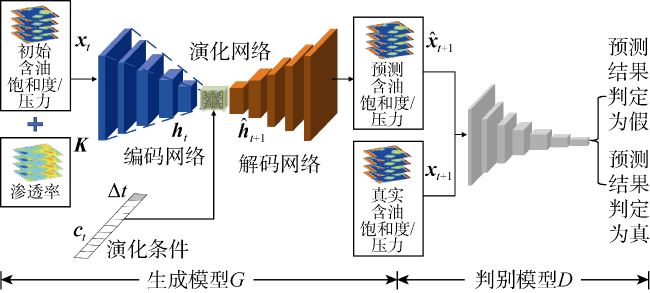
CE-GAN在条件生成对抗网络的基础上,结合特征空间条件演化使原来无法控制方向的生成网络实现定向演化,CE-GAN通过生成模型G与判别模型D的对抗学习优化模型参数,构建灵活的油藏动态预测代理模型。生成模型G使用卷积自编码网络作为主干,编码层与解码层之间引入井控(即油水井的生产制度)和生产时间作为演化条件,实现油藏动态的潜在变量演化,最终通过解码网络将演化得到的潜在变量解码成油藏动态预测图。因此,生成模型G由编码网络(Genc,ϕ),演化网络(Gevo,ψ)和解码网络(Gdec,θ)3部分组成。
①编码网络:在地质不确定性约束下将油藏动态图映射到潜在变量。编码网络的输入为初始(t时刻)油藏动态图xt和渗透率图K($K\in {{\mathbb{R}}^{{{n}_{b}}}}$),输出为低维潜在变量ht(${{h}_{t}}\in {{\mathbb{R}}^{{{n}_{h}}}}$),计算过程如下:
${{h}_{t}}=G_{enc, \phi }^{{}}\left( {{x}_{t}},K \right)$
②演化网络:实现井控与生产时间约束下的潜在变量演化。演化网络以潜在变量ht作为输入,在井控${{\mathbf{c}}_{t}}\in {{\mathbb{R}}^{{{n}_{w}}}}$和生产时间∆t的约束下,预测并输出t+1时刻对应的潜在变量预测值${{\hat{h}}_{t+1}}$(${{\hat{h}}_{t+1}}\in {{\mathbb{R}}^{{{n}_{h}}}}$),计算过程如下:
${{\hat{h}}_{t+1}}=G_{evo,\psi }^{{}}\left( {{h}_{t}},{{\mathbf{c}}_{t}},\Delta t \right)$
③解码网络:将演化得到的潜在变量恢复为预测的油藏动态图。解码网络的输入为演化网络预测得到的潜在变量${{\hat{h}}_{t+1}}$,输出为t+1时刻的油藏动态图${{\hat{x}}_{t+1}}$,计算过程如下:
${{\hat{x}}_{t+1}}=G_{dec,\theta }^{{}}\left( {{{\hat{h}}}_{t+1}} \right)$
此外,训练卷积神经网络作为判别模型D,将数据失配损失和物理约束损失相结合,与生成模型G进行对抗性训练,学习预测油藏动态和真实油藏动态之间的差异,优化油藏动态代理模型的预测能力,使其生成更逼真的油藏动态图。
2.1.1 生成模型框架
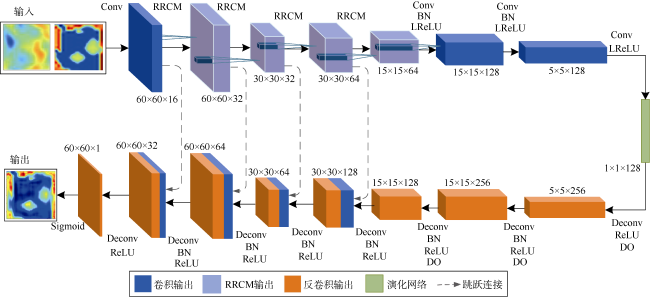
生成模型网络结构如图2 所示,生成模型的输入包括生产时间、渗透率/压力、初始油藏动态以及井控条件,输出任意时刻井控条件下的油藏动态预测值。编码网络中第1层为一个3×3卷积计算,2至5层是4个循环残差卷积模块(RRCM),每个循环残差卷积模块由1×1卷积、3×3卷积和ReLU(线性整流函数)激活层组成,其余3层是3个标准卷积模块(Conv),每个标准卷积模块由3×3卷积、批归一化(BN)和LReLU(带泄露的线性整流函数)激活层组成,其中最后1个卷积模块不应用批归一化。解码网络包括8个反卷积模块(Deconv),每个模块均包含3×3反卷积和ReLU激活层,前3个反卷积模块中应用随机失活(DO),除第1个和最后1个反卷积模块外其他模块皆采用批归一化,解码网络最后经Sigmoid激活层输出油藏动态预测值。部分编码层和解码层之间增加了注意力门限跳跃连接,进行不同尺度的特征传递。编码网络与解码网络间通过演化网络连接。
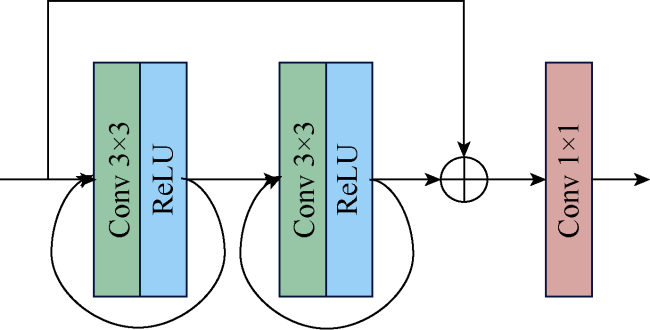
编码网络中引入循环残差卷积模块,可以增强卷积层的特征传递和复用能力。循环残差卷积模块如图3 所示,包括多个带有ReLU激活函数的循环卷积模块。利用循环卷积模块从输入的油藏动态图中提取低级特征信息,将这些特征与输入的油藏动态图或浅层编码层得到的油藏动态图特征进行残差连接,合并得到多尺度油藏动态图高级特征,随后将其输入1×1卷积层进行特征压缩。循环残差卷积模块能够有效解决由多个卷积操作造成的特征信息和网络参数残余等问题,从而增强特征传递,有效利用各层输出特征图,提升生成模型对油藏动态图的特征提取能力。
另外,考虑到预测过程中输出油藏动态对输入油藏动态的依赖性,注意力门限跳跃连接可以提升输入油藏动态图的特征信息权重。如图2 所示,编码网络的前4层和解码网络的后4层之间使用门限跳跃连接操作进行图像特征信息融合,把对应尺度上的输入油藏动态图特征信息引入解码过程中,为油藏动态的模拟提供多尺度、多层次的融合特征,由此得到更精准的油藏动态预测效果。
2.1.2 演化网络
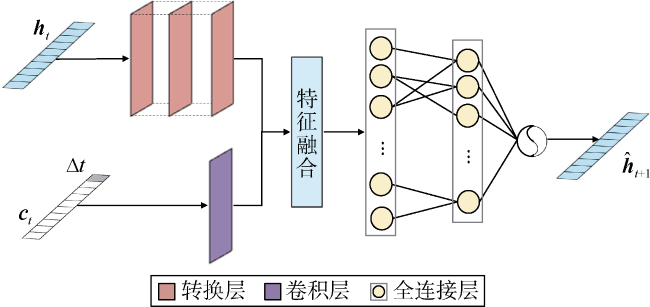
演化网络以时变井控作为控制条件实现潜在变量演化(见图4 )。演化网络由两个分支组成,第1分支作为潜在变量ht的特征提取器,由3个转换层堆栈组成一维卷积神经网络,3个转换层采用1×5卷积,卷积核分别为32,64,128,步幅为3,卷积层后采用BatchNorm进行归一化和ReLU函数进行激活;第2分支以注采井控(即注入井注入量和生产井产液量)和生产时间作为输入,与一维卷积神经网络学习的特征进行融合,融合后的特征向量被馈送到全连接网络,预测得到t+1时刻的潜在变量${{\hat{h}}_{t+1}}$。
2.1.3 判别模型框架
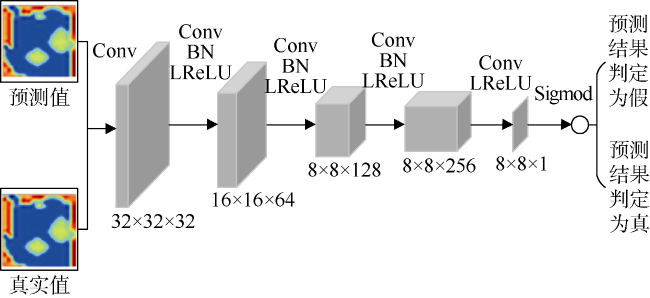
判别模型需要标记预测油藏动态的真伪。因此,可以将判别模型D看作一个可以进行特征提取和线性分类的二元分类器。判别模型由包含5个卷积层的卷积神经网络构成(见图5 ),每层卷积核大小为3×3,前3层步长为2,后2层步长为1,且前4层卷积核个数依次为32,64,128及256,批归一化应用于2至4层中,除第1层外其他层皆采用LReLU激活函数,以避免神经元死亡问题。判别模型的输入是生成模型产生的模拟油藏动态图和真实油藏动态图,输出采用Sigmod函数进行概率分析,并将判别结果归一化:输出0到1,0表示完全假,1表示完全真;最后取输出矩阵的均值表征模拟油藏动态与真实油藏动态的相似程度。
2.2 考虑物理约束的损失函数
与传统生成对抗网络一样,CE-GAN的训练采用交替对抗训练法,该方法通过判别模型与生成模型的交替学习来优化模型参数。本文针对CE-GAN中的油藏动态编码网络、潜在变量演化网络以及油藏动态解码网络,分别计算模型的重构损失(Lr)、演化损失(Le)和预测损失(Lp),它们是CE-GAN中生成模型损失函数的主要组成部分,计算公式如(6)—(8)式:
${{L}_{\text{r}}}=\left\| {{x}_{t}}-{{{\hat{x}}}_{t}} \right\|_{2}^{2}=\left\| {{x}_{t}}-G_{\text{dec},\theta }^{\text{ }}\left( {{h}_{t}} \right) \right\|_{2}^{2}=\left\| {{x}_{t}}-G_{dec,\theta }^{{}}\left[ G_{enc,\phi }^{{}}\left( {{x}_{t}},K \right) \right] \right\|_{2}^{2}$
${{L}_{\text{e}}}=\left\| {{h}_{t+1}}-{{{\hat{h}}}_{t+1}} \right\|_{2}^{2}=\left\| G_{enc,\theta }^{{}}\left( {{x}_{t+1}} \right)-G_{evo,\psi }^{{}}\left( {{h}_{t}},{{\mathbf{c}}_{t+1}},\Delta t \right) \right\|_{2}^{2}=\left\| G_{enc,\theta }^{{}}\left( {{x}_{t+1}} \right)-G_{evo,\psi }^{{}}\left[ G_{enc,\phi }^{{}}\left( {{x}_{t}} \right),{{\mathbf{c}}_{t+1}},\Delta t \right] \right\|_{2}^{2}$
${{L}_{p}}=\left\| {{x}_{t+1}}-{{{\hat{x}}}_{t+1}} \right\|_{2}^{2}=\left\| {{x}_{t+1}}-G_{\operatorname{dec},\theta }^{{}}\left( {{{\hat{h}}}_{t+1}} \right) \right\|_{2}^{2}=\left\| {{x}_{t+1}}-G_{\operatorname{dec},\theta }^{{}}\left\{ G_{evo,\psi }^{{}}\left[ G_{enc,\phi }^{{}}\left( {{x}_{t}},K \right),{{\mathbf{c}}_{t}},\Delta t \right] \right\} \right\|_{2}^{2}$
此外,判别模型D用于区分真实数据与生成模型G的模拟数据,G和D在一个两方极小极大博弈中竞争。判别模型D的损失函数为LD:
${{L}_{D}}=-E\left[ \lg D(x) \right]-E\left\{ \lg \left[ 1-D\left( G_{\text{dec},\theta }^{\text{ }}({{{\hat{h}}}_{t}}) \right) \right] \right\}$
假设Dn(x)为D第n层的隐含表示,生成模型使用平均特征匹配目标,该模型的对抗损失为:
${{L}_{a\text{dv}}}=\frac{1}{2}\left\| E\left[ {{D}_{n}}\left( x \right) \right]-E\left\{ {{D}_{n}}\left[ G_{\text{dec},\theta }^{\text{ }}\left( {{{\hat{h}}}_{t}} \right) \right] \right\} \right\|_{2}^{2}$
本文还引入基于物理约束的损失函数,即同时考虑重构油藏动态和预测油藏动态最小化通量的不一致性,定义每个生产井的流动物理损失:
${{L}_{\text{phy }}}=\left\| \left( q_{\text{w}, t}^{{}}-{{{\hat{q}}}_{\text{w}, t}} \right)+\left( {{q}_{\text{w}, t+1}}-{{{\hat{q}}}_{\text{w}, t+1}} \right) \right\|_{2}^{2}$
位于网格块j的生产井流量值采用Peaceman模型进行计算[44]:
${{\left( {{{\hat{q}}}_{l}} \right)}_{j}}=\frac{2\pi {{K}_{j}}{{K}_{r,l}}\left( {{S}_{w,}}_{j} \right)}{{{\mu }_{l}}}\ln \frac{{{r}_{w}}}{{{r}_{o}}}d\left( {{p}_{j}}-{{p}_{w}} \right)$
其中
${{r}_{o}}=0.28\frac{\sqrt{\frac{{{K}_{y}}}{{{K}_{x}}}\Delta {{y}^{2}}+\frac{{{K}_{x}}}{{{K}_{y}}}\Delta {{x}^{2}}}}{\sqrt[4]{{{\left( \frac{{{K}_{y}}}{{{K}_{x}}} \right)}^{4}}+{{\left( \frac{{{K}_{x}}}{{{K}_{y}}} \right)}^{4}}}}$
当Kx=Ky时,上式可简化为:
${{r}_{o}}=0.14\sqrt{(\Delta {{x}^{2}}+\Delta {{y}^{2}})}$
生成模型G的损失函数如(13)式所示。CE-GAN的损失函数包括生成模型的损失LG和判别模型的损失LD。
${{L}_{G}}=\lambda {{L}_{\text{phy}}}+{{\lambda }_{1}}{{L}_{\text{a}dv}}+{{\lambda }_{2}}{{L}_{\text{r}}}+{{\lambda }_{3}}{{L}_{\text{e}}}+{{\lambda }_{4}}{{L}_{\text{p}}}$
3 基础油藏模型性能
3.1 数据集准备
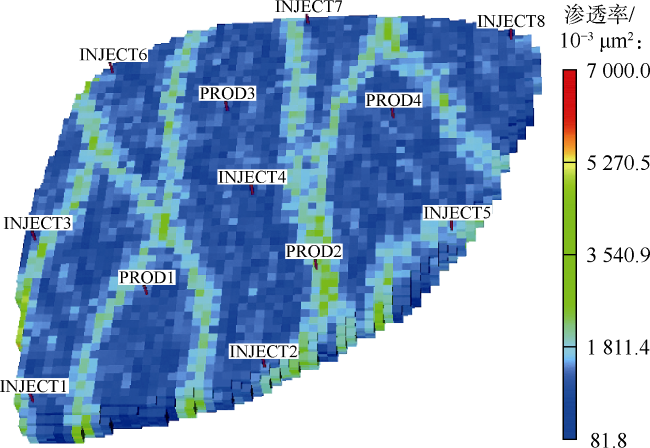
采用经典的Egg模型评估本文提出的油藏动态预测代理模型的性能。该模型的网格总数为60×60×7,其中有效网格为18 533个,网格大小8 m×8 m×4 m。该模型共有12口井,其中8口为注水井,采用定流量注入方式,另外4口为生产井,采用定液量生产方式(见图6 )。该模型的对数渗透率方差为0.17,x,y,z方向的相关长度分别为240,240,20 m,有关该模型的更多详细信息参阅文献[45]。
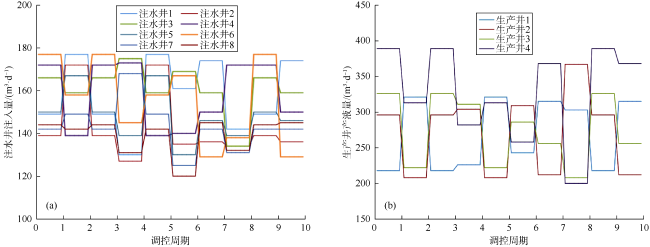
Egg确定性模型和随机模型共有100个不同的渗透率集合,与其他储层和流体属性一起构成本文的基础油藏模型,对基础油藏模型生成相应的生产井和注水井工作制度,模拟生产5年,测试集和训练集的模拟时间相同。在模拟过程中,通过调节随时间变化的注入量和产液量分别控制注水井和生产井;每半年改变一次井控策略,共10个控制周期,每个控制周期结束后保存油藏动态图。初始渗透率图、初始油藏动态图以及各控制周期的油藏动态输出图、油水井工作制度组合为一组样本。
油、水井控制设计方法如下:生产井产液量控制在200~400 m3/d,注水井注入量控制在120~180 m3/d,均为连续型变量。注水井先在140~160 m3/d的均匀分布中随机抽样得到基线注水速率qb,从[−20 m3/d,20 m3/d]中均匀采样随机扰动Δq,每个控制步添加Δq得到注水井注入量为qb+Δq。生产井不存在控制基线,每个控制步中生产井在200~400 m3/d随机采样,避免了注水速率不参考基线值时可能发生的平均效应,从而使含油饱和度具有更广泛的分布。注水井和生产井的控制方案如图7 所示,每组渗透率执行10次模拟,控制注采比为1.00~1.12以保持总注入速率和产液速率之间的平衡。随机选择80%的样本训练神经网络,20%的样本测试模型性能。
3.2 神经网络设计
本文模型输入图像具有纵向维度,对应不同地层,模型输入数据大小为60×60×7。训练样本总数为800个(即100×10个训练对的80%),损失函数的权重系数λ=0.01,λ1=1,λ2=λ4=0.2,λ3=0.1,模型重要参数的设置如表1 所示。所有网络模型均使用Adam优化器进行训练,且每10个epoch(周期)进行一次衰减,衰减系数为0.05。
表1 CE-GAN重要参数设置表 |
| 参数 | 参数值 |
|---|---|
| 生成模型编码后潜在变量维度 | 128 |
| 演化网络全连接层隐层维度 | [64, 128] |
| 判别模型全连接层隐层维度 | 64 |
| 生成模型和判别模型的学习率 | [5×10⁻⁴, 1×10⁻³] |
| 批处理数量 | 64 |
由于训练效果对训练样本的预处理方式敏感,需要分别选择合理的压力和含油饱和度数据预处理方式。对于压力数据,首先从每个时间步的集合中减去该步骤对应的所有数据样本的平均值,然后在训练前将得到的压力残差线性缩放到[−1,1];训练后先对数据进行反归一化处理,然后加上平均值,以获得原始域中的压力预测值。含油饱和度数据预处理采用残差学习方法[46],为了避免相邻步骤之间的含油饱和度太相似而无法学习,将训练目标设定为含油饱和度变化${{S}_{o,t+1}}-{{S}_{o, t}}$;训练后将预测的含油饱和度残差添加到${{S}_{o, t}}$上,生成所需的输出${{S}_{o,t+1}}$。
3.2.1 模型性能评价指标
在模型测试过程中,除评估预测结果与数值模拟结果间的数值误差外,采用结构相似指数(SSIM)[47](见(14)式)检查本文提出的CE-GAN预测结果与数值模拟结果之间的图像感知差异。SSIM取值范围为[−1,1],值越高表示相似程度越高。
$SSIM\left( u,v \right)=\frac{\left( 2{{\mu }_{u}}{{\mu }_{v}}+{{c}_{1}} \right)\left( 2{{\sigma }_{uv}}+{{c}_{2}} \right)}{\left( \mu _{u}^{2}+\mu _{v}^{2}+{{c}_{1}} \right)\left( \sigma _{u}^{2}+\sigma _{v}^{2}+{{c}_{2}} \right)}$
3.2.2 时间和井控数据处理
大多数代理模型在设计时没有充分考虑时间序列的影响,只能预测样本集覆盖时间范围内固定时刻的生产动态,降低了模型的实用性。在实际应用中,油水井的生产制度总是随开发时间的推进而变化,因此本文提出的模型考虑时变井控的影响,将生产时间和井控数据以一维数据的形式作为油藏动态的演化控制条件,作用在油藏动态编码后的潜在特征上。
除该方法外,也可以将时间和井控通过维度扩展转化为二维矩阵,作为补充信息与模型的输入数据一起参与训练。将每个样本数据中的时间t扩展成与输入数据相同大小的矩阵,矩阵中每个元素都用t表示;而扩展后的井控数据矩阵中,油水井位置的元素为对应时间点油水井产液量或注水量,其他位置为0。
3.3 模型性能分析
3.3.1 模型训练和性能测试
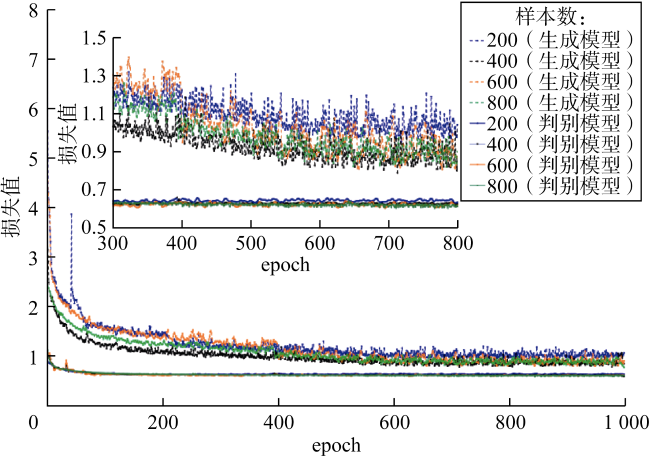
为了测试CE-GAN在不同训练数据量下的学习能力,分别采用200,400,600,800个训练样本训练CE-GAN代理模型。图8 显示了不同训练样本数下CE-GAN训练损失值与epoch的关系,所有CE-GAN代理模型都在配备NVIDIA GeForce GTX 3080 GPU的节点上训练,共训练1 000个epoch。由图可以看出,生成模型和判别模型的损失值经过600个epoch后均趋于稳定。从300~800个epoch对应的损失函数放大图看出,最终生成模型损失值收敛到0.85~1.06,判别模型损失值收敛到0.65。相比于生成模型,判别模型的结构更简单,因此其收敛速度更快。
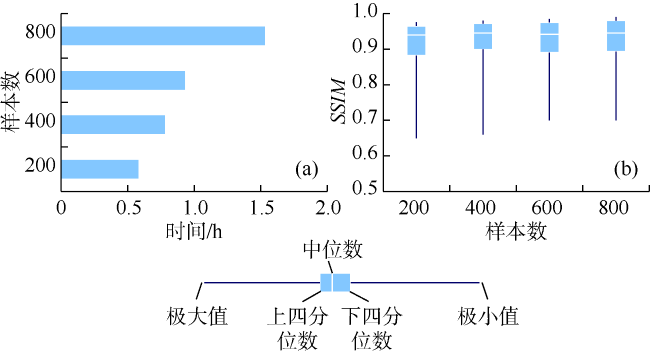
3.3.2 损失函数改进效果
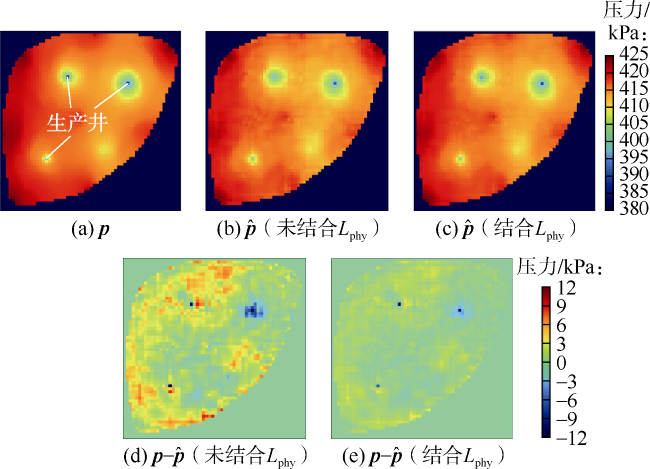
对结合基于物理约束的损失函数的模型开展消融实验。与数值模拟计算的压力相比较(见图10a ),未结合物理约束损失的CE-GAN代理模型预测的压力分布(见图10b )虽然在视觉上与其相似,但是从压力残差图中可以看出(见图10d ),CE-GAN代理模型的预测结果并不平滑,尤其在近井区域出现了较大误差,可能对实际应用产生重大影响。结合流动物理损失的CE-GAN代理模型的压力预测结果如图10c 所示,该预测结果与数值模拟结果间的残差最大值(见图10e )与图10d 相比从9 kPa降低到3 kPa。因此,结合流动物理损失的CE-GAN代理模型预测结果准确性和平滑性都得到了显著改善,可以避免不符合物理意义的局部极值,使得CE-GAN具备良好的数据回归和流动特征表征能力。
3.3.3 时间和井控数据处理分析
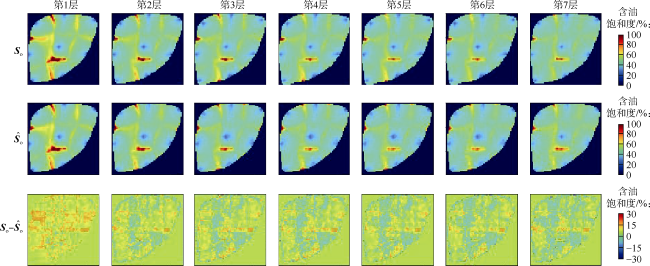
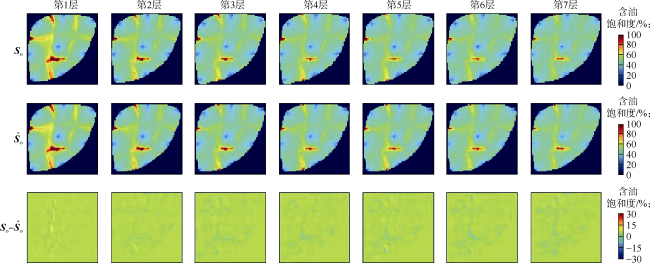
通过对比预测结果的残差,发现相比于将时间和井控数据作为前端输入,采用特征插入方式预测的残差图存在较少噪声,预测精度更高,模型预测结果与数值模拟结果吻合较好。这是因为特征插入的方式能够避免编码过程中模型对有效特征的提取能力下降,并降低训练的复杂性。
3.3.4 模型时间域泛化性
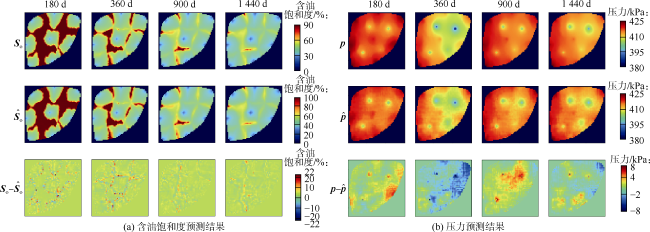
模型训练完成后,为了验证CE-GAN对时变井控的处理能力,进行模型时间域泛化性分析。图13a 和图13b 分别展示了CE-GAN和数值模拟的含油饱和度与压力计算结果,图中1—4列代表4个不同预测时间点,1—3行分别展示数值模拟的计算结果、CE-GAN代理模型的预测结果以及二者之间的残差。从图中可以观察到数值模拟计算的含油饱和度与CE-GAN预测的含油饱和度之间表现出很强的相似性,较大的含油饱和度残差出现在注水前缘附近,含油饱和度相对残差$\left( \frac{{{\left\| {{S}_{o}}-{{{\hat{S}}}_{o}} \right\|}_{1}}}{{{\left\| {{S}_{o}} \right\|}_{1}}}\times 100\% \right)$的中位数为7%,残差最大值(约15%)出现在360 d的预测结果中;数值模拟计算的压力与CE-GAN预测的压力基本一致,压力相对残差$\left( \frac{{{\left\| p-\hat{p} \right\|}_{1}}}{{{\left\| p \right\|}_{1}}}\times 100\% \right)$的中位数和最大值分别为0.4%和2.0%。
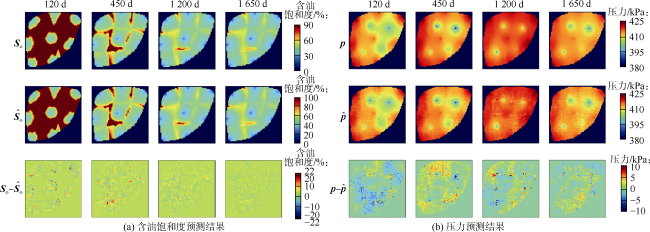
上述案例中,CE-GAN代理模型采用的样本集覆盖的时间点包括180,360,540,720,900,1 080,1 260,1 440,1 520,1 800 d。在实际应用中,代理模型需要预测随时间不断变化的油藏动态,因此随机选择样本数据覆盖时间外的4个时间点(120,450,1 200,1 650 d)以检查模型的时间域泛化性能。图14a 和图14b 分别展示了4个时间点对应的CE-GAN代理模型和数值模拟计算的含油饱和度与压力分布,可以看出CE-GAN对于训练样本覆盖时间范围之外的油藏动态仍呈现出良好的预测效果。含油饱和度相对残差的中位数和最大值分别约9%和16%,压力相对残差的中位数和最大值分别为0.5%和3.0%。
因此,本文提出的模型能够有效处理时变井控方案,并准确预测油藏动态随时间变化的趋势。尽管CE-GAN代理模型需要借助数值模拟构建样本数据,但其出色的时间域泛化能力保证了模型良好的预测性能。针对地质特征相似且输入参数(如渗透率分布、井控等)的变化范围接近训练样本集的油藏,可以通过油藏动态代理模型迁移实现油藏动态预测。
3.3.5 模型计算效率
将数值模拟计算时间与CE-GAN代理模型构建和预测的总时间进行比较,数值模拟完成每次模拟预测大约需要310 s;由于CE-GAN代理模型训练数据的准备借助于数值模拟,因此在前600次模拟中,数值模拟和CE-GAN花费的时间相同(186 000 s)。CE-GAN的训练大约需要3 380 s,相当于11次数值模拟运行。但值得注意的是,一旦训练完成,CE-GAN代理模型可以在2 s内获得不同时间和不同渗透率分布条件下的含油饱和度和压力预测结果,而数值模拟仍然需要310 s才能运行下一次模拟,CE-GAN代理模型实现了近160倍的计算速度提升。
虽然CE-GAN代理模型需要数百次模拟进行样本数据的准备,降低了CE-GAN的单次计算效率,但深度学习的优势在于其优越的泛化能力。对于需要多次数值模拟的问题,CE-GAN表现出优异的预测性能,即相较于数值模拟,采用本文提出的CE-GAN代理模型进行历史拟合和生产优化更高效。
4 实际油藏模型验证
将CE-GAN代理模型应用到大庆油田某区块的油藏模拟中,以10口注水井和14口生产井作为研究对象,渗透率和井位分布如图15 所示。油藏模型共包含501 768个(101×69×72)网格单元,其中活动网格数量为389 088。
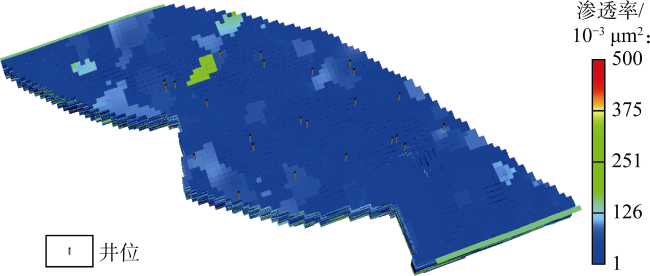
模拟时间从2008年6月到2018年12月,每半年进行一次井控方案调整,总计20个注采调控周期。采用基线值和采样扰动的设计方式,注水井基线注水速率为0~226 m3/d,采样扰动取−25~25 m3/d。共执行200组注采井控模拟方案,其中160组用于训练,40组用于测试。所有网络模型均使用Adam优化器进行训练,除生成模型学习率为1×10−4外,其余参数与表1 参数设置相同。
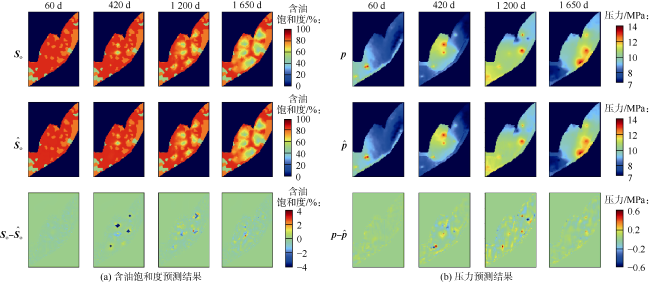
将2008年6月1日的含油饱和度和压力作为输入,预测未来10年二者的变化情况,图16 显示了油藏生产60,420,1 200,1 650 d时第8层含油饱和度和压力的预测结果。其中,第1行是数值模拟的计算结果,第2行是CE-GAN代理模型计算结果,第3行是两种计算结果之间的残差。压力和含油饱和度相对残差的中位数均为4%,证明本文提出的CE-GAN代理模型能够准确预测油藏动态。


最后,比较了数值模拟和CE-GAN代理模型计算的时间成本。对200组测试数据进行数值模拟,每次模拟运行约1 920 s。CE-GAN训练需要约60 556 s,用时相当于运行31次数值模拟。训练完成的CE-GAN代理模型计算40组测试数据大约需要272 s,单次预测平均时间为6.8 s,CE-GAN代理模型显著提升了计算效率,其速度相比之前提高了近280倍。因此,生产优化过程中如果需要模拟的算例数量大于231个,应选用CE-GAN代理模型模拟油气藏在真实环境下的开发行为,便于开展可重复的、高效率的开发方案设计、测算、优选与优化。
5 结论
本研究创新性地提出了一种基于条件演化生成对抗网络(CE-GAN)的油藏动态预测代理模型,在流形空间中定义油藏动态预测问题,并将其转化为图像到图像的回归问题。该代理模型以渗透率分布、初始油藏动态和时变井控作为输入,其中生产时间被视为网络的额外输入,提升了模型的时间泛化性;同时,在对抗训练中引入一种结合回归损失和物理损失的训练策略,使模型能够更好地逼近油藏动态的不连续分布,最终实现了对时变井控下油藏动态的快速预测。
经过基础油藏模型和实际油藏模型的性能检验,基于CE-GAN的油藏动态预测代理模型能够同时考虑储层的非均质性和井控变化对油藏动态的影响,成功预测了时变井控下水驱开发油藏压力和含油饱和度的近似值。此外,该模型能够准确描述任意时间的油藏动态,尽管深度学习中样本集的准备需要较长时间,但模型的预测效率比传统数值模拟高出约两个数量级,可以代替数值模拟处理历史拟合和生产优化等计算密集型任务。
符号注释:
ct——所有网格在t时刻的油藏动态演化条件;c1,c2——常数;C——强制项;d——网格高度,m;Dn(x)——D模型第n层的隐含表示;E——期望函数;$\hat{f}()$——油藏动态预测代理模型;F( )——模型算子;Gdec,θ——解码网络,θ表示解码网络的模型参数;Genc,ϕ——编码网络,ϕ为编码网络的模型参数;Gevo,ψ——演化网络,ψ表示演化网络的模型参数;ht——xt编码得到的t时刻的潜在变量;ht+1——xt+1编码得到的t+1时刻的潜在变量;${{\hat{h}}_{t+1}}$——ht演化得到的t+1时刻的潜在变量;K——渗透率,m2;Kj——网格块j的渗透率,m2;${{K}_{r,l}}\left( {{S}_{w,j}} \right)$——网格块j在含水饱和度Sw下l相的相对渗透率,无因次;Kx,Ky——x,y方向的渗透率,m2;Ladv——生成模型G的对抗损失;Le——演化损失;LD——判别模型D的损失值;LG——生成模型G的损失值;Lp——预测损失;Lphy——物理约束损失;Lr——重构损失;nb——网格个数;nh——潜在变量的维度;nw——井数;$\hat{p}$——CE-GAN代理模型预测的压力,Pa;pj——网格块j的网格压力,Pa;pt——所有网格在t时刻的压力,Pa;pw——井底流压,Pa;Δq——注水速率随机扰动,m3/d;qb——基线注水速率,m3/d;${{\left( {{{\hat{q}}}_{l}} \right)}_{j}}$——网格块j的l相流量值,m3/s;qw,t——t时刻实际监测井流量值,m3/d;$\hat{q}_{\text{w},t}^{{}}$——t时刻CE-GAN代理模型预测井流量值,m3/d;ro——等效半径,m;rw——井筒半径,m;${{\mathbb{R}}^{{{n}_{b}}}}$,${{\mathbb{R}}^{{{n}_{h}}}}$,${{\mathbb{R}}^{{{n}_{w}}}}$——实数域上的nb,nh,nw维向量空间;SSIM——结构相似指数,无因次;${{\hat{S}}_{\text{o}}}$——CE-GAN代理模型预测的含油饱和度,%;${{S}_{o, t}}$——t时刻的含油饱和度,%;St——所有网格在t时刻的含油饱和度,%;Sw,j——网格块j的含水饱和度,%;t——时间,d;∆t——生产时间,d;x,y,z——油藏的3个方向;Δx——网格长度,m;xt,xt+1——所有网格在t时刻和t+1时刻的油藏动态集合;${{\hat{x}}_{t}}$——未经过潜在变量演化得到的重构状态;${{\hat{x}}_{t+1}}$——${{\hat{h}}_{t+1}}$经过潜在变量解码得到的t+1时刻的油藏动态预测图;X——油藏动态;Δy——网格宽度,m;γ——网络参数;ξ——边界和初始条件;λ——流动物理损失调节权重,无因次;λ1——对抗损失调节权重,无因次;λ2——重构损失调节权重,无因次;λ3——演化损失调节权重,无因次;λ4——预测损失调节权重,无因次;μl——流体l的黏度,Pa·s;μu,μv——图像u和v的均值;σu,σv——图像u和v的方差;σuv——图像u和v的协方差;Λ——地质模型参数。