

0 引言
中国页岩气资源量丰富,历经10多年发展,已成为世界第3个实现页岩气商业化开发的国家[1]。当前页岩气开采主要集中在3 500 m以浅的中浅层,深层页岩气开采依然处于起步阶段,存在大量技术难题[2]。井壁失稳是制约页岩气高效开发的关键问题之一,页岩属于典型的钻井高风险地层,卡钻、埋钻等井下复杂事故频发,增加了钻井成本与后期作业难度。页岩水化与层理发育是造成页岩井壁失稳的主要诱因。针对页岩层理特征,Jaeger[3]提出的单一弱面准则被广泛用于表征页岩力学性质;闫传梁等[4]阐明了层理与井眼的空间位置与井壁稳定性的相关性;基于横观各向同性理论,Gupta等[5]明确了层理对井周应力的影响规律。围绕页岩水化,众多学者借助CT扫描、核磁共振、扫描电镜等手段,观测到了水化裂纹的扩展过程,明确了损伤的演化规律[6⇓-8],在此基础上,三轴、直剪等力学实验被用于分析水化作用对页岩力学特征的影响[9⇓-11];结合各向异性与水化损伤,Dokhani等[12]构建了页岩井壁稳定力-化耦合模型,得到了广泛应用。围绕页岩井壁失稳,目前取得了丰富的研究成果,但页岩地层钻井井下事故仍然频发,井壁稳定技术有待进一步提升[13]。
地层被钻开后,液柱压力替代原地应力,在井筒中产生应力卸载作用,随后钻井液与页岩接触,诱发页岩水化。文献调研表明,现有成果重点研究地层钻开后(井眼已经形成)钻井液与页岩相互作用下的井壁稳定性,而对地层钻开时的应力卸载作用鲜有涉及。为此本文基于室内力学实验,以横观各向同性理论与弱面准则为依据,融合应力卸载与页岩水化作用,研究二者共同作用下的页岩力学特征,建立应力卸载-水化井壁稳定模型,分析页岩地层井壁稳定性的影响因素,进而实现“地层钻开—钻井液与页岩作用”条件下的井壁稳定性评价。
1 应力卸载作用下的页岩力学强度
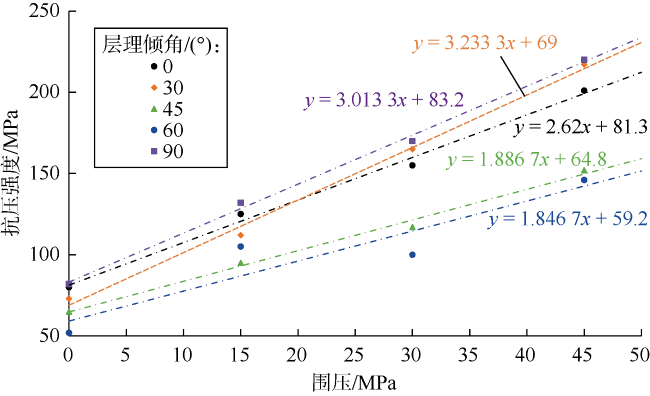
以四川盆地长宁区块志留系龙马溪组页岩为研究对象,对发育不同倾角层理页岩开展三轴力学实验,明确了围压与抗压强度的定量对应关系(见图1 )。可见,随围压增大,抗压强度增加,层理倾角为45°与60°时页岩抗压强度偏低,符合发育中等倾角弱结构面岩石具有低强度特征的抗压强度变化规律,强度偏低的层理产生了沿层理弱面破坏[14]。以此定量关系为基础,设计后续卸载力学实验。
地层钻开后,井壁页岩经历了应力卸载(见图2a )。基于该应力变化,通过卸围压形式,以常规三轴应力应变曲线为对照组(见图2b ),建立经历卸载过程的三轴实验(见图2c ):①保持围压为恒定值,然后加载轴向应力至固定值。②保持轴向应力不变,卸载围压由A到B点。③卸载过程结束后,将围压从B点恢复到原值C点,随后加载应力从D点直至岩石破裂的E点。由此获得经历卸载过程的岩石强度参数,并与相同围压条件下常规三轴抗压强度对比,明确卸载损伤效应。
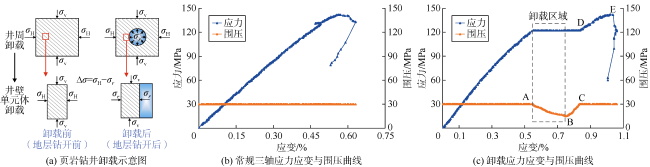
实验过程中,设置3个围压值15,25,45 MPa,卸载幅度分别设置为每个选定围压的10%,30%,50%,70%;基于图1 所示的围压与抗压强度的相关性,计算每个选定围压下的抗压强度,并取抗压强度的35%,55%,75%作为轴向应力,形成多组实验参数,如表1 所示。
表1 钻井应力卸载室内实验参数表 |
| 编号 | 围压/ MPa | 轴向应力 | 卸载幅度 | ||
|---|---|---|---|---|---|
| 数值/ MPa | 占抗压强度 比例/% | 数值/ MPa | 占围压 比例/% | ||
| 1 | 15 | 42.21 | 35 | 1.5 | 10 |
| 2 | 90.45 | 75 | 1.5 | 10 | |
| 3 | 66.33 | 55 | 4.5 | 30 | |
| 4 | 42.21 | 35 | 7.5 | 50 | |
| 5 | 66.33 | 55 | 7.5 | 50 | |
| 6 | 42.21 | 35 | 10.5 | 70 | |
| 7 | 25 | 51.38 | 35 | 2.5 | 10 |
| 8 | 80.74 | 55 | 7.5 | 30 | |
| 9 | 51.38 | 35 | 12.5 | 50 | |
| 10 | 80.74 | 55 | 12.5 | 50 | |
| 11 | 51.38 | 35 | 17.5 | 70 | |
| 12 | 110.10 | 75 | 17.5 | 70 | |
| 13 | 45 | 69.72 | 35 | 4.5 | 10 |
| 14 | 69.72 | 35 | 13.5 | 30 | |
| 15 | 149.40 | 75 | 13.5 | 30 | |
| 16 | 69.72 | 35 | 22.5 | 50 | |
| 17 | 109.56 | 55 | 22.5 | 50 | |
| 18 | 149.40 | 75 | 31.5 | 70 | |
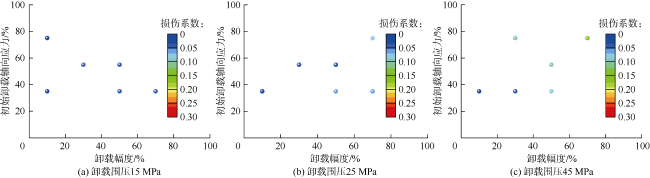
依据损伤力学理论,钻井应力卸载造成的强度损伤系数如(1)式所示,以此为依据,采用层理倾角为0°的页岩岩样,计算分析钻井应力卸载对页岩强度的损伤程度(见图3 )。可以看到,随卸载幅度增加,侧向支撑力减弱,轴向压缩导致的岩石破坏增强,卸载造成的抗压强度弱化更为显著。因此,若初始钻井液密度设计偏低,过高的卸载幅度诱发强卸载效应,弱化井壁稳定性,不利于后续钻井安全。钻井应力卸载对页岩强度的影响程度与应力状态密切相关,在低围压与低轴向应力下,力学损伤系数偏低。主要原因为:在低围压下,可造成的卸载应力变化较低,不易形成明显的强度衰减;低轴向应力条件下,页岩处于弹性变形阶段,卸载后的轴向应力主要产生弹性变形,造成的强度损伤较弱。在高围压(如45.0 MPa)与高轴向应力(149.4 MPa)条件下,卸载后的抗压强度下降更显著,损伤系数更大,高应力环境下钻井应力卸载影响更强。
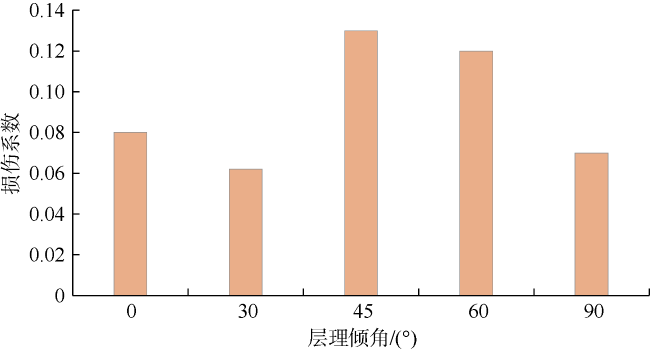
钻井应力卸载时页岩强度特征与层理产状密切相关。层理使页岩力学强度具有显著的各向异性,随层理倾角的变化,主应力与层理的夹角、层理与卸载方向的夹角均产生改变,应力卸载后页岩力学性质随之改变。鉴于此,针对不同倾角层理页岩岩样,基于恒定卸载条件,开展了不同倾角层理的应力卸载模拟实验(见图4 )。可以看到,层理倾角为45°,60°时,页岩对应力卸载最为敏感,损伤系数明显高于其他倾角,说明沿层理弱面更易产生破坏,主要原因为层理弱面承载能力偏低,卸载同样大小应力后,轴向压缩破坏更显著,强度衰减更明显。由此可见,弱面与卸载协同作用将进一步弱化页岩力学稳定性。
2 水化作用对页岩力学强度的影响
水化作用条件下层理与基体的损伤系数可描述为:
$\left\{ \begin{matrix} & {{D}_{\text{hmc}}}\left( t \right)=1-{{{c}_{\text{m}}}\left( t \right)}/{{{c}_{\text{mo}}}}\;\ \ \ \\ & {{D}_{\text{hmi}}}(t)=1-{{{\varphi }_{\text{m}}}\left( t \right)}/{{{\varphi }_{\text{mo}}}}\;\ \\ & {{D}_{\text{hbc}}}\left( t \right)=1-{{{c}_{\text{b}}}\left( t \right)}/{{{c}_{\text{bo}}}}\;\ \ \ \\ & {{D}_{\text{hbi}}}(t)=1-{{{\varphi }_{\text{b}}}\left( t \right)}/{{{\varphi }_{\text{bo}}}}\;\ \ \ \\ \end{matrix} \right.$
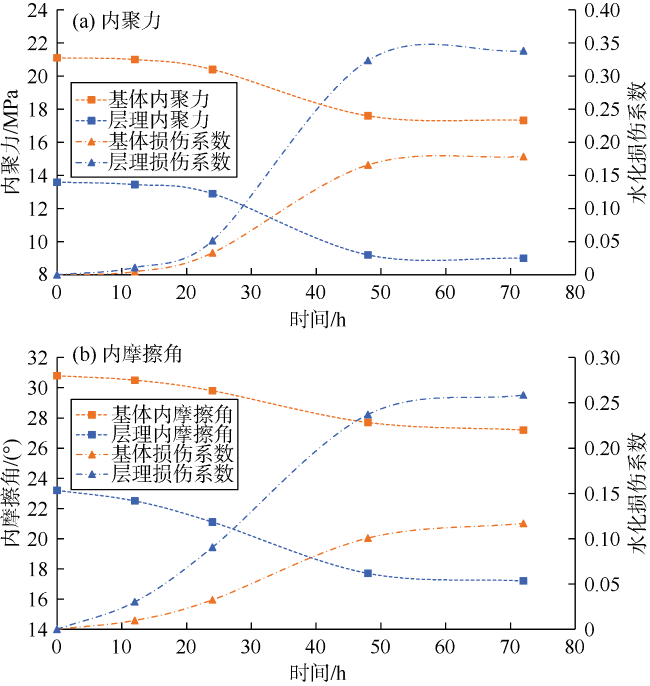
沿水平层理与垂直层理开展剪切实验,可明确水化过程中页岩层理与基体的强度特征、层理与基体的损伤状况(见图5 )。实验流程如下:实验流体采用去离子水,实验岩样分别选取层理倾角0°和90°的圆柱页岩岩样。首先在100 ℃与3 MPa压差下开展去离子水与岩样的浸泡实验,建立水化过程;在浸泡一定时间后开展岩石剪切实验,先施加固定垂向载荷,再分别沿水平层理与垂直层理方向施加剪切应力,直至岩样破坏,获取强度与损伤特征。可以看到:①水化过程中,层理与基体的强度损伤在前期并不明显,表现为内聚力基本平稳,约24 h后内聚力大幅下降,两者强度急剧衰减,在后期内聚力逐渐趋于稳定;层理与基体的损伤系数前期较低且上升速度相对较缓,中期上升速度加快,提升幅度较大,至后期逐渐趋于稳定。②层理属于相对高渗面,水相更易侵入层理,因此在相同水化作用时间条件下,与基体相比,层理内聚力低,强度小,同时随着水化作用时间的延长,损伤系数的上升速度更快,增幅更大(见图5a )。③水化过程中,内摩擦角、损伤系数的变化趋势与图5a 具有相似性,表现为前期下降较缓,约24 h后下降加快,后期逐渐平稳。④水相更易侵入层理,水化过程中,与基体相比,层理内摩擦角更小,下降幅度更大,损伤系数增幅更显著(见图5b )。
3 应力卸载-水化作用下页岩井壁稳定模型
3.1 井周应力分布
根据横观各向同性应力分布理论,直角坐标系下层理发育页岩地层井眼井周应力为[15]:
$\left\{ \begin{matrix} & \sigma _{x,\text{b}}^{{}}=\sigma _{x,\text{o}}^{{}}+2\operatorname{Re}\left[ {{\mu }_{1}}^{\text{2}}{{\phi }_{1}}\left( {{z}_{1}} \right)+{{\mu }_{2}}^{2}{{\phi }_{2}}\left( {{z}_{2}} \right)+{{\mu }_{3}}^{2}{{\lambda }_{3}}{{\phi }_{3}}\left( {{z}_{3}} \right) \right] \\ & \sigma _{y\text{,b}}^{{}}=\sigma _{y\text{,o}}^{{}}+2\operatorname{Re}\left[ {{\phi }_{1}}^{\prime }\left( {{z}_{1}} \right)+{{\phi }_{2}}'\left( {{z}_{2}} \right)+{{\lambda }_{3}}{{\phi }_{3}}^{\prime }\left( {{z}_{3}} \right) \right] \\ & \sigma _{z\text{,b}}^{{}}=\sigma _{z\text{,o}}^{{}}-\frac{1}{{{a}_{33}}}\left( {{a}_{31}}{{\sigma }_{x,\text{h}}}+{{a}_{32}}{{\sigma }_{y\text{,h}}}+{{a}_{34}}{{\tau }_{yz\text{,h}}}+{{a}_{35}}{{\tau }_{xz\text{,h}}}+{{a}_{36}}{{\tau }_{xy\text{,h}}} \right) \\ & \tau _{xy\text{,}b}^{{}}=\tau _{xy\text{,o}}^{{}}-2\operatorname{Re}\left[ {{\mu }_{1}}{{\phi }_{1}}\left( {{z}_{1}} \right)+{{\mu }_{2}}{{\phi }_{2}}\left( {{z}_{2}} \right)+{{\mu }_{3}}{{\lambda }_{3}}{{\phi }_{3}}\left( {{z}_{3}} \right) \right] \\ & \tau _{xz\text{,b}}^{{}}=\tau _{xz\text{,o}}^{{}}+2\operatorname{Re}\left[ {{\lambda }_{1}}{{\mu }_{1}}{{\phi }_{1}}\left( {{z}_{1}} \right)+{{\lambda }_{2}}{{\mu }_{2}}{{\phi }_{2}}\left( {{z}_{2}} \right)+{{\mu }_{3}}{{\phi }_{3}}\left( {{z}_{3}} \right) \right] \\ & \tau _{yz\text{,b}}^{{}}=\tau _{yz\text{,o}}^{{}}-2\operatorname{Re}\left[ {{\lambda }_{1}}{{\phi }_{1}}\left( {{z}_{1}} \right)+{{\lambda }_{2}}{{\phi }_{2}}\left( {{z}_{2}} \right)+{{\phi }_{3}}\left( {{z}_{3}} \right) \right] \\ \end{matrix} \right.$
基于上式,通过空间坐标转换方法,获得井眼柱坐标系下的应力分布[16]:
$\left\{ \begin{matrix} & {{\sigma }_{r}}={{p}_{\text{w}}}-\delta \phi \left( {{p}_{\text{w}}}-{{p}_{\text{p}}} \right) \\ & {{\sigma }_{\theta }}=-{{p}_{\text{w}}}+\left( \sigma _{x\text{,b}}^{{}}+\sigma _{y\text{,b}}^{{}} \right)-2\left( \sigma _{x\text{,b}}^{{}}-\sigma _{y\text{,b}}^{{}} \right)\cos \left( 2\theta \right)- \\ & \ \ \ \ \ \ \ \ \ 4\tau _{xy\text{,b}}^{{}}\sin \left( 2\theta \right)+\delta \left[ \frac{\alpha \left( 1-2\nu \right)}{1-\nu }-\phi \right]\left( {{p}_{\text{w}}}-{{p}_{\text{p}}} \right) \\ & {{\sigma }_{z}}=\sigma _{z\text{,b}}^{{}}-2\nu \left[ \left( \sigma _{x\text{,b}}^{{}}-\sigma _{y\text{,b}}^{{}} \right)\cos \left( 2\theta \right)+2\tau _{xy\text{,b}}^{{}}\sin \left( 2\theta \right) \right]+ \\ & \ \ \ \ \ \ \ \ \ \delta \left[ \frac{\alpha \left( 1-2\nu \right)}{1-\nu }-\phi \right]\left( {{p}_{\text{w}}}-{{p}_{\text{p}}} \right) \\ & {{\tau }_{\theta z}}=2\tau _{xy\text{,b}}^{{}}\cos \theta -2\tau _{xz\text{,b}}^{{}}\sin \theta \\ & {{\tau }_{r\theta }}={{\tau }_{rz}}=0 \\ \end{matrix} \right.$
基于井周应力分布,可确定井壁任意位置三向主应力,如(5)式所示,进而确定最大与最小主应力。
$\left\{ \begin{matrix} & {{\sigma }_{i}}={{p}_{\text{w}}}-\delta \phi \left( {{p}_{\text{w}}}-{{p}_{\text{p}}} \right) \\ & {{\sigma }_{j}}=\frac{{{\sigma }_{z}}+{{\sigma }_{\theta }}}{2}+\sqrt{{{\left( \frac{{{\sigma }_{\theta }}-{{\sigma }_{z}}}{2} \right)}^{2}}+\tau _{\theta z}^{^{2}}} \\ & {{\sigma }_{k}}=\frac{{{\sigma }_{z}}+{{\sigma }_{\theta }}}{2}-\sqrt{{{\left( \frac{{{\sigma }_{\theta }}-{{\sigma }_{z}}}{2} \right)}^{2}}+\tau _{\theta z}^{^{2}}} \\ \end{matrix} \right.$
3.2 井壁应力卸载当量分布
钻开前,井周岩石应力状态主要受原地应力控制,径向地应力分量如图6a 所示;钻开后,应力卸载主要源于液柱压力替代了地应力分量。因此可忽略轴向与周向应力调整,以钻开后井筒径向的应力变化代表卸
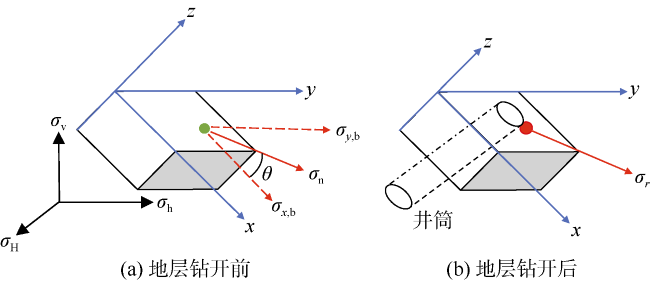
载应力变化(见图6b ),表达式如下所示:
$\Delta \sigma ={{\sigma }_{\text{n}}}-{{\sigma }_{r}}={{\sigma }_{\text{n}}}-\left[ {{p}_{\text{w}}}-\delta \phi \left( {{p}_{\text{w}}}-{{p}_{\text{p}}} \right) \right]$
其中:${{\sigma }_{\text{n}}}=\sigma _{y\text{,b}}^{{}}\sin \theta +\sigma _{x\text{,b}}^{{}}\cos \theta $
3.3 井壁失稳判断
基于井壁主应力分布特征,为判断层理发育页岩地层井壁是否失稳,需要明确主应力方向、卸载方向与层理面的空间位置。其中,最大主应力与轴向z的夹角为[17]:
$\gamma =\frac{1}{2}\arctan \frac{2{{\tau }_{\theta z}}}{{{\sigma }_{\theta }}-{{\sigma }_{z}}}$
最大主应力与层理面法向夹角为:
${{\beta }_{\text{w}}}=\arccos \frac{\mathbf{n}\cdot \mathbf{N}}{\left| \mathbf{n} \right|\left| \mathbf{N} \right|}$
其中,n由层理面倾角和走向确定:
$\mathbf{n}=\mathbf{i}\sin {{b}_{\text{w}}}\cos {{a}_{\text{w}}}+\mathbf{j}\sin {{b}_{\text{w}}}\sin {{a}_{\text{w}}}+\mathbf{k}\cos {{b}_{\text{w}}}$
N由井周角、井斜角、方位角、最大主应力与轴线z的夹角共同控制,表达式为:
$\left\{ \begin{matrix} & \mathbf{N}={{b}_{1}}\mathbf{i}+{{b}_{2}}\mathbf{j}+{{b}_{3}}\mathbf{k} \\ & {{b}_{1}}=\cos b\cos a\sin \theta -\sin b\cos \theta +\cos b\sin a\cos \gamma \\ & {{b}_{2}}=\sin b\cos a\sin \theta +\cos b\cos \theta +\sin b\sin a\cos \gamma \\ & {{b}_{3}}=-\sin a\sin \theta +\cos a\cos \gamma \\ \end{matrix} \right.$
由于卸载方向位于井筒平面,依据相同转换方法,可得卸载方向与层理法向的夹角。卸载损伤系数受控于层理角度、卸载方向、初始卸载围压、卸载轴向应力与卸载应力变化。依据损伤力学理论,结合钻井应力卸载与水化作用,两类损伤的耦合方程可表示为[18]:
$D=1-\left[ 1-{{D}_{\text{h}}}\left( t \right) \right]\left[ 1-{{D}_{\text{u}}}\left( {{\sigma }_{z}},\ {{\sigma }_{\text{n}}},\ \Delta \sigma,\ {{\beta }_{\text{w}}},\ {{\beta }_{\text{uw}}} \right) \right]$
依据损伤系数,基于单一弱面准则,可得到应力卸载-水化协同作用下的页岩基体((12)式)和层理((13)式)临界破坏判定方程:
${{\sigma }_{1}}-{{\sigma }_{3}}=\frac{2\left[ {{c}_{\text{mo}}}\left( 1-D \right)+{{\sigma }_{3}}\tan {{\varphi }_{\text{mo}}}\left( 1-D \right) \right]}{\left[ 1-\tan {{\varphi }_{\text{mo}}}\left( 1-D \right)\cot {{\beta }_{\text{o}}} \right]\sin 2{{\beta }_{\text{o}}}}$
${{\sigma }_{1}}-{{\sigma }_{3}}=\frac{2\left[ {{c}_{\text{bo}}}\left( 1-D \right)+{{\sigma }_{3}}\tan {{\varphi }_{\text{bo}}}\left( 1-D \right) \right]}{\left[ 1-\tan {{\varphi }_{\text{bo}}}\left( 1-D \right)\cot {{\beta }_{\text{w}}} \right]\sin 2{{\beta }_{\text{w}}}}$
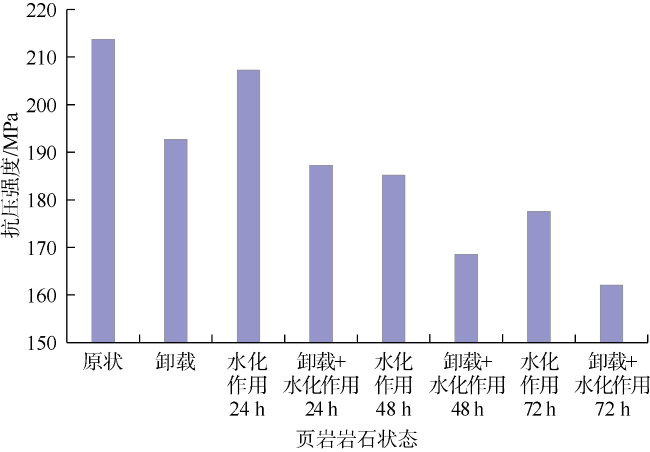
基于力学实验数据与页岩破坏准则,可以得到不同钻井时间下的页岩强度(见图7 )。钻井前期(24 h),卸载后的抗压强度低于水化作用后的抗压强度,说明此时,卸载损伤大于水化损伤。在钻井后期(48 h和72 h),水化损伤加剧,水化损伤对页岩强度的影响更为显著。此外,在同一钻井时刻,卸载+水化作用后的抗压强度最低,说明两者协同作用将加剧井壁失稳。
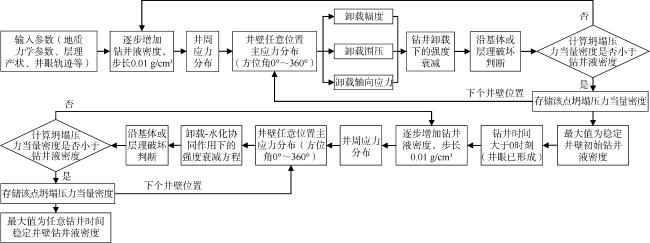
综上,考虑应力卸载-水化协同作用的井壁稳定性模型计算流程如图8 所示。首先明确钻开后井周应力分布,获取卸载应力变化、卸载围压及卸载轴向应力,从而确定卸载后井周岩石强度,明确井壁岩石破坏类型,计算钻开后地层坍塌压力,确定初始钻井液密度;在此基础上,考虑卸载与水化协同作用下的页岩强度损伤规律,计算获取井眼形成后任意钻井时间的页岩地层坍塌压力。
4 井壁稳定分析
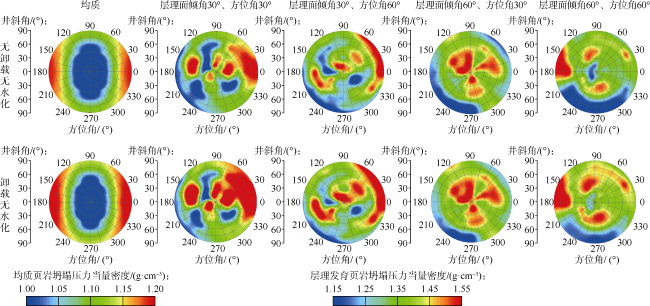
基于构建的页岩井壁稳定性模型,开展井壁稳定性分析。页岩地层岩石力学参数采用前期力学实验数据,其他计算参数分别为:井深3 153 m,层理面倾角19.8°,层理面方位角116.5°,垂向地应力当量密度2.31 g/cm3,水平最大和最小主应力当量密度分别为2.28,1.95 g/cm3,孔隙压力当量密度1.15 g/cm3,孔隙度3.2%,Biot系数0.85。忽略水化作用,仅考虑钻井应力卸载,分析不同地层结构下卸载对坍塌压力影响(见图9 )。均质条件下,坍塌压力偏低且呈对称分布,坍塌压力当量密度主要为1.00~1.20 g/cm3,卸载造成的坍塌压力增量相对较小;与均质条件相比,考虑层理弱面后,坍塌压力显著提升,坍塌压力当量密度主要为1.15~1.55 g/cm3,且不再具备对称分布特征。考虑层理时,卸载造成的坍塌压力增量大于均质条件(云图变化更明显),层理弱面对应力卸载更为敏感;不同层理倾角和层理方位角条件下,由于井筒与层理相交位置的差异性,卸载方向、层理方向、井壁主应力彼此之间的相对位置发生改变,无论是否存在钻井应力卸载,坍塌压力分布变化均十分明显,可见井眼轨迹、层理产状是影响井壁稳定性的关键因素。
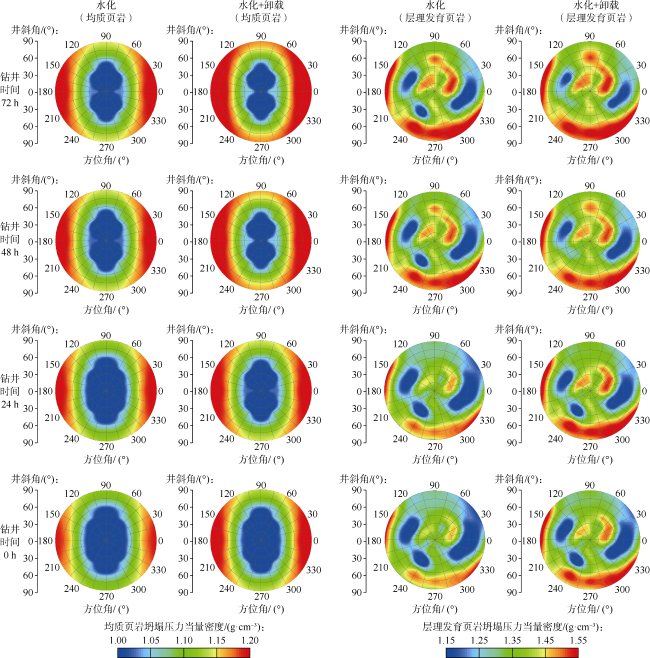
采用本文模型分析应力卸载-水化协同作用下页岩地层坍塌压力分布(见图10 )。可以看到:①均质地层与层理发育地层相对比,由于层理属于弱面,同时也是相对高渗面,对应力卸载更敏感,无论是否考虑卸载作用,层理发育地层井眼中心都具备更高的坍塌压力,且应力卸载对层理发育地层造成的坍塌压力的增幅更大;随钻井时间增加,层理发育地层水化作用更强,坍塌压力随之增加。②与目前常用页岩力-化耦合模型相比(考虑水化、无卸载),考虑卸载作用后,坍塌压力增大,弱化页岩井壁稳定性。③钻井前期(24 h),应力卸载造成的坍塌压力增量更明显。随钻井时间增加,水化作用对岩石的损伤逐步加剧,至钻井后期,相比卸载作用,水化作用引起的坍塌压力上升更显著,说明水化作用对坍塌压力的影响逐渐占据主导地位。
综上,层理、卸载、水化均是影响页岩地层井壁稳定性的重要因素。以层状介质为基础,综合应力卸载与水化作用的影响,才能实现合理的页岩地层钻井工程优化设计,页岩地层钻井全过程中,钻井液密度的选择必须综合考虑应力卸载与水化的共同作用。
5 现场应用
以长宁区块G204井为应用对象,龙马溪组页岩垂深3 315 m,孔隙压力当量密度1.08 g/cm3,垂向地应力当量密度2.24 g/cm3,水平最大和水平最小地应力当量密度分别为2.19 g/cm3和1.89 g/cm3。井斜角88.5°,方位角114.3°,层理倾角25.4°,层理方位角102.6°。实际钻井中,初始钻井液密度为1.26 g/cm3,前期井眼稳定,后续出现井眼垮塌,逐步提升钻井液密度,前两次调整后井下掉块依然明显,在密度达到1.47 g/cm3后实现顺利钻进。采用该井基础数据,对比钻井过程中考虑不同预测条件的坍塌压力预测结果(见图11 ),可以看到:①均质条件下,无论是否考虑应力卸载的影响,页岩坍塌压力预测结果均显著偏低。②考虑层理面与水化作用,但忽略钻井应力卸载的影响,坍塌压力预测值与实际情况的符合度提升,但依然偏小。
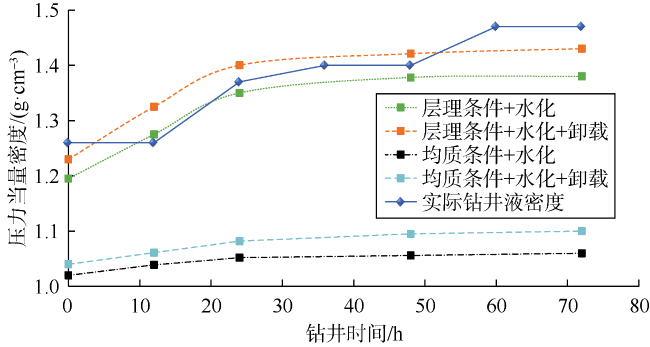


③同时考虑层理面、水化作用以及钻井应力卸载的影响,坍塌压力预测结果与实际工况吻合程度较好,体现了模型的准确性。
6 结论
页岩钻开后发生应力卸载,围压、轴向应力越大,应力卸载造成的页岩强度弱化越显著,应力卸载幅度与页岩力学强度弱化程度正相关。
页岩层理越发育,越易沿层理破坏,应力卸载时,弱结构面与应力卸载协同作用,页岩强度弱化程度越高,力学稳定性越差,井壁失稳风险越大。外部流体易沿层理侵入,促进页岩水化,水化作用同样使页岩力学稳定性变差,降低井壁稳定性。应力卸载对页岩地层坍塌压力的影响主要发生在钻井前期,水化损伤对井壁失稳的影响主要发生在钻井后期。
层理、应力卸载、水化作用共同影响页岩井壁稳定性,应力卸载-水化协同作用下页岩井壁稳定性模型综合考虑了三者的影响,经现场应用检验,预测结果符合钻井实际,可靠性较好。
符号注释:
a——井斜角,(°);aw——层理面方位角,(°);a31,a32,a33,a34,a35,a36——横观各向同性介质柔度矩阵系数,无因次;b——井眼方位角,(°);b1,b2,b3——x,y,z方向矢量的模,无因次;bw——层理面倾角,(°);cbo,cb(t)——原状页岩层理与水化作用过程中页岩层理的内聚力,MPa;cmo,cm(t)——原状基体与水化作用下基体内聚力,MPa;D——损伤系数,无因次;Du——卸载造成的损伤系数,无因次;Dh(t),Dhmc(t),Dhmi(t)——任意时间t下的页岩水化损伤系数、基体内聚力与基体内摩擦角的水化损伤系数,无因次;Dhbc(t),Dhbi(t)——任意时间t下的层理内聚力与层理内摩擦角的水化损伤系数,无因次;i,j,k——笛卡尔坐标轴方向的单位矢量;n——层理法向矢量;N——井壁最大主应力方向矢量;pp——孔隙压力,MPa;pw——液柱压力,MPa;Re——复数的实部;x,y,z——空间直角坐标系,m;z1,z2,z3——复变量;α——Biot系数,无因次;βw——最大主应力与层理面夹角,(°);βuw——主应力与卸载方向夹角,(°);βo——页岩基体破坏面与最大主应力的夹角,(°);γ——最大主应力作用面与轴向夹角,(°);δ——井壁渗透系数,无因次;θ——井周角,(°);λ1,λ2,λ3——特征根比值,无因次;μ1,μ2,μ3——应变协调方程对应的特征方程特征根,无因次;ν——泊松比,无因次;σ1,σ3——最大主应力与最小主应力,MPa;σc——原状页岩抗压强度,MPa;σcu——卸载作用后的抗压强度,MPa;σi,σj,σk——井壁三向主应力,MPa;σn——原地应力在卸载方向上的应力分量,MPa;σv,σH,σh——地层垂向主应力、水平最大和水平最小主应力,MPa;σr,σz,σθ——井眼柱坐标下径向应力、z轴方向应力、周向应力,MPa;τrz,τθz,τrθ——井眼柱坐标下相切于rz平面、θz平面、rθ平面的剪应力,MPa;σx,b,σy,b,σz,b——层理发育地层x轴方向、y轴方向、z轴方向的井周应力,MPa;τxy,b,τyz,b,τxz,b——层理发育地层相切于xy平面、yz平面、xz平面的井周剪应力,MPa;σx,o,σy,o,σz,o——原地应力下的x轴方向、y轴方向、z轴方向的井周应力,MPa;τxy,o,τyz,o,τxz,o——原地应力下相切于xy平面、yz平面、xz平面的井周剪应力,MPa;σx,h,σy,h——井眼钻开后引起的沿井壁x轴方向、y轴方向的边界应力,MPa;τxy,h,τyz,h,τxz,h——井眼钻开后引起的沿井壁相切于xy平面、yz平面、xz平面的边界应力,MPa;Δσ——卸载应力变化,MPa;ϕ——孔隙度,%;ϕ1,ϕ2,ϕ3——横观各向同性方程的解析函数;φbo,φb(t)——原状层理与水化作用下层理内摩擦角,(°);φmo,φm(t)——原状页岩基体与水化作用过程中页岩基体的内摩擦角,(°)。