

0 引言
古隆起是指地质历史中不同时期、不同成因的相对上升构造[1]。受不同时期构造运动的影响,盆地不同的演化阶段往往发育不同的古隆起,且古隆起一般会随着盆地的演化发生迁移和演变[2]。古隆起对盆地储集层的沉积与后期剥蚀、圈闭形成以及油气后期运移和保存均具有重要的控制作用[3];古隆起由于位于构造高部位,流体势较低、储集体系和输导体系发育,往往是油气聚集的有利区[4-5],特别是一些规模较大、发育时间较长的古隆起更有利于油气的富集[6]。因此,古隆起的演化与迁移研究能够很好地限定油气的运移过程及寻找有利的油气聚集部位,指导油气勘探。古隆起的形成与迁移往往能够反映盆地及周缘造山带的构造演化历程,因此研究古隆起演化历程对周缘造山带演化分析具有重要的指示意义。
为了探究上述所提出的3个科学问题,在钻井层位标定的基础上,利用区域性的二维地震剖面和重点探区三维剖面进行古隆起的识别,并对塔西南地区全域进行二维地震资料系统解释,编制寒武系盐下白云岩顶界面各时期古构造平面形态图来反映古隆起的空间展布及迁移规律;选择典型地震剖面进行区域性地质格架剖面构建,详细剖析古隆起的发育特征及其演化。在此基础上,结合塔里木盆地南部西昆仑造山带的早古生代演化特征,厘定早古生代晚期古隆起的构造属性,探讨其迁移演化对西昆仑早古生代造山过程的限定作用和对储集层发育的控制作用,以期揭示塔里木盆地的早古生代盆地演化与盆地原型,支撑塔西南下古生界的油气勘探。
1 地质背景
塔里木盆地是发育在前寒武系基底之上的1个典型的大型叠合复合盆地[14]。盆地的变质岩基底形成主要与距今时间为2.45~2.65,1.8~2.0,0.9~1.1 Ga的几个阶段的构造事件有关[15⇓-17]。新元古代晚期,受罗迪尼亚超大陆裂解的影响,塔里木盆地发育了北东向的大陆内部裂谷系和北西向的塔西南大陆边缘裂谷系[18]。早古生代构造事件对塔里木盆地产生了十分重要的影响,致使盆地内形成了多个古隆起以及褶皱-逆冲构造带,例如玛南褶皱冲断带。这些古隆起控制了奥陶系、志留系、泥盆系和石炭系的沉积和后期剥蚀改造,同时也控制了油气聚集,贾承造等认为古生界克拉通盆地油气聚集受古隆起及其斜坡带的影响[19-20]。
造山带和盆地作为时空发展和形成机制上具有密切联系的统一动力学系统,盆地形成受周缘造山作用控制,而盆地的变形和沉积记录了盆缘造山作用过程。塔里木盆地早古生代的构造演化与周缘造山带密切相关。塔里木盆地西南部发育有西昆仑造山带,该造山带为复合造山带,可以划分为北昆仑地块、南昆仑地块和甜水海地块,之间被两条缝合带所分隔。北部是库地—其曼于特蛇绿混杂岩带所代表的早古生代晚期造山带,南部是以麻扎—康瓦西—苏巴什蛇绿构造混杂岩带所代表的中生代早期造山带,分别代表了原特提斯洋(古昆仑洋)和古特提斯洋两个大洋构造旋回。早古生代西昆仑地区具有多洋岛的特征,西昆仑内部多个具有前寒武纪结晶基底的小地块是从塔里木克拉通板块上分裂出来的[21]。Zhang等认为距今约440~450 Ma塔里木板块西南缘(也称北昆仑地块)与南昆仑地块发生了碰撞,在塔里木板块西南缘发育了前陆盆地[22]。
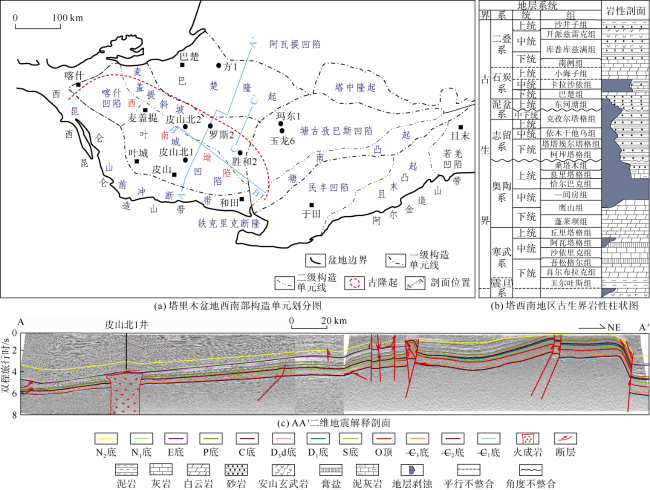
塔西南地区由巴楚隆起、西南坳陷和西昆仑山前冲断带3个构造单元组成,其中西南坳陷又包括喀什凹陷、叶城凹陷和麦盖提斜坡(见图1 a)。塔西南地区早古生代沉积在中奥陶统发生了重要的改变,寒武系—早奥陶统主要为1套海相碳酸盐岩沉积,下寒武统沉积了1套作为盆地内最重要的烃源岩之一的含磷酸盐的深水暗色泥岩[23];而中奥陶统受构造事件的影响部分地区没有接受沉积,从上奥陶统开始出现了陆源碎屑沉积,部分地区存在隆起剥蚀区(见图1 b)。
2 塔西南地区早古生代古隆起识别与基本特征
古隆起在地质演化过程中往往会遭受强的剥蚀作用,导致与上覆地层之间形成不整合接触,同时在上覆地层中出现上超等现象。因此,可以通过地震剖面上不整合面和上超界面的分析来识别古隆起的存在和发育特征。
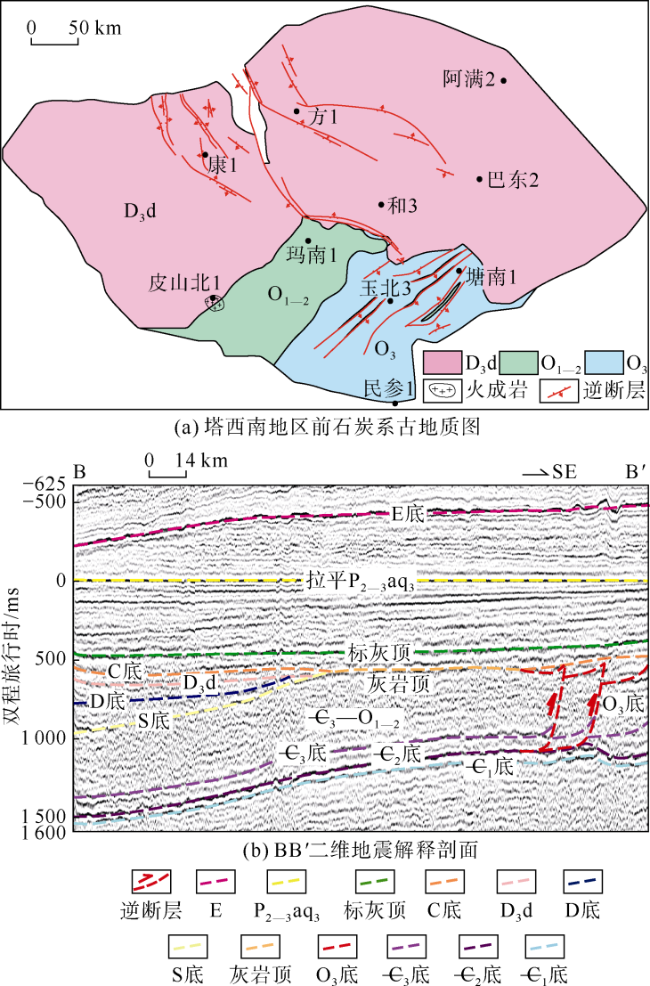
为了进一步揭示隆起区的特征,选取昆仑山前到阿瓦提凹陷之间的多条二维地震测线进行拼接,形成剖面走向均为近北东—南西向区域格架大剖面。剖面自南向北,依次穿过的构造单元有西昆仑山前冲断带、叶城凹陷、麦盖提斜坡、巴楚隆起和阿瓦提凹陷,并选择AA°和CC°开展古隆起的识别。
上寒武统到中—下奥陶统厚度总体比较均匀,仅往南西方向略微减薄(见图1 c)。上奥陶统厚度往南西方向急剧减小,并存在地层削蚀现象,表明上奥陶统沉积之后曾经发生抬升并遭受剥蚀。志留系向南西方向厚度明显减薄,并在皮山北1井处尖灭(见图1 c)。从沉积关系来看,剖面上志留系表现出逐渐上超沉积的现象,因此,志留系与下伏地层之间的接触关系为超覆接触关系。泥盆系与下伏地层也为超覆接触关系,但是地层减薄尖灭位置更偏剖面的左侧,表明泥盆系沉积范围较志留系有所扩大。石炭系在整条剖面都有发育,且地层厚度基本一致,仅在剖面左侧出现轻微的减薄。这一剖面的地层发育特征表明,该地区存在1个古隆起,该古隆起初始形成于中奥陶世末,对上奥陶统—泥盆系的沉积具有重要的控制作用,直到石炭纪才对沉积没有控制。
3 塔西南地区早古生代古隆起的迁移与演化
3.1 地层剥蚀厚度和原始沉积厚度恢复与古隆起的发育
在古隆起漫长的演化过程中,经历了多期构造事件,存在多期地层剥蚀,使盆地的原来沉积和变形的状态发生改变,大大增加了对古隆起构造演化历史研究的难度。因此,对各变形期剥蚀厚度进行恢复是研究古隆起构造演化的前提。
依此方法,恢复了塔西南地区每期构造事件导致的地层剥蚀厚度以及每个地层多期构造事件导致的总剥蚀量,结合各地层的残余厚度图,编绘了塔西南地区各时期地层原始厚度图(见图3 ),以帮助分析塔西南地区的古隆起的构造演化过程。
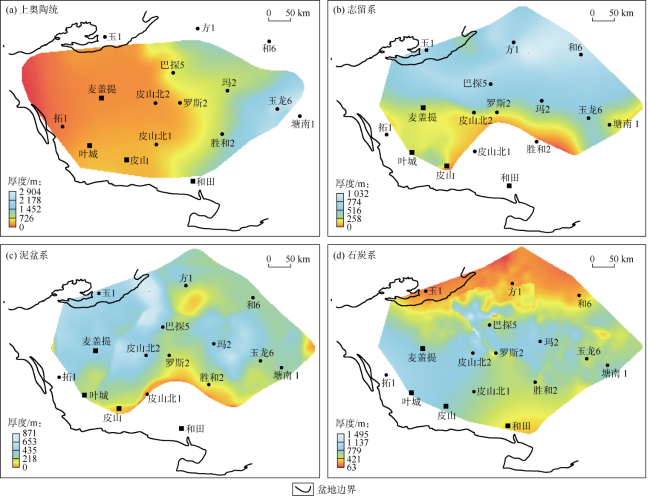
上奥陶统沉积厚度呈现南西薄、北东厚的特点,整体往北东方向增厚(见图3 a)。沉积厚度从皮山北1井的350 m,到胜和2井的950 m,再到玉龙6井的近2 000 m,呈现出明显的空间差异性。
志留纪,塔里木盆地南部的和田一带出现了地层沉积缺失区,地层尖灭线大致沿皮山北1井到胜和2井,以南的地区是为沉积缺失区域(见图3 b)。这一沉积缺失区的范围大致勾勒出当时古隆起的范围。地层尖灭线以北的地区为志留系的沉积区,沉积厚度在皮山北2井和罗斯2井为200 m左右,北部方1井可达
1 000 m。
泥盆系沉积范围比志留系向南部略有扩大,其沉积缺失区的范围较志留系变小(见图3 c)。例如,胜和2井从志留系没有沉积(见图3 b)到泥盆系沉积厚度约150 m(见图3 c),可见泥盆系的沉积范围大于志留系的沉积范围,这一现象在地震剖面上也可以识别(见图1 )。泥盆系的厚度变化趋势与志留系相似。
与志留系和泥盆系相比,石炭系范围更广,在古隆起的最高点也有沉积。石炭系在塔西南地区整体上呈现出向南略有减薄的特点,此时古隆起已经消失,对石炭系的沉积控制较弱(见图3 d)。
3.2 寒武系盐下白云岩顶面古构造形态揭示古隆起时空迁移
为了研究塔西南地区的古隆起的时空迁移,在恢复各期构造事件的剥蚀量的基础之上,以层序发育比较稳定、地震反射界面清晰的寒武系盐下白云岩顶界面为对象,结合塔西南地区各个时期的残余地层厚度,利用双弧软件编制了各个时期寒武系盐下白云岩顶界面古构造平面形态图(见图4 )。根据寒武系盐下白云岩顶界面构造形态的变化来直观地分析古隆起在空间上的迁移和时间上的演化过程。图4 a—图4 f分别为寒武系盐下白云岩顶界面在中奥陶世末、晚奥陶世末、志留纪末、中泥盆世末、泥盆纪末、石炭纪末等关键构造事件时期的古构造平面形态图。中奥陶世末期,塔西南地区盐下白云岩顶界面总体呈现出西南缘的西昆仑山前高、北东部的麦盖提斜坡处低的格局,存在1个盐下白云岩顶界面的隆起区,结合剖面特征可以认为此时塔西南地区形成了1个较大范围的低幅度古隆起区(见图4 a)。
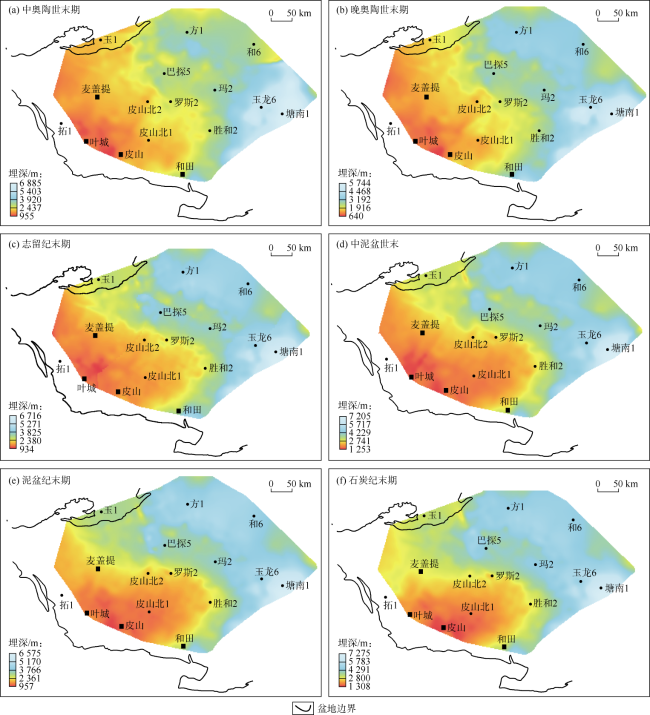
晚奥陶世末,整个塔西南地区寒武系盐下白云岩顶界面进一步抬高,而且寒武系盐下白云岩顶界面所反映的古隆起区域进一步扩大。结合区域性剖面的分析,可以认为中奥陶世的低幅度古隆起在晚奥陶世已经成为1个区域性的隆起。根据寒武系盐下白云岩顶界面的形态分析,此时的古隆起存在两个次一级的隆起构造高点,其中麦盖提斜坡西部地区隆起的构造高点位于西昆仑内部,而另一个构造高点在叶城附近(见图4 b)。通过对比区域格架大剖面也可以发现,晚奥陶世末构造变形具有空间上的分异性,麦盖提斜坡西部、玛扎塔格南部和玛扎塔格东部变形差异较大。麦盖提斜坡西部地区仅表现为整体向西昆仑山方向的抬升,奥陶系遭受剥蚀,志留系、泥盆系和石炭系自北向南超覆,而玛扎塔格南部和玛扎塔格东部变形则表现为强烈的冲断变形(见图4 b)。
志留纪末,塔西南寒武系盐下白云岩顶界面隆起范围向东部扩大,皮山北1井、皮山北2井、胜和2井和罗斯2井等区域开始隆升。寒武系盐下白云岩顶界面隆起区的向东部扩大隐含着古隆起的向东扩展,东部地区也成为古隆起的一部分(见图4 c)。
中泥盆世末,塔西南寒武系盐下白云岩顶界面隆起区在志留纪基础上进一步向东部增强,古隆起区的构造高部位主要位于塔里木盆地南部的皮山—和田地区,早期位于西北侧的另一个隆起高部位消失,这充分反映了古隆起的向东迁移和增强(见图4 d)。
泥盆纪末,塔西南寒武系盐下白云岩顶界面的隆起范围已经开始逐渐缩小,仅在塔里木盆地南部发育隆起区,隆起的构造高部位位于皮山北1井及其西南部地区,塔西南地区的古隆起的范围大幅度缩小,仅是塔里木盆地南部的1个小型古隆起(见图4 e)。
石炭纪末,塔西南寒武系盐下白云岩顶界面的隆起形态基本上与泥盆纪末的形态保持一致,隆起的构造高部位仍旧位于皮山北1井及其西南部地区,但是古隆起的幅度较泥盆纪末明显要低(见图4 f)。石炭纪末的塔西南地区的古隆起已经是1个低幅度的隆起,结合BB°剖面分析发现在隆起的高部位沉积了石炭系,此时的古隆起已经成为水下隆起(见图4 f)。
结合塔西南寒武系盐下白云岩顶界面的形态特征及其迁移演变和区域大剖面的结构,可知早古生代晚期塔西南地区发育了1个古隆起。该古隆起开始形成于中奥陶世末,发育有两个相对高的部位。晚奥陶世已经初具规模,隆起的幅度得到了进一步抬升,两个相对隆起高的部位更加显著。志留纪,古隆起整体稳定隆升,隆起范围快速向东部扩大,皮山北1井、皮山北2井、胜和2井和罗斯2井等区域已成为古隆起的一部分,古隆起的构造高部位位于皮山—和田地区。泥盆纪,古隆起的范围开始逐渐缩小。石炭纪,古隆起开始成为水下隆起。
虽然前人在塔西南地区也识别出古隆起,但是本文所揭示的古隆起在空间上包含了前人所提出的塔西南古隆起与和田古隆起。依据前面古隆起的迁移特征,笔者认为前人所提的塔西南古隆起与和田古隆起是塔西南地区的1个古隆起在迁移演化过程中在不同区域、不同阶段的表现,不能再把前人所提的古隆起作为两个古隆起来对待,而是1个统一的古隆起,将这一古隆起命名为“塔里木盆地西南部古隆起”。
3.3 塔里木盆地西南部古隆起演化过程
为了探讨塔里木盆地西南部古隆起的形成和演化过程,利用北东—南西走向剖面制作了该古隆起演化过程示意图,细化各个演化阶段的构造和沉积特征,来进一步分析该古隆起早古生代演化过程(见图5 )。为了研究塔里木盆地西南部古隆起平面上的迁移演化,编制了该古隆起的平面迁移示意图(见图6 )。
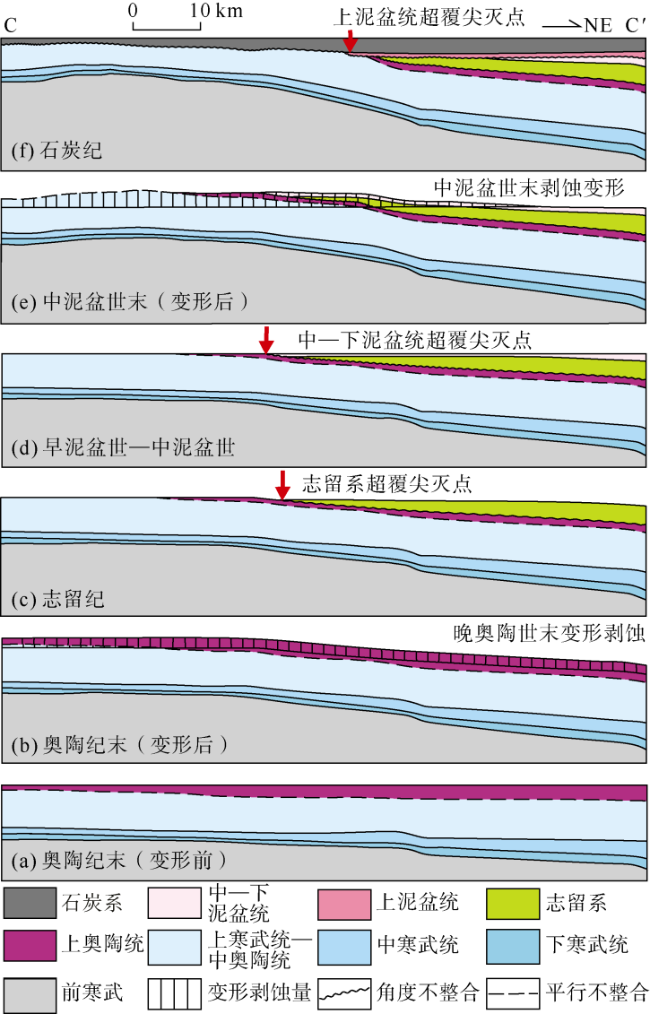
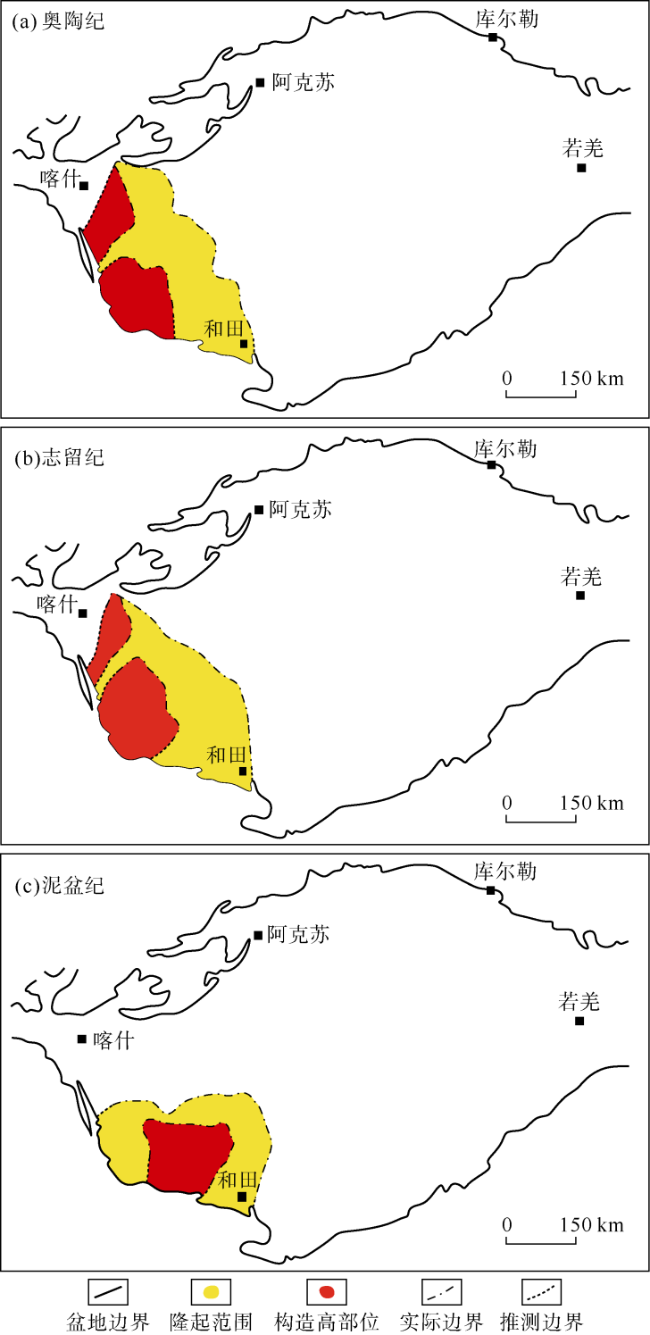
塔西南地区,在震旦系之上沉积了显生宙的寒武系,两者之间为平行不整合接触关系。在中奥陶世末期,受周缘造山带的影响,塔里木盆地西南部整体抬升,形成了区域性的古隆起,即塔里木盆地西南部古隆起(见图6 ),并导致中—下奥陶统的剥蚀和上奥陶统超覆沉积在中—下奥陶统之上(见图5 a)。
上奥陶统沉积末期,塔西南地区构造抬升强烈,导致了上奥陶统遭受剥蚀。奥陶纪末的这一期构造抬升事件的剥蚀量呈现出向塔西南地区南部逐渐增大的趋势。在CC°剖面,北东段的上奥陶统呈现出楔状残留形态,图中黑色短竖线所表示的地层为被剥蚀部分(见图5 b)。晚奥陶世的塔里木盆地西南部古隆起具有一定的规模,同时在隆起上有两个相对高的部位(见图6 )。
志留系沉积时期,受早期古隆起的影响,沉积地层表现出逐渐向南超覆于古隆起之上的特征。图5 中黄色的志留系与下伏地层呈超覆接触关系,志留系的厚度逐渐向北东方向加厚(见图5 c)。
下、中泥盆统沉积时期,沉积地层向古隆起上进一步超覆,其超覆范围大于志留系的超覆范围,超覆尖灭点已靠近皮山北1井。中泥盆统沉积末期,塔西南地区发生构造变形作用,导致地层遭受了新的一期剥蚀。上泥盆统东河塘组的沉积继续超覆于古隆起之上,此时塔里木盆地西南部古隆起已经趋于稳定状态。从平面分布上来看,泥盆纪时期的塔里木盆地西南部古隆起开始向皮山—和田地区缩减和迁移,构造高部位位于皮山—和田地区,而和田以西的高部位逐渐开始消亡(见图6 )。
4 讨论
针对引言中提出的科学问题,对塔里木盆地西南部古隆起的构造属性、古隆起迁移演化对造山过程的限定以及塔西南地区早古生代储集层发育的影响进行深入探讨与分析。
4.1 塔里木盆地西南部古隆起的构造属性
而且,塔西南地区的沉积特征在早古生代发生了重要转变,寒武纪为碳酸盐台地相,到了晚奥陶世出现陆源碎屑沉积。林畅松等[27]认为这一沉积特征的转变与周边昆仑洋、阿尔金洋由洋盆扩张转向闭合挤压背景有关。这样的沉积环境的变化也意味着该地区很可能发生了从寒武纪—早奥陶世的被动大陆边缘到中奥陶世—中泥盆世的前陆盆地的变化。
前陆盆地往往有3个主要的构造单元,包括前陆褶皱冲断带、前渊凹陷和前缘隆起。前缘隆起是克拉通一侧的挠曲抬升区,在前陆盆地发育过程中常常发生迁移,不仅可以从造山带一侧向克拉通一侧纵向迁移,也可以随造山作用在横向上的变化而发生迁移。
塔里木盆地西南部古隆起从中奥陶世末在塔西南地区的西段开始形成,到志留纪扩大到整个塔西南地区,再到泥盆纪迁移到塔里木盆地南部的皮山—和田地区。这一古隆起与同时期的西昆仑造山带,在空间上相邻,且发育在西昆仑造山带碰撞造山过程中俯冲板块一侧;在时间上相一致,均为早古生代晚期。因此,该塔里木盆地西南部古隆起是塔里木板块与西昆仑南地块在早古生代发生碰撞后,在俯冲板块——塔里木板块上发育的前陆盆地重要单元——前缘隆起。而前陆盆地的前渊凹陷则由于受到晚三叠世和新生代两期挤压构造事件的影响,西昆仑造山带大规模向塔里木盆地内部推进,导致塔西南早古生代前陆盆地的前渊凹陷被完全改造。
4.2 塔里木盆地西南部古隆起演化过程对西昆仑造山作用的限定
前人的研究表明塔里木盆地南部的西昆仑造山带的形成时间约在志留纪早期,但是西昆仑造山带的造山作用的方式缺少相关研究。也就是西昆仑造山带的造山作用方式在空间上是等时,还是呈“剪刀式”?如果是“剪刀式”,那又是什么样的过程?
造山带和盆地作为时空发展和形成机制上具有密切联系的统一动力学系统,盆地的变形和沉积记录了盆缘造山作用过程与方式。因此,可以从盆地内部的前缘隆起的迁移来指示相邻造山带的造山作用的过程与方式。
前缘隆起的初始发育往往指示了周缘造山带的初始碰撞。塔里木盆地西南部古隆起中奥陶世末的初始形成指示了塔里木板块与西昆仑南部地块发生了初始碰撞。奥陶纪末的快速隆起并遭受剥蚀指示了塔里木板块与西昆仑南部地块的强烈碰撞(见图4 、图7 )。志留纪快速向东部扩大指示了塔里木板块与西昆仑南部地块的造山作用向东迁移。该古隆起中泥盆世末迁移到塔里木盆地南部地区,且古隆起大幅度缩小至南部的1个小型古隆起,这些特征指示了造山作用已经迁移到东段,西段的造山作用明显减弱或停止(见图4 、图7 )。塔里木盆地西南部古隆起这一空间上向东的迁移演化反映了西昆仑造山带的造山作用很可能是呈“剪刀式”从西向东进行。
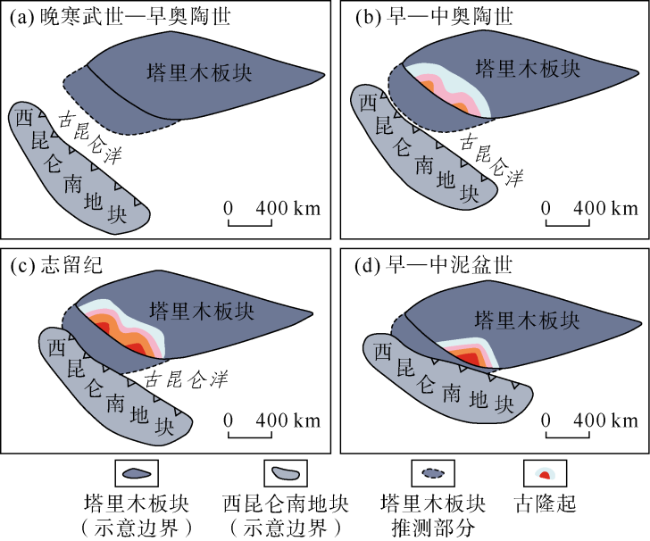


综上所述,塔里木盆地南部西昆仑早古生代造山带的造山作用先从造山带西段开始,初始碰撞开始于中奥陶世末期,晚奥陶世末期造山作用增强;志留纪西昆仑造山带造山作用已经扩展到西昆仑造山带的东段;早—中泥盆世西昆仑造山带的造山作用主要发生在西昆仑造山带的东段;晚泥盆世西昆造山带的造山作用基本结束。西昆仑造山带的造山作用从中奥陶世末开始于西段,呈“剪刀式”从西向东进行(见图7 )。
4.3 塔里木盆地西南部古隆起迁移演化对早古生代储集层发育的影响
古隆起的发育导致地层的抬升剥蚀,在不整合面之下的古隆起顶部形成古风化壳和古岩溶,是良好的风化壳溶蚀缝洞储集层;同时,暴露剥蚀形成的溶蚀孔洞使原本渗透性较差的层位也能成为较好的输导层。
塔里木盆地西南部古隆起的发育及其迁移导致空间上发育不同时期的不整合。在该古隆起形成早期,其抬升剥蚀作用主要发生在西部地区,形成了中奥陶世末和晚奥陶世末两期不整合,且不整合面之下的风化壳发育在碳酸盐岩中,从而形成了两期的古岩溶,不整合面之下发育了风化壳溶蚀缝洞储集层。根据古隆起的演化,这两套风化壳溶蚀缝洞储集层主要分布在现今麦盖提斜坡西段,是麦盖提斜坡西段最为有利的勘探目的层。
受古隆起迁移的影响,东部的麦盖提斜坡东段和塘古孜巴斯南部的风化壳溶蚀缝洞储集层则表现出较大的差异。塔西南东部地区古隆起强烈抬升发生在晚奥陶世末和中泥盆世末,形成了两期不整合。晚奥陶世末不整合之下的风化壳是发育在碳酸盐岩中,可以形成区域性的风化壳溶蚀缝洞储集层。但是,中泥盆世末不整合之下的风化壳受剥蚀强度的影响,剥蚀强度大的地区可能发育在碳酸盐岩中,形成古岩溶;而剥蚀强度小的北部地区很可能是发育在碎屑岩中,不发育岩溶性储集层。中泥盆世末不整合之下的风化壳溶蚀缝洞储集层不具有区域性特征。因此,该古隆起迁移演化控制了该地区早古生代风化壳溶蚀缝洞储集层的空间差异性。
塔里木盆地西南部古隆起的空间迁移也制约了油气的勘探方向。通常认为古隆起的高部位是风化剥蚀最强的区域,也就意味着风化壳溶蚀缝洞储集层最为发育的地区,是油气勘探重点的区域。但该古隆起的构造高部位在其演化过程中发生了大规模的迁移,奥陶纪末古隆起存在两个次一级的隆起构造高点,其中麦盖提斜坡西部地区隆起的构造高点位于西昆仑内部,而另一个构造高点在叶城附近(见图4 b);中泥盆世末古隆起区的构造高部位主要位于塔里木盆地南部的皮山—和田地区(见图4 d);泥盆纪末隆起的构造高部位位于皮山北1井及其西南部地区(见图4 e)。因此,在勘探部署时要充分考虑这一古隆起构造高部位的迁移对风化壳溶蚀缝洞储集层的控制作用。
5 结论
在早古生代晚期,塔里木盆地存在1个广布塔西南、统一的区域性古隆起,本文称之为塔里木盆地西南部古隆起。前人所提出的“塔西南古隆起”和“和田古隆起”不是两个独立的古隆起,而是本文所识别的古隆起的时空迁移演化的结果。该古隆起始于中奥陶世末,志留纪时期古隆起范围快速向东部扩大,泥盆纪时期古隆起逐渐缩小为皮山—和田一带小型古隆起,石炭纪时期古隆起逐渐消亡。
塔里木盆地西南部古隆起属于塔西南早古生代前陆盆地的前缘隆起,其形成演化与塔里木盆地南部西昆仑早古生代造山作用有关。
塔里木盆地西南部古隆起从塔西南的西北部迁移到南部的皮山—和田地区,指示了西昆仑造山带早古生代的造山作用从中奥陶世末开始于西段,呈“剪刀式”自西向东发展。
古隆起的迁移演化控制了塔西南地区中奥陶世末、晚奥陶世末和中泥盆世末3期不整合发育和风化壳溶蚀缝洞储集层的空间分布,而古隆起构造高部位的迁移对风化壳溶蚀缝洞储集层的发育也具有重要的控制作用。
致谢
本文完成得到了浙江大学章凤奇教授以及教育部含油气盆地构造研究中心帮助,在此一并表示感谢!